CCSS.
The Standard
With prompting and support, identify basic similarities in and differences between two texts on the same topic (e.g., in illustrations, descriptions, or procedures).
Common Core State Standards for English Language Arts · Reading Standards for Informational Text
Teacher's field guide
What This Standard Means
What Students Need to Do
- Students listen to or read two nonfiction books about one subject. They find one way the books match and one way they differ using pictures, facts, or steps.
What Mastery Looks Like
- With teacher questions and page cues, students name an accurate match and difference. They point to a picture, fact, or step in each book as evidence.
Common Misconceptions
- Students may retell each book without making a comparison. They may focus only on cover color or book size instead of pictures, facts, or steps.
How to Assess It
- After reading two short books about frogs, ask, “What is one thing both books show, and what is one thing only one book shows?”
Lesson moves
Ways to Teach It
Place two books about penguins beside two hoops, then have children sort copied picture and fact cards into matching and different groups.
Ask, “What did both books teach us about penguins, and what did only one book teach us?”
Show paired pages from two animal books, then students hold up SAME or DIFFERENT cards and explain their choice.
Compare picture directions from two seed packets, noticing which planting steps match and which steps differ.
Free download
Printable RI.K.9 Worksheet
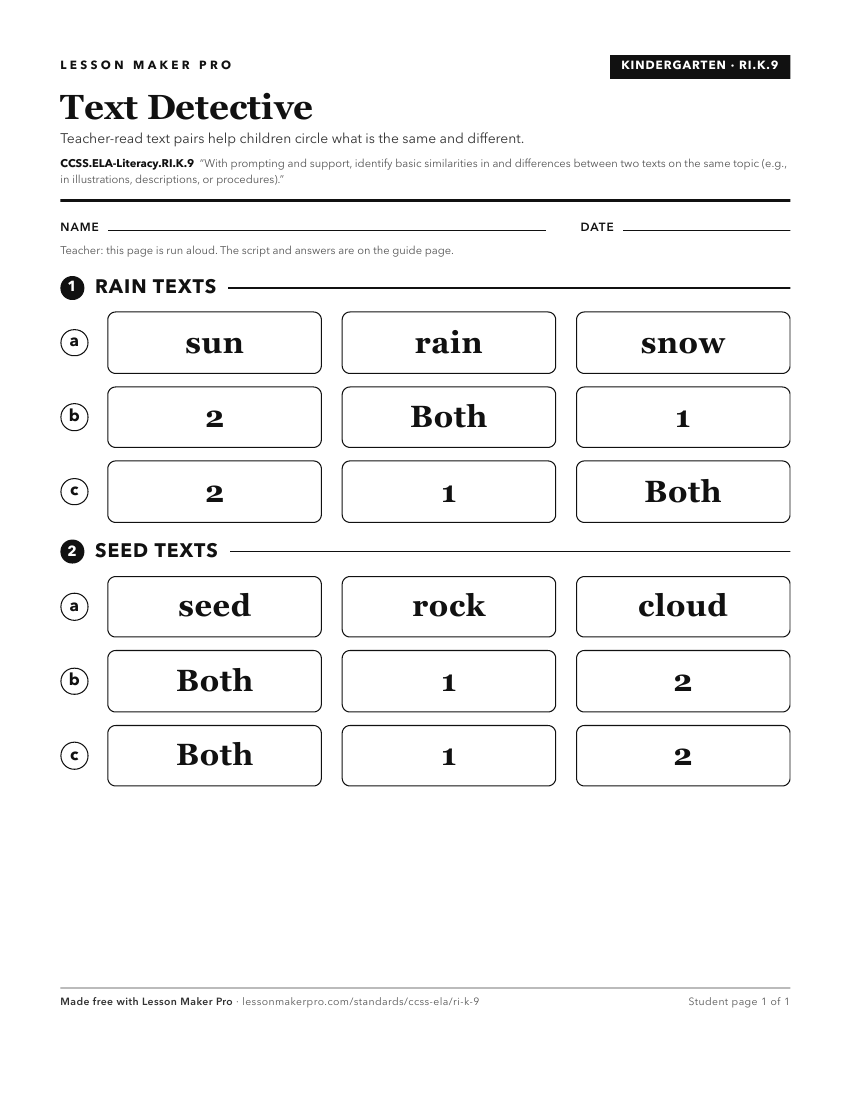
A ready-to-print activity worksheet aligned to CCSS.ELA-Literacy.RI.K.9, with an answer key for the teacher on its own page. No account needed.
PDF, US Letter, prints cleanly in black and white.
Download the worksheetLearning progression
Where This Standard Sits
See the whole path on the Reading: Informational Text progression map.
What This Unlocks
Mastery here sets students up for these next.
Keep exploring
Related Standards
- CCSS.ELA-Literacy.RI.5.5
Compare and contrast the overall structure (e.g., chronology, comparison, cause/effect, problem/solution) of events, ideas, concepts, or information in two or m...
- CCSS.ELA-Literacy.RI.3.9
Compare and contrast the most important points and key details presented in two texts on the same topic.
- CCSS.ELA-Literacy.CCRA.R.9
Analyze how two or more texts address similar themes or topics in order to build knowledge or to compare the approaches the authors take.
Turn this exact standard into a lesson
Grade, subject, topic, and the complete standard are prefilled. Create one free, no account needed.
Also for this standard:Make a WorksheetMake a QuizMake a Sub Lesson