CCSS.
The Standard
Compare and contrast the most important points and key details presented in two texts on the same topic.
Common Core State Standards for English Language Arts · Reading Standards for Informational Text
Teacher's field guide
What This Standard Means
What Students Need to Do
- Students read two informational texts about the same topic. They identify each text’s main points and key details, then explain what is alike and different.
What Mastery Looks Like
- Students identify the main point and key details in each text. They explain what the texts share and how they differ, using accurate evidence from both.
Common Misconceptions
- Students may list facts from each text without making a comparison. They may focus on length, pictures, or small details instead of main points. They may also treat different details as contradictions.
How to Assess It
- Give students two short passages about how bats find food. Ask them to write one shared main point, one different detail, and evidence from both passages.
Lesson moves
Ways to Teach It
Give pairs fact cards from two short volcano texts; students place them in labeled hoops for shared, Text A, or Text B.
Ask, “Which text gives the stronger explanation of animal camouflage, and which key detail supports your answer?”
Play Comparison Relay: teams read two weather passages and race to match main-point cards with supporting details from each source.
Compare two school lunch menus and their nutrition notes, then decide which menu better meets a student athlete’s needs.
Free download
Printable RI.3.9 Worksheet
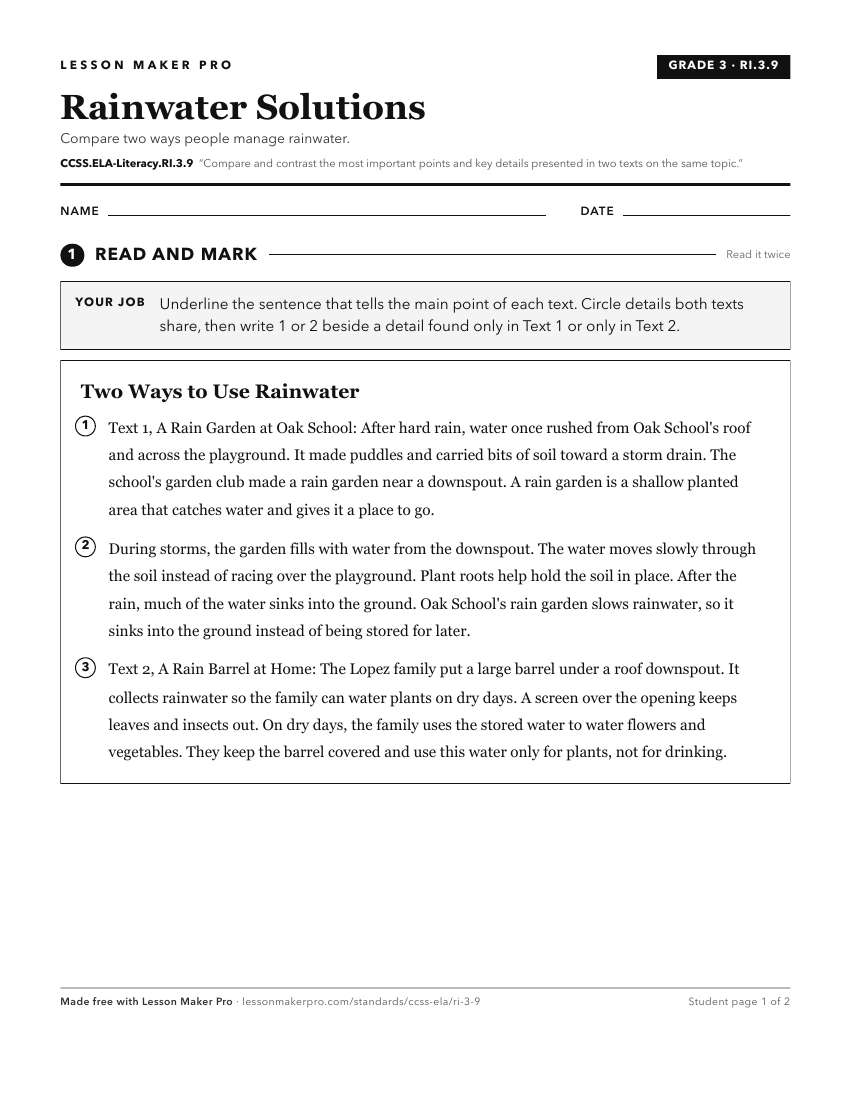
A ready-to-print activity worksheet aligned to CCSS.ELA-Literacy.RI.3.9, with an answer key for the teacher on its own page. No account needed.
PDF, US Letter, prints cleanly in black and white.
Download the worksheetLearning progression
Where This Standard Sits
See the whole path on the Reading: Informational Text progression map.
Before This Standard
If students are struggling here, check these first.
What This Unlocks
Mastery here sets students up for these next.
Keep exploring
Related Standards
- CCSS.ELA-Literacy.RI.5.5
Compare and contrast the overall structure (e.g., chronology, comparison, cause/effect, problem/solution) of events, ideas, concepts, or information in two or m...
- CCSS.ELA-Literacy.RI.1.9
Identify basic similarities in and differences between two texts on the same topic (e.g., in illustrations, descriptions, or procedures).
- CCSS.ELA-Literacy.CCRA.R.9
Analyze how two or more texts address similar themes or topics in order to build knowledge or to compare the approaches the authors take.
Turn this exact standard into a lesson
Grade, subject, topic, and the complete standard are prefilled. Create one free, no account needed.
Also for this standard:Make a WorksheetMake a QuizMake a Sub Lesson