CCSS.
The Standard
Analyze how an author develops and contrasts the points of view of different characters or narrators in a text.
Common Core State Standards for English Language Arts · Reading Standards for Literature
Teacher's field guide
What This Standard Means
What Students Need to Do
- Students track what each character or narrator knows, believes, notices, and leaves out. They explain how dialogue, thoughts, actions, and word choice reveal differences between perspectives.
What Mastery Looks Like
- A student can identify two distinct perspectives and cite details that build each one. The student can explain how the contrast shapes conflict, suspense, or the reader’s understanding.
Common Misconceptions
- Students often confuse point of view with first-person or third-person narration alone. They may summarize what characters say instead of explaining how details reveal and contrast their attitudes or knowledge.
How to Assess It
- Exit ticket: Choose two speakers from today’s scene. Cite one detail revealing each perspective, then explain how the difference affects the scene.
Lesson moves
Ways to Teach It
Give pairs color-coded sticky notes to mark what two characters know, believe, and notice in a shared scene.
Ask, “Which character understands the conflict more accurately, and what two details support your claim?”
Play Perspective Match: teams match anonymous lines, thoughts, and actions to characters, then justify each match with a trait or belief.
Compare two eyewitness accounts of one school event, then list how position, goals, and prior knowledge create different versions.
Free download
Printable RL.7.6 Worksheet
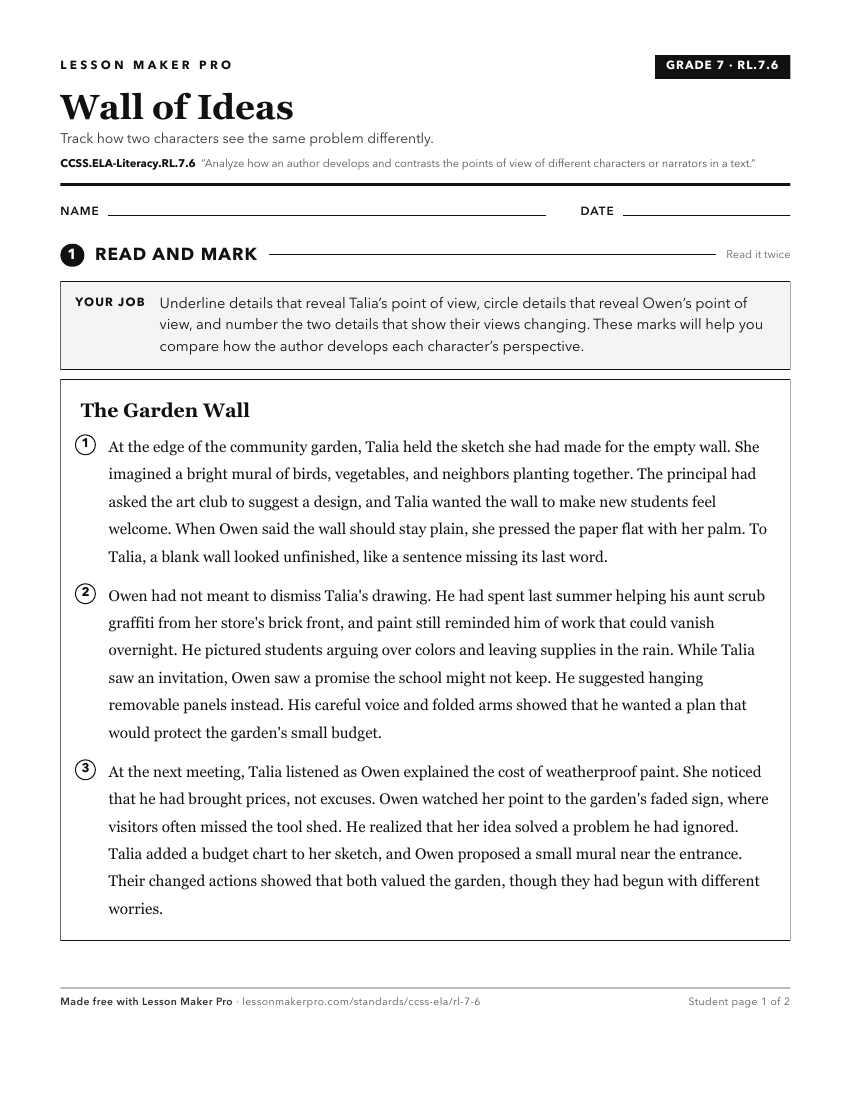
A ready-to-print activity worksheet aligned to CCSS.ELA-Literacy.RL.7.6, with an answer key for the teacher on its own page. No account needed.
PDF, US Letter, prints cleanly in black and white.
Download the worksheetLearning progression
Where This Standard Sits
See the whole path on the Reading: Literature progression map.
Before This Standard
If students are struggling here, check these first.
What This Unlocks
Mastery here sets students up for these next.
Keep exploring
Related Standards
- CCSS.ELA-Literacy.RI.7.6
Determine an author's point of view or purpose in a text and analyze how the author distinguishes his or her position from that of others.
- CCSS.ELA-Literacy.RH.9-10.6
Compare the point of view of two or more authors for how they treat the same or similar topics, including which details they include and emphasize in their resp...
Turn this exact standard into a lesson
Grade, subject, topic, and the complete standard are prefilled. Create one free, no account needed.
Also for this standard:Make a WorksheetMake a QuizMake a Sub Lesson