CCSS.
The Standard
Analyze seventeenth-, eighteenth-, and nineteenth-century foundational U.S. documents of historical and literary significance (including The Declaration of Independence, the Preamble to the Constitution, the Bill of Rights, and Lincoln's Second Inaugural Address) for their themes, purposes, and rhetorical features.
Common Core State Standards for English Language Arts · Reading Standards for Informational Text
Teacher's field guide
What This Standard Means
What Students Need to Do
- Students read major American civic texts from the 1600s through the 1800s. They identify each writer’s theme and purpose, then explain how specific rhetorical choices support both. They connect those choices to audience and historical context.
What Mastery Looks Like
- A student can state a text’s main purpose and theme, then support each claim with precise lines. The student can explain how repetition, parallel structure, appeals, and word choice shape an audience’s response. The student can also connect those choices to the historical situation.
Common Misconceptions
- Students often name a broad topic, such as freedom, instead of stating a theme about that topic. They may confuse purpose with summary or list rhetorical devices without explaining their effects. Archaic words and long sentences can also lead them to misread a writer’s claim.
How to Assess It
- Give students one paragraph from Lincoln’s Second Inaugural Address. Ask them to state Lincoln’s purpose and explain how one rhetorical choice advances it, using one quoted phrase as evidence.
Lesson moves
Ways to Teach It
Give pairs color-coded cards naming claims, evidence, appeals, and repeated phrases, then have them match the cards to a short Declaration excerpt.
After reading the Constitution’s Preamble, ask students to write which goal seems most urgent, then defend their choice with two phrases.
Play rhetorical feature bingo using short excerpts, with squares for repetition, parallelism, contrast, ethical appeal, emotional appeal, and logical appeal.
Compare a Bill of Rights amendment with a current school policy, then discuss how each text defines rights, limits, and authority.
Free download
Printable RI.11-12.9 Worksheet
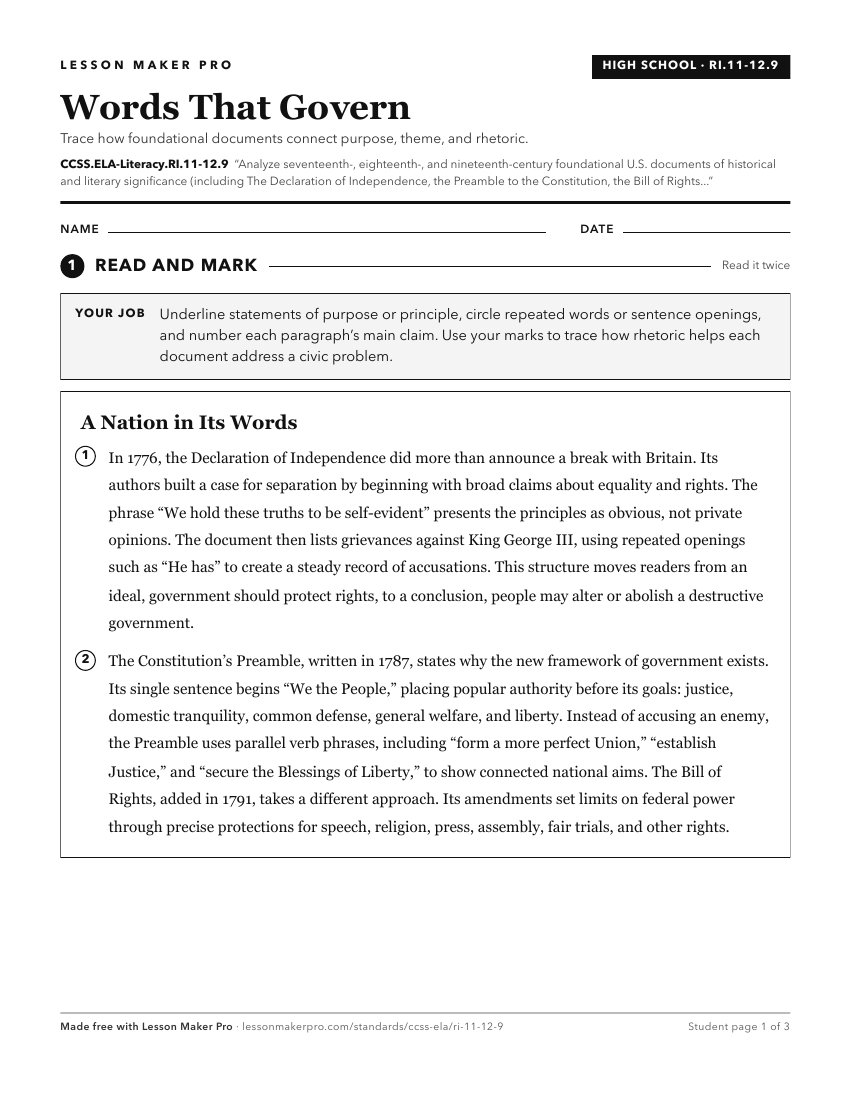
A ready-to-print activity worksheet aligned to CCSS.ELA-Literacy.RI.11-12.9, with an answer key for the teacher on its own page. No account needed.
PDF, US Letter, prints cleanly in black and white.
Download the worksheetLearning progression
Where This Standard Sits
See the whole path on the Reading: Informational Text progression map.
Before This Standard
If students are struggling here, check these first.
Keep exploring
Related Standards
- CCSS.ELA-Literacy.RL.11-12.9
Demonstrate knowledge of eighteenth-, nineteenth- and early-twentieth-century foundational works of American literature, including how two or more texts from th...
- CCSS.ELA-Literacy.RI.11-12.8
Delineate and evaluate the reasoning in seminal U.S. texts, including the application of constitutional principles and use of legal reasoning (e.g., in U.S. Sup...
- CCSS.ELA-Literacy.W.11-12.9b
Apply grades 11—12 Reading standards to literary nonfiction (e.g., "Delineate and evaluate the reasoning in seminal U.S. texts, including the application of con...
Turn this exact standard into a lesson
Grade, subject, topic, and the complete standard are prefilled. Create one free, no account needed.
Also for this standard:Make a WorksheetMake a QuizMake a Sub Lesson