CCSS.
The Standard
Delineate and evaluate the reasoning in seminal U.S. texts, including the application of constitutional principles and use of legal reasoning (e.g., in U.S. Supreme Court majority opinions and dissents) and the premises, purposes, and arguments in works of public advocacy (e.g., The Federalist, presidential addresses).
Common Core State Standards for English Language Arts · Reading Standards for Informational Text
Teacher's field guide
What This Standard Means
What Students Need to Do
- Students trace claims, premises, evidence, and conclusions in major U.S. legal and public texts. They identify the constitutional principle or public purpose shaping the argument. They judge whether each conclusion follows from the stated reasons.
What Mastery Looks Like
- A student can annotate a majority opinion, dissent, or public address to show its line of reasoning. The student can explain how a constitutional principle is applied and identify a strong inference, weak assumption, or missing support.
Common Misconceptions
- Students often summarize the topic instead of tracing the argument. They may confuse a premise with evidence, assume a court opinion is automatically sound, or treat a dissent as merely an opposing view.
How to Assess It
- Give students a 200-word excerpt from a Supreme Court majority or dissent. Ask them to label the claim, two premises, the constitutional principle, and one sound or weak inference.
Lesson moves
Ways to Teach It
Print an opinion excerpt on strips, then have pairs arrange the claim, premises, evidence, and conclusion into the author's reasoning chain.
Ask students to write: Which side applies the constitutional principle more convincingly, and what exact reasoning supports your judgment?
Run an argument sort where teams place excerpt cards under claim, premise, evidence, assumption, or conclusion, then defend one disputed card.
Have students evaluate a city council speech or presidential address by mapping its purpose, audience, premises, and proposed action.
Free download
Printable RI.11-12.8 Worksheet
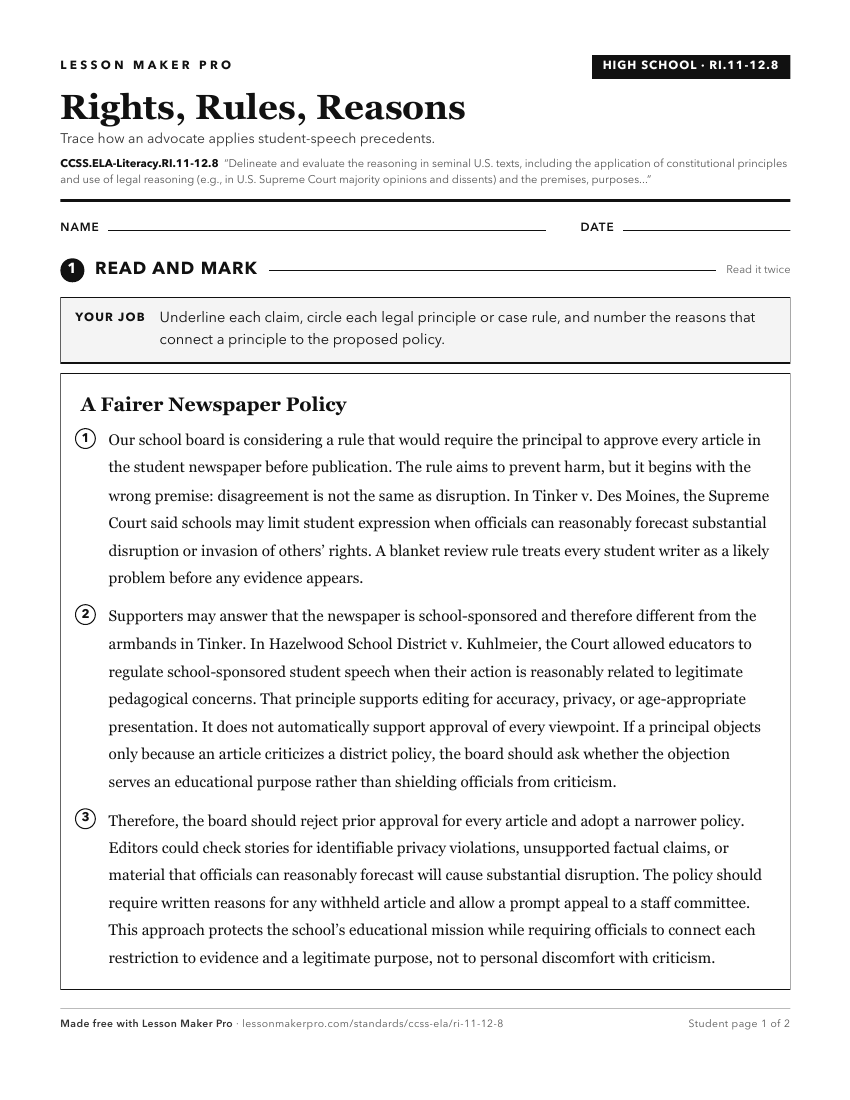
A ready-to-print activity worksheet aligned to CCSS.ELA-Literacy.RI.11-12.8, with an answer key for the teacher on its own page. No account needed.
PDF, US Letter, prints cleanly in black and white.
Download the worksheetLearning progression
Where This Standard Sits
See the whole path on the Reading: Informational Text progression map.
Before This Standard
If students are struggling here, check these first.
Keep exploring
Related Standards
- CCSS.ELA-Literacy.CCRA.R.8
Delineate and evaluate the argument and specific claims in a text, including the validity of the reasoning as well as the relevance and sufficiency of the evide...
- CCSS.ELA-Literacy.W.11-12.9b
Apply grades 11—12 Reading standards to literary nonfiction (e.g., "Delineate and evaluate the reasoning in seminal U.S. texts, including the application of con...
- CCSS.ELA-Literacy.RI.9-10.9
Analyze seminal U.S. documents of historical and literary significance (e.g., Washington's Farewell Address, the Gettysburg Address, Roosevelt's Four Freedoms s...
- CCSS.ELA-Literacy.RI.11-12.9
Analyze seventeenth-, eighteenth-, and nineteenth-century foundational U.S. documents of historical and literary significance (including The Declaration of Inde...
Turn this exact standard into a lesson
Grade, subject, topic, and the complete standard are prefilled. Create one free, no account needed.
Also for this standard:Make a WorksheetMake a QuizMake a Sub Lesson