CCSS.
The Standard
- CCSS.ELA-Literacy.W.11-12.9
- Draw evidence from literary or informational texts to support analysis, reflection, and research.
Apply grades 11—12 Reading standards to literary nonfiction (e.g., "Delineate and evaluate the reasoning in seminal U.S. texts, including the application of constitutional principles and use of legal reasoning [e.g., in U.S. Supreme Court Case majority opinions and dissents] and the premises, purposes, and arguments in works of public advocacy [e.g., The Federalist, presidential addresses]").
Common Core State Standards for English Language Arts
Teacher's field guide
What This Standard Means
What Students Need to Do
- Students analyze how authors of major nonfiction texts build arguments. They trace premises, claims, evidence, and conclusions, then evaluate the reasoning in evidence-based writing.
What Mastery Looks Like
- Students accurately identify an author’s premises, purpose, claims, evidence, and conclusions. They explain how constitutional principles or legal reasoning shape the argument, then support their evaluation with precise quotations.
Common Misconceptions
- Students may summarize the topic instead of evaluating the argument. They may treat quoted evidence as proof without explaining how the author connects it to a claim or principle.
How to Assess It
- Give students one paragraph from a majority opinion or public address. Ask them to identify one claim, trace its reasoning, and judge whether the evidence supports it.
Adopted as
This framework is adopted as written in Connecticut, Delaware, District of Columbia, Michigan, Nevada, New Hampshire, Vermont, Wyoming.
- California: W_11-12_9b
- Connecticut: CCSS.ELA-Literacy.W.11-12.9b
- Delaware: CC11-12W9b
- District of Columbia: CCSS.ELA-Literacy.W.11-12.9b
- Maryland: W_11-12_9_b
- Michigan: CCSS.ELA-Literacy.W.11-12.9b
- Montana: CCSS.ELA-Literacy.W.11-12.9b
- Nevada: CCSS.ELA-Literacy.W.11-12.9b
- New Hampshire: CCSS.ELA-Literacy.W.11-12.9b
- New Mexico: CCSS.ELA-Literacy.W.11-12.9b
- Vermont: CCSS.ELA-Literacy.W.11-12.9b
- Washington: CCSS.ELA-Literacy.W.11-12.9b
- Wyoming: CCSS.ELA-Literacy.W.11-12.9b
Lesson moves
Ways to Teach It
Give pairs a majority opinion and dissent, then use colored sticky notes to label claims, constitutional principles, evidence, and reasoning.
Discuss: Which author’s purpose most shapes the argument, and where does that purpose affect a claim or choice of evidence?
Run a reasoning sort where students match premise, claim, evidence, and conclusion cards from a presidential address, then defend each match.
Compare a school policy proposal with a public advocacy text, then write which uses stronger reasoning and why.
Free download
Printable W.11-12.9b Worksheet
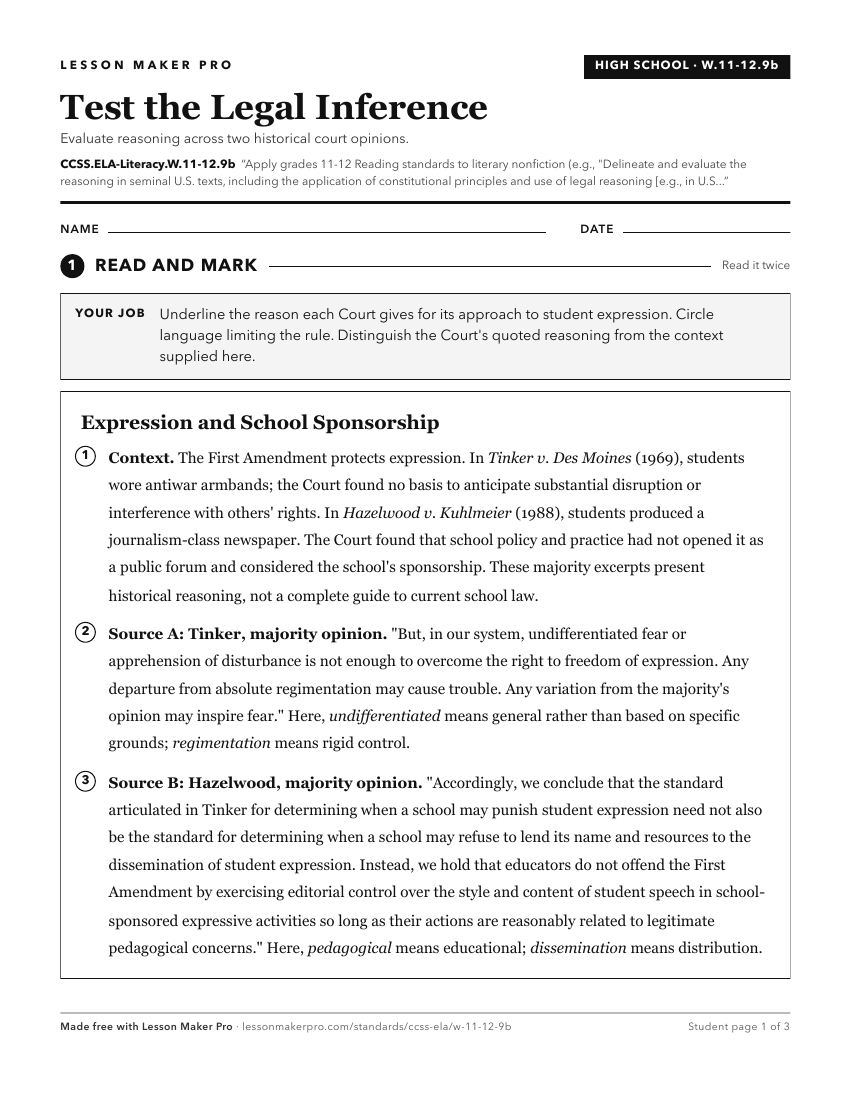
A ready-to-print activity worksheet aligned to CCSS.ELA-Literacy.W.11-12.9b, with an answer key for the teacher on its own page. No account needed.
PDF, US Letter, prints cleanly in black and white.
Download the worksheetLearning progression
Where This Standard Sits
Before This Standard
If students are struggling here, check these first.
Keep exploring
Related Standards
- CCSS.ELA-Literacy.W.8.9b
Apply grade 8 Reading standards to literary nonfiction (e.g., "Delineate and evaluate the argument and specific claims in a text, assessing whether the reasonin...
- CCSS.ELA-Literacy.W.11-12.9a
Apply grades 11—12 Reading standards to literature (e.g., "Demonstrate knowledge of eighteenth-, nineteenth- and early-twentieth-century foundational works of A...
- CCSS.ELA-Literacy.W.7.9b
Apply grade 7 Reading standards to literary nonfiction (e.g. "Trace and evaluate the argument and specific claims in a text, assessing whether the reasoning is ...
Turn this exact standard into a lesson
Grade, subject, topic, and the complete standard are prefilled. Create one free, no account needed.
Also for this standard:Make a WorksheetMake a QuizMake a Sub Lesson