CCSS.
The Standard
Determine the central ideas or information of a primary or secondary source; provide an accurate summary that makes clear the relationships among the key details and ideas.
Common Core State Standards for English Language Arts · Reading Standards for Literacy in History/Social Studies 6—12
Teacher's field guide
What This Standard Means
What Students Need to Do
- Students read a primary or secondary source and identify its main ideas. They choose key supporting details and explain how those details connect in an objective summary.
What Mastery Looks Like
- Students identify the source's main claims or messages and select details that develop them. Their summary is accurate, concise, and shows cause, contrast, sequence, or another clear relationship.
Common Misconceptions
- Students may choose a repeated detail as the main idea or list facts without showing how they connect. They may add opinions, omit a competing idea, or copy sentences instead of summarizing.
How to Assess It
- Give students a short historical source and ask for one central idea, three connected details, and a three-sentence objective summary.
Adopted as
This framework is adopted as written in Connecticut, Delaware, District of Columbia, Michigan, Nevada, New Hampshire, Vermont, Wyoming.
- California: RH_11-12_2
- Connecticut: CCSS.ELA-Literacy.RH.11-12.2
- Delaware: CC11-12RH/SS2
- District of Columbia: CCSS.ELA-Literacy.RH.11-12.2
- Michigan: CCSS.ELA-Literacy.RH.11-12.2
- Montana: CCSS.ELA-Literacy.RH.11-12.2
- Nevada: CCSS.ELA-Literacy.RH.11-12.2
- New Hampshire: CCSS.ELA-Literacy.RH.11-12.2
- New Mexico: CCSS.ELA-Literacy.RH.11-12.2
- New York: 11-12.RH.2
State teaching guidance: Within this grade band's disciplinary instruction, NY calls for a balance of literary and informational texts, including full-length and shorter works. By the end of the school year, students should comprehend texts appropriately complex at or above grade level. Apply this shared reading guidance across instruction when selecting resources. NY Next Generation Literacy Standards, Grades 6–12 (2017), page 6. Check shared national resources against this guidance before use.
- Vermont: CCSS.ELA-Literacy.RH.11-12.2
- Washington: CCSS.ELA-Literacy.RH.11-12.2
- Wyoming: CCSS.ELA-Literacy.RH.11-12.2
Lesson moves
Ways to Teach It
Cut a source into sections, then have pairs sort each section under a central idea and explain their choices.
Ask students to write: Which detail best develops the author's main message, and how does it connect?
Play Summary Swap: students trade summaries, underline central ideas, circle supporting details, and flag opinions or missing links.
Compare a speech with a news account of the same event, then summarize how each connects causes, actions, and outcomes.
Free download
Printable RH.11-12.2 Worksheet
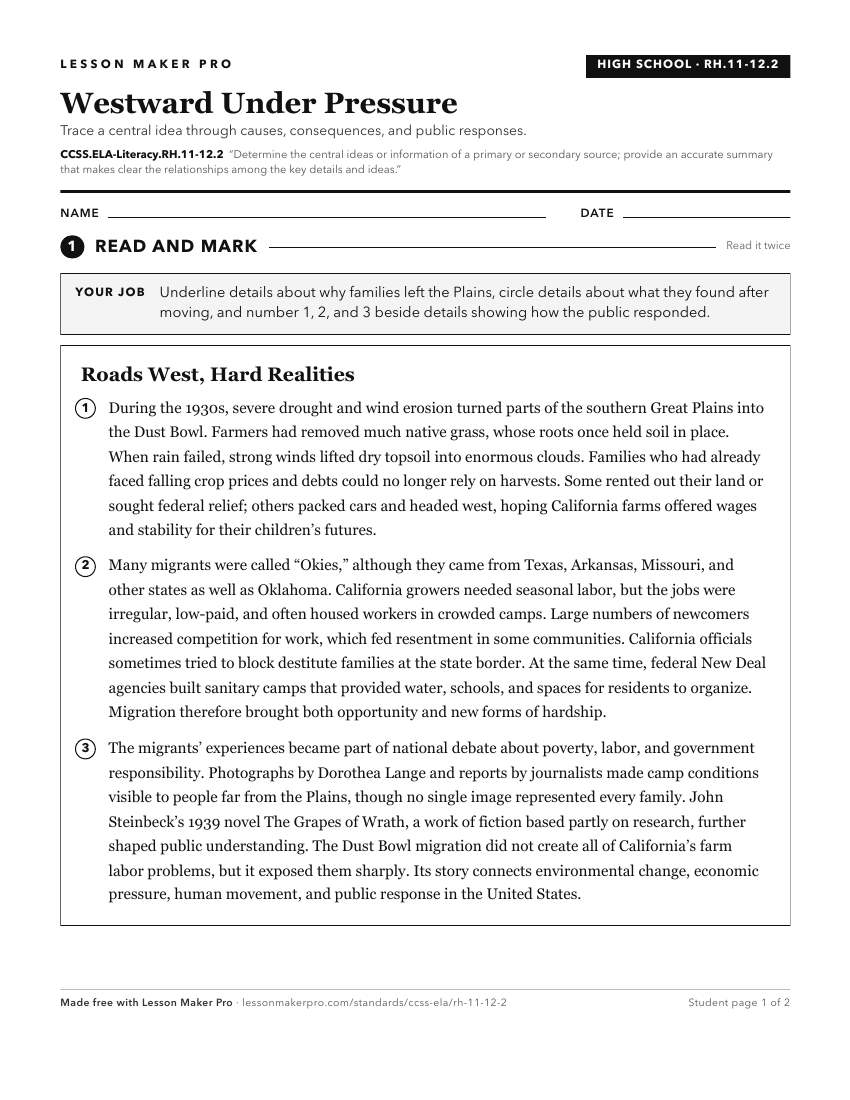
A ready-to-print activity worksheet aligned to CCSS.ELA-Literacy.RH.11-12.2, with an answer key for the teacher on its own page. No account needed.
PDF, US Letter, prints cleanly in black and white.
Download the worksheetLearning progression
Where This Standard Sits
See the whole path on the Reading: History/Social Studies progression map.
Before This Standard
If students are struggling here, check these first.
Keep exploring
Related Standards
- CCSS.ELA-Literacy.RH.6-8.2
Determine the central ideas or information of a primary or secondary source; provide an accurate summary of the source distinct from prior knowledge or opinions...
- CCSS.ELA-Literacy.RST.6-8.2
Determine the central ideas or conclusions of a text; provide an accurate summary of the text distinct from prior knowledge or opinions.
- CCSS.ELA-Literacy.RST.9-10.2
Determine the central ideas or conclusions of a text; trace the text's explanation or depiction of a complex process, phenomenon, or concept; provide an accurat...
Turn this exact standard into a lesson
Grade, subject, topic, and the complete standard are prefilled. Create one free, no account needed.
Also for this standard:Make a WorksheetMake a QuizMake a Sub Lesson