CCSS.
The Standard
Recognize that spoken words are represented in written language by specific sequences of letters.
Common Core State Standards for English Language Arts
Teacher's field guide
What This Standard Means
What Students Need to Do
- Students connect a word they hear with the letters they see in print. They learn that the letters and their order identify the word.
What Mastery Looks Like
- A student can match a familiar spoken word to its printed form. The student notices when letters are missing, added, or placed in a different order.
Common Misconceptions
- Students may think the picture tells the exact words on the page. They may also believe changing or rearranging letters does not change a word.
How to Assess It
- Say “cat,” then show cat, act, and cap. Ask the student to circle the printed word that matches and explain the choice.
Lesson moves
Ways to Teach It
Give students letter tiles to build a named word, then mix the tiles and have them rebuild it in the correct order.
Show two words, such as dog and dig, and ask, “Which word matches what I said, and how do you know?”
Play Word Match Bingo by saying familiar words while students cover the matching printed words on their cards.
Read classroom labels aloud, then have students match word cards to objects such as door, table, shelf, and clock.
Free download
Printable RF.K.1b Worksheet
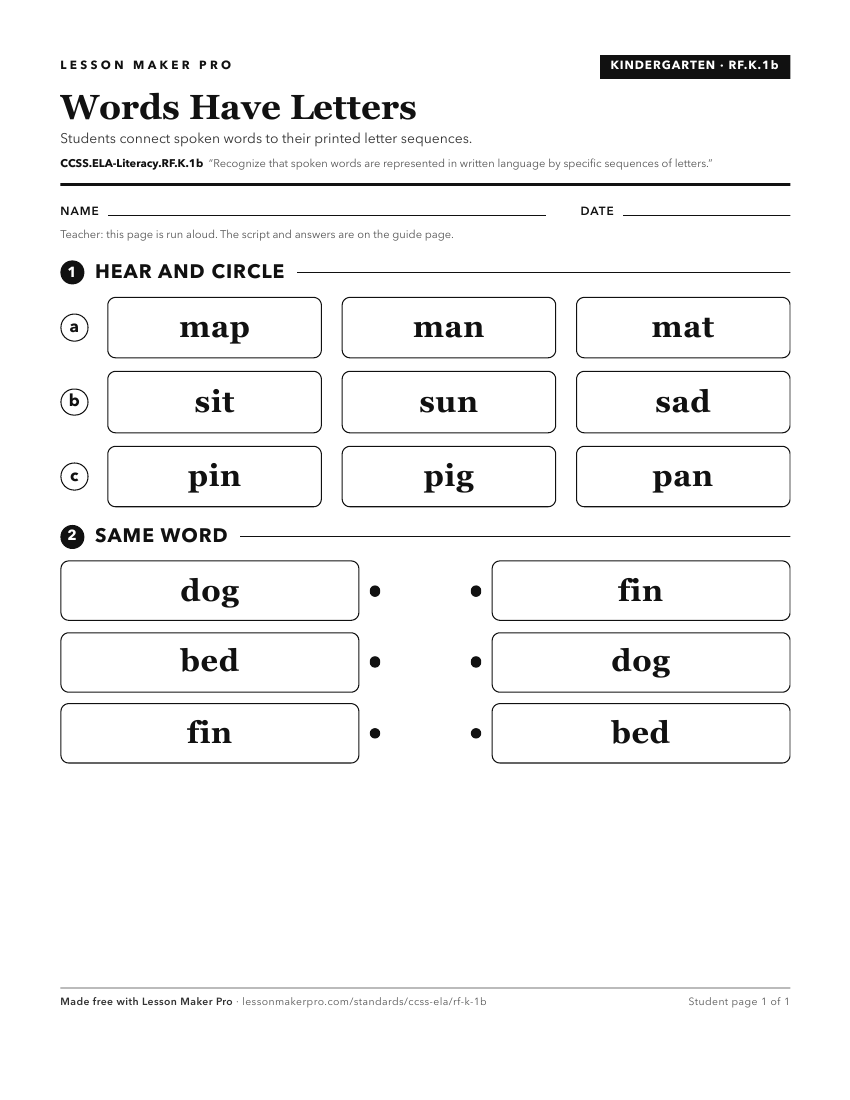
A ready-to-print activity worksheet aligned to CCSS.ELA-Literacy.RF.K.1b, with an answer key for the teacher on its own page. No account needed.
PDF, US Letter, prints cleanly in black and white.
Download the worksheetKeep exploring
Related Standards
- CCSS.ELA-Literacy.L.K.2d
Spell simple words phonetically, drawing on knowledge of sound-letter relationships.
- CCSS.ELA-Literacy.L.3.2f
Use spelling patterns and generalizations (e.g., word families, position-based spellings, syllable patterns, ending rules, meaningful word parts) in writing wor...
- CCSS.ELA-Literacy.RF.K.3d
Distinguish between similarly spelled words by identifying the sounds of the letters that differ.
- CCSS.ELA-Literacy.L.3.3b
Recognize and observe differences between the conventions of spoken and written standard English.
Turn this exact standard into a lesson
Grade, subject, topic, and the complete standard are prefilled. Create one free, no account needed.
Also for this standard:Make a WorksheetMake a QuizMake a Sub Lesson