CCSS.
The Standard
- CCSS.ELA-Literacy.RF.5.4
- Read with sufficient accuracy and fluency to support comprehension.
Read grade-level text with purpose and understanding.
Common Core State Standards for English Language Arts
Teacher's field guide
What This Standard Means
What Students Need to Do
- Students set a clear reason for reading before they begin. They follow the meaning of a passage, then explain what they learned using details from the text.
What Mastery Looks Like
- A student names the reading goal, identifies the main idea or key event, and cites a detail that supports it. The student slows down or rereads when meaning breaks down.
Common Misconceptions
- Some students think fluent reading means reading as fast as possible. Others use expression but cannot explain the passage. They may keep going after a confusing sentence instead of slowing down or rereading.
How to Assess It
- Give students a short passage and say, "Read to find why the character changes her mind." Ask them to answer in one sentence and underline two supporting details.
Lesson moves
Ways to Teach It
Give students a short article, sticky notes, and a question; they place notes beside details that answer the question.
Ask, "How did your reading goal change what you noticed?" Students write three sentences and share one example.
Play Purpose Match: students draw a reading goal, scan a passage, and race to find two details that fit.
Have students read a school lunch menu, choose a meal within a budget, and explain which details guided the choice.
Free download
Printable RF.5.4a Worksheet
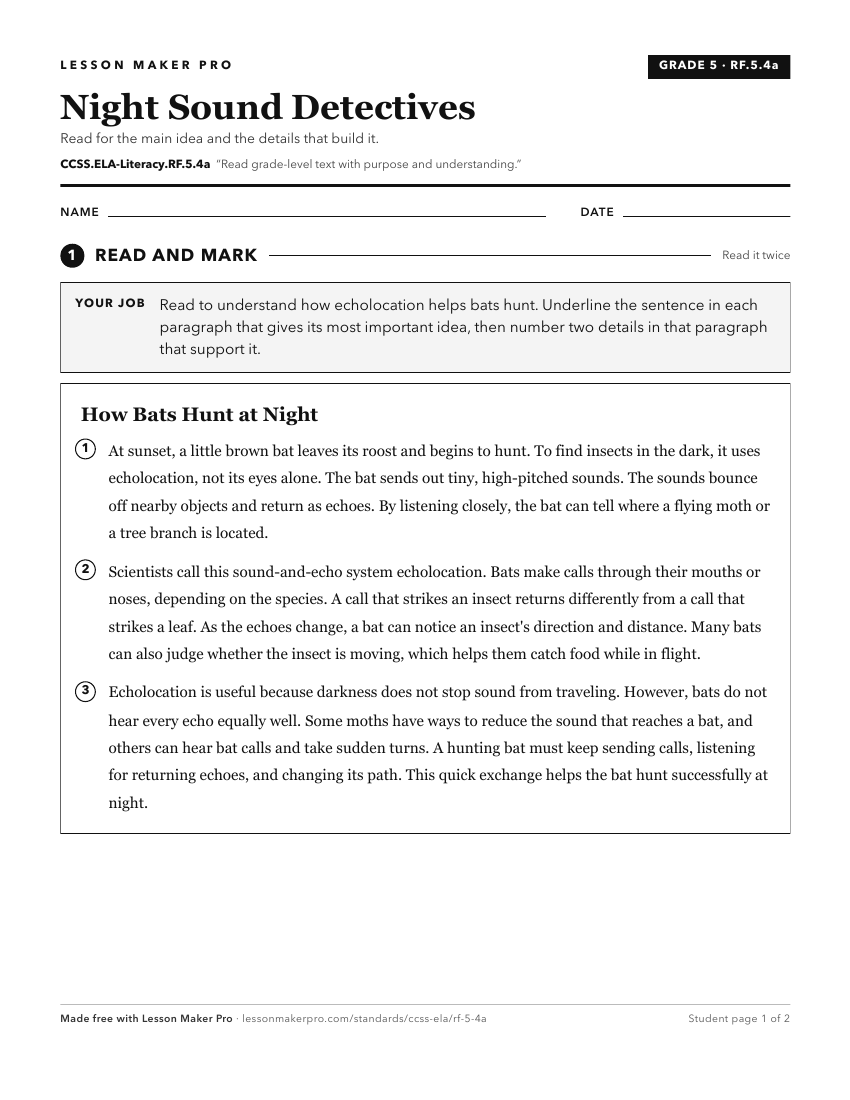
A ready-to-print activity worksheet aligned to CCSS.ELA-Literacy.RF.5.4a, with an answer key for the teacher on its own page. No account needed.
PDF, US Letter, prints cleanly in black and white.
Download the worksheetKeep exploring
Related Standards
Turn this exact standard into a lesson
Grade, subject, topic, and the complete standard are prefilled. Create one free, no account needed.
Also for this standard:Make a WorksheetMake a QuizMake a Sub Lesson