CCSS.
The Standard
Read on-level prose and poetry orally with accuracy, appropriate rate, and expression on successive readings
Common Core State Standards for English Language Arts
Teacher's field guide
What This Standard Means
What Students Need to Do
- Students read grade-level stories and poems aloud more than once. They work toward accurate words, a natural pace, clear phrasing, and expression that matches meaning and punctuation.
What Mastery Looks Like
- Students read a grade-level passage accurately, at a steady conversational pace, and in meaningful phrases. On a second reading, they correct errors and improve pace or expression.
Common Misconceptions
- Students may treat speed as the goal, rushing past punctuation or skipping words. Some read every word in the same tone, or think expression means using an exaggerated voice.
How to Assess It
- Give each student a short grade-level passage to read aloud twice. Mark errors, timing, pauses, and expression, then compare the two readings.
Lesson moves
Ways to Teach It
Have pairs mark phrase breaks and punctuation on a printed poem, then rehearse and perform it twice for each other.
Ask students to explain how changing stress in one sentence can change its meaning, then read the sentence two ways.
Play Fluency Replay, where students reread a short passage three times and track fewer errors, smoother phrasing, and better expression.
Use a weather report script so students practice clear pacing, accurate words, and expression for a real audience.
Free download
Printable RF.3.4b Worksheet
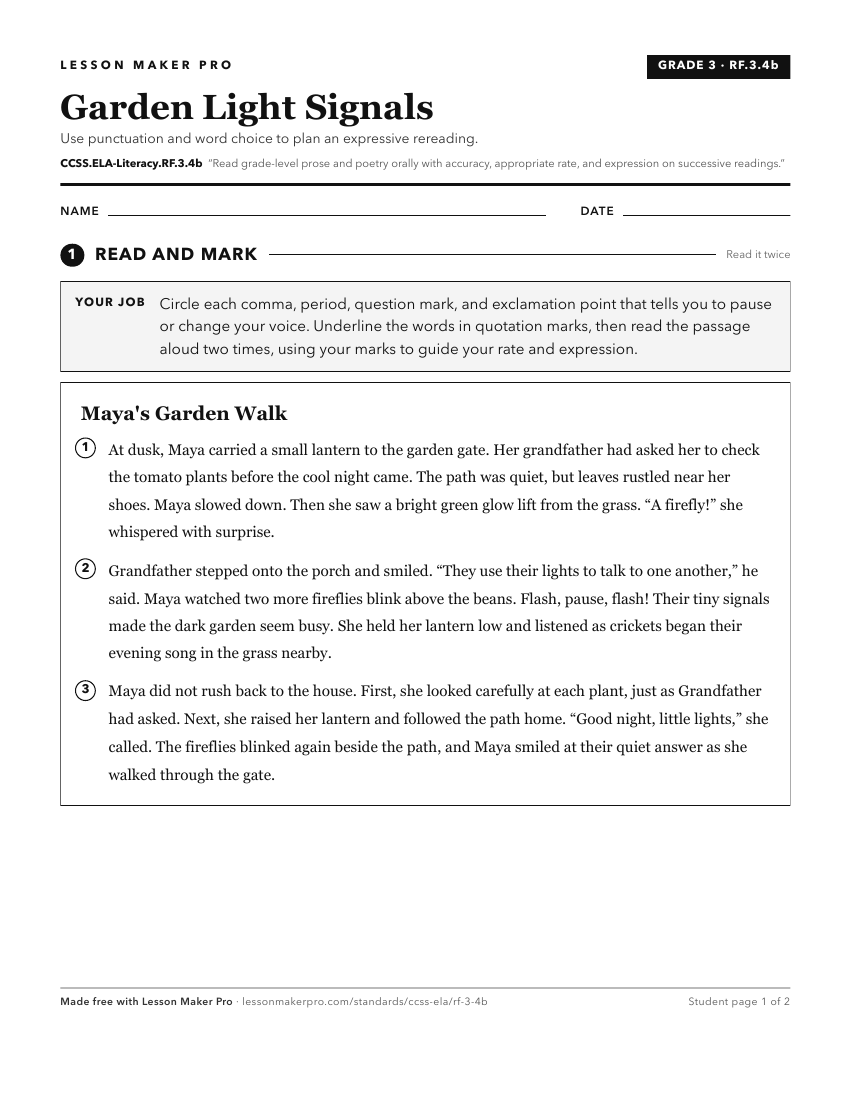
A ready-to-print activity worksheet aligned to CCSS.ELA-Literacy.RF.3.4b, with an answer key for the teacher on its own page. No account needed.
PDF, US Letter, prints cleanly in black and white.
Download the worksheetLearning progression
Where This Standard Sits
Before This Standard
If students are struggling here, check these first.
What This Unlocks
Mastery here sets students up for these next.
Keep exploring
Related Standards
Turn this exact standard into a lesson
Grade, subject, topic, and the complete standard are prefilled. Create one free, no account needed.
Also for this standard:Make a WorksheetMake a QuizMake a Sub Lesson