CCSS.
The Standard
Use parallel structure.
Common Core State Standards for English Language Arts
Teacher's field guide
What This Standard Means
What Students Need to Do
- Students make items in a list or series follow the same grammatical pattern. They also balance ideas joined by words such as “and,” “or,” and “but.”
What Mastery Looks Like
- Students write lists, comparisons, and paired ideas with matching grammatical patterns. They can spot an uneven construction, revise it, and explain which forms now match.
Common Misconceptions
- Students may mix forms, such as “running, to swim, and biking,” because each item still names an activity. They may also assume repeated words automatically make a sentence balanced.
How to Assess It
- Give this exit ticket: “Maya enjoys sketching portraits, to write poems, and playing guitar.” Ask students to revise it and explain the change.
Lesson moves
Ways to Teach It
Give groups sentence strips with mismatched phrases, then have them replace or rearrange strips until each sentence has matching forms.
Ask students to compare “I came to learn, practice, and improve” with an uneven version, then explain which sounds clearer and why.
Play Parallel or Not: display sentences, have teams signal their answer, then award a point for an accurate correction.
Examine slogans, job postings, or school rules for balanced wording, then rewrite one uneven example for clarity.
Free download
Printable L.9-10.1a Worksheet
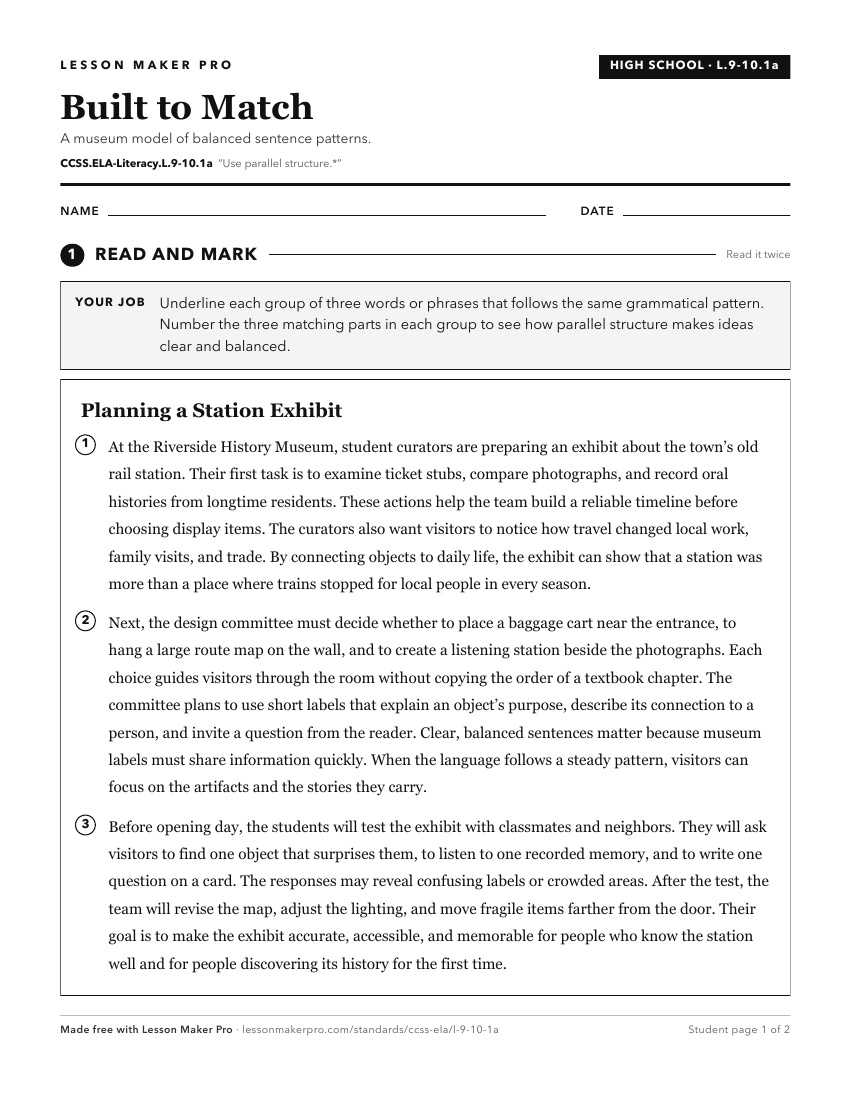
A ready-to-print activity worksheet aligned to CCSS.ELA-Literacy.L.9-10.1a, with an answer key for the teacher on its own page. No account needed.
PDF, US Letter, prints cleanly in black and white.
Download the worksheetLearning progression
Where This Standard Sits
Before This Standard
If students are struggling here, check these first.
Keep exploring
Related Standards
- CCSS.ELA-Literacy.WHST.9-10.2c
Use varied transitions and sentence structures to link the major sections of the text, create cohesion, and clarify the relationships among ideas and concepts.
- CCSS.ELA-Literacy.WHST.11-12.2c
Use varied transitions and sentence structures to link the major sections of the text, create cohesion, and clarify the relationships among complex ideas and co...
- CCSS.ELA-Literacy.L.6.3a
Vary sentence patterns for meaning, reader/listener interest, and style.
- CCSS.ELA-Literacy.L.3.1h
Use coordinating and subordinating conjunctions.
Turn this exact standard into a lesson
Grade, subject, topic, and the complete standard are prefilled. Create one free, no account needed.
Also for this standard:Make a WorksheetMake a QuizMake a Sub Lesson