CCSS.
The Standard
Use varied transitions and sentence structures to link the major sections of the text, create cohesion, and clarify the relationships among ideas and concepts.
Common Core State Standards for English Language Arts
Teacher's field guide
What This Standard Means
What Students Need to Do
- Students connect sections of informational writing so the relationship between ideas is clear. They use accurate linking words and vary sentence openings and patterns.
What Mastery Looks Like
- Students connect sections so readers can follow shifts, comparisons, causes, and examples. They choose accurate transitions and vary sentence patterns without making the writing sound forced.
Common Misconceptions
- Students may treat transitions as decorations or rely on repeated words like “first,” “next,” and “also.” They may use a transition that signals the wrong relationship. Some vary sentence length without changing sentence structure.
How to Assess It
- Exit ticket: Write a two-sentence bridge between a section on solar power benefits and a section on its limits. Use a contrast transition and different sentence openings.
Lesson moves
Ways to Teach It
Give groups printed paragraph strips to arrange, then have them add transition cards that show how each section relates.
Ask students to explain how “however,” “therefore,” and “for example” would change the connection between the same two ideas.
Run a transition sort race where teams place linking words under contrast, cause, sequence, example, or addition.
Have students mark transitions in a news explainer, then rewrite one repetitive section using varied sentence openings.
Free download
Printable WHST.9-10.2c Worksheet
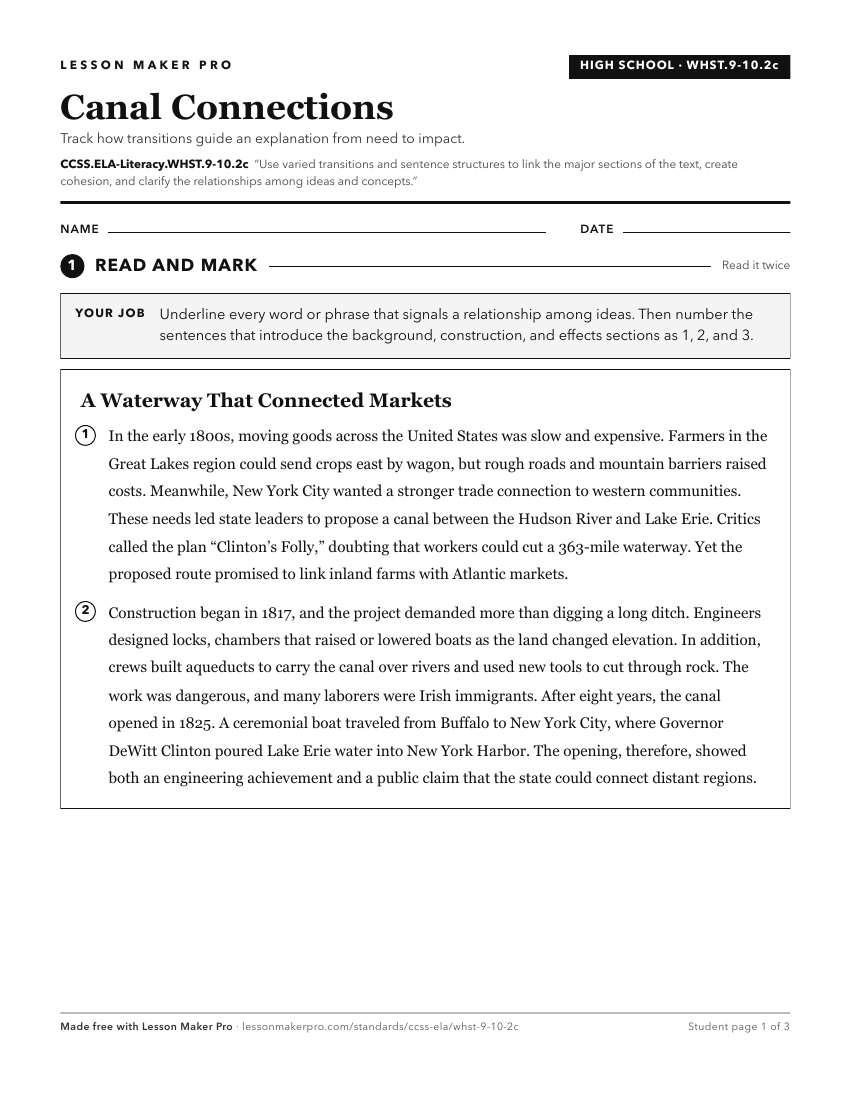
A ready-to-print activity worksheet aligned to CCSS.ELA-Literacy.WHST.9-10.2c, with an answer key for the teacher on its own page. No account needed.
PDF, US Letter, prints cleanly in black and white.
Download the worksheetLearning progression
Where This Standard Sits
What This Unlocks
Mastery here sets students up for these next.
Keep exploring
Related Standards
- CCSS.ELA-Literacy.W.11-12.2c
Use appropriate and varied transitions and syntax to link the major sections of the text, create cohesion, and clarify the relationships among complex ideas and...
- CCSS.ELA-Literacy.W.9-10.2c
Use appropriate and varied transitions to link the major sections of the text, create cohesion, and clarify the relationships among complex ideas and concepts.
- CCSS.ELA-Literacy.WHST.6-8.2c
Use appropriate and varied transitions to create cohesion and clarify the relationships among ideas and concepts.
Turn this exact standard into a lesson
Grade, subject, topic, and the complete standard are prefilled. Create one free, no account needed.
Also for this standard:Make a WorksheetMake a QuizMake a Sub Lesson