CCSS.
The Standard
Vary sentence patterns for meaning, reader/listener interest, and style.
Common Core State Standards for English Language Arts
Teacher's field guide
What This Standard Means
What Students Need to Do
- Students reshape the same idea into simple, compound, and complex sentences. They change sentence openings and lengths to control emphasis, pace, and tone.
What Mastery Looks Like
- A student can revise a repetitive paragraph so the sentences do not all begin or sound alike. The revision stays clear, keeps the intended meaning, and uses structure purposefully.
Common Misconceptions
- Students may think variety means adding more words or changing only the first word. They may create fragments, run-ons, or long sentences that hide the main idea.
How to Assess It
- Give students a four-sentence paragraph with repeated openings. Ask them to revise three sentences, underline each change, and explain one effect on pace or emphasis.
Lesson moves
Ways to Teach It
Give pairs sentence strips from a choppy paragraph, then have them combine and reorder the strips to create three smooth versions.
Ask students to rewrite “The door opened” three ways to create suspense, surprise, and calm, then explain which choices changed the effect.
Play Sentence Pattern Relay: teams draw a structure card, then revise one sentence to match it without changing the meaning.
Compare sentence patterns in a sports report and an advertisement, then write one product sentence suited to each audience.
Free download
Printable L.6.3a Worksheet
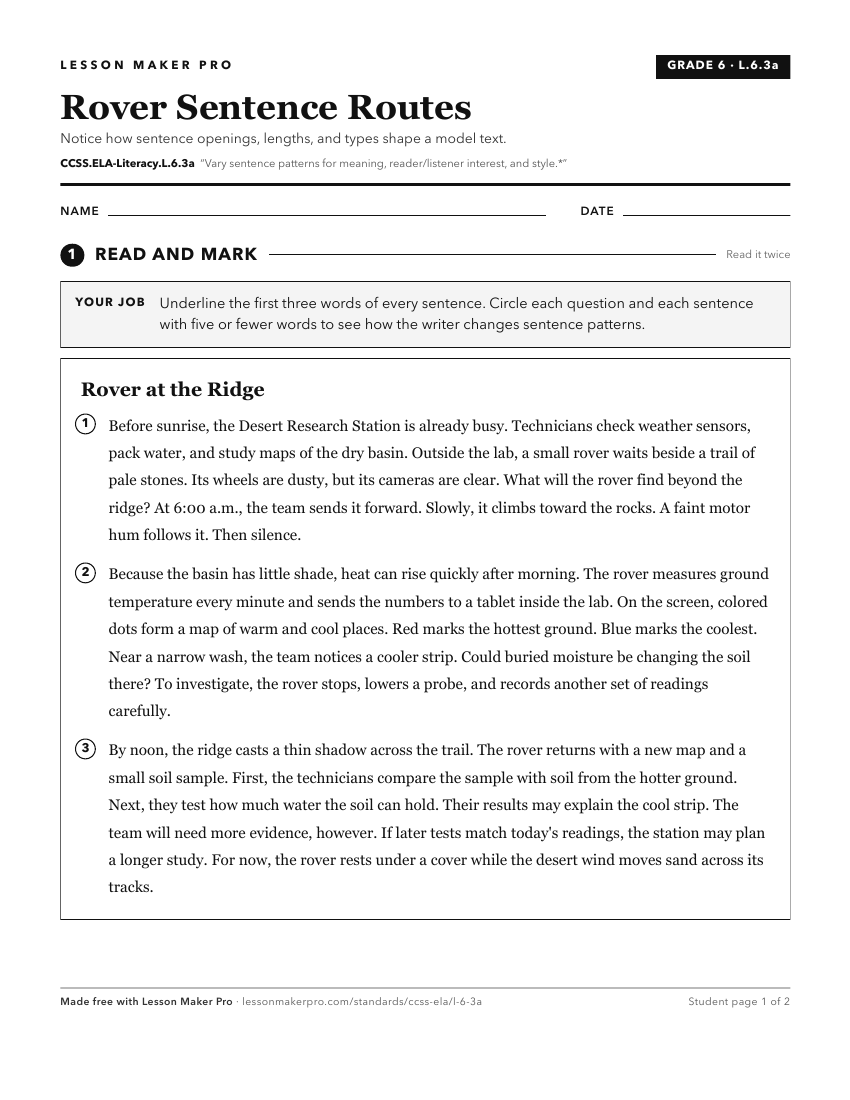
A ready-to-print activity worksheet aligned to CCSS.ELA-Literacy.L.6.3a, with an answer key for the teacher on its own page. No account needed.
PDF, US Letter, prints cleanly in black and white.
Download the worksheetLearning progression
Where This Standard Sits
Before This Standard
If students are struggling here, check these first.
What This Unlocks
Mastery here sets students up for these next.
Keep exploring
Related Standards
- CCSS.ELA-Literacy.L.7.1b
Choose among simple, compound, complex, and compound-complex sentences to signal differing relationships among ideas.
- CCSS.ELA-Literacy.L.11-12.3a
Vary syntax for effect, consulting references (e.g., Tufte's Artful Sentences) for guidance as needed; apply an understanding of syntax to the study of complex ...
- CCSS.ELA-Literacy.L.9-10.1b
Use various types of phrases (noun, verb, adjectival, adverbial, participial, prepositional, absolute) and clauses (independent, dependent; noun, relative, adve...
Turn this exact standard into a lesson
Grade, subject, topic, and the complete standard are prefilled. Create one free, no account needed.
Also for this standard:Make a WorksheetMake a QuizMake a Sub Lesson