CCSS.
The Standard
Choose among simple, compound, complex, and compound-complex sentences to signal differing relationships among ideas.
Common Core State Standards for English Language Arts
Teacher's field guide
What This Standard Means
What Students Need to Do
- Students decide how ideas relate, then build a sentence that makes that link clear. They use coordination and subordination to show addition, contrast, cause, time, or condition.
What Mastery Looks Like
- A student can combine given clauses in more than one correct way and explain how each version changes emphasis. The sentences are complete, punctuated correctly, and suited to the intended relationship.
Common Misconceptions
- Students often think longer sentences are automatically better, or that adding any conjunction creates a correct sentence. They may confuse dependent clauses with complete thoughts, create comma splices, or join clauses without a clear relationship.
How to Assess It
- Exit ticket: Combine “The team practiced daily” and “It lost the final game” twice, using but once and although once. Underline the version that best emphasizes surprise, then explain why.
Lesson moves
Ways to Teach It
Give pairs color-coded clause strips; students arrange three sentence versions and add the needed conjunctions and punctuation.
Ask students to rewrite “Maya left” to show cause, contrast, and time, then discuss which structure makes each relationship clearest.
Play Sentence Sort: teams classify sentence cards, repair one error on each card, and name the relationship between its ideas.
Compare headlines about one event, then revise each sentence structure to change emphasis without changing the facts.
Free download
Printable L.7.1b Worksheet
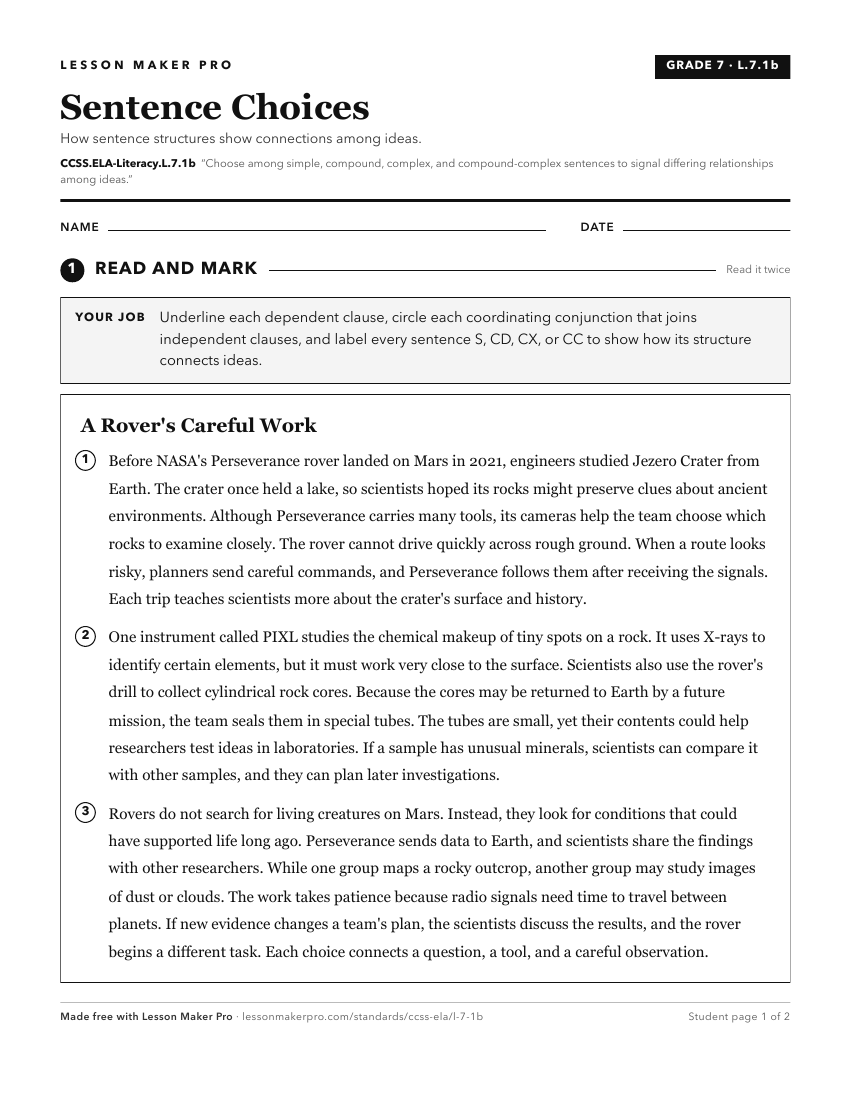
A ready-to-print activity worksheet aligned to CCSS.ELA-Literacy.L.7.1b, with an answer key for the teacher on its own page. No account needed.
PDF, US Letter, prints cleanly in black and white.
Download the worksheetKeep exploring
Related Standards
- CCSS.ELA-Literacy.WHST.11-12.2c
Use varied transitions and sentence structures to link the major sections of the text, create cohesion, and clarify the relationships among complex ideas and co...
- CCSS.ELA-Literacy.L.6.3a
Vary sentence patterns for meaning, reader/listener interest, and style.
- CCSS.ELA-Literacy.L.3.1i
Produce simple, compound, and complex sentences.
- CCSS.ELA-Literacy.L.5.3a
Expand, combine, and reduce sentences for meaning, reader/listener interest, and style.
Turn this exact standard into a lesson
Grade, subject, topic, and the complete standard are prefilled. Create one free, no account needed.
Also for this standard:Make a WorksheetMake a QuizMake a Sub Lesson