CCSS.
The Standard
Produce simple, compound, and complex sentences.
Common Core State Standards for English Language Arts
Teacher's field guide
What This Standard Means
What Students Need to Do
- Students create sentences using one complete thought, two joined complete thoughts, or a main thought with a dependent clause. They use conjunctions and punctuation to connect ideas clearly.
What Mastery Looks Like
- Students write all three sentence types correctly and explain how the clauses are connected. Their compound sentences use correct joining words and punctuation, and their complex sentences include a complete main clause.
Common Misconceptions
- Students may join two complete thoughts with only a comma. They may also mistake any long sentence for a complex sentence or leave a dependent clause standing alone.
How to Assess It
- Give students three ideas: “Maya packed a snack,” “She filled her water bottle,” and “before she left.” Ask them to write one simple, one compound, and one complex sentence.
Lesson moves
Ways to Teach It
Give pairs clause cards and conjunction cards, then have them build and label simple, compound, and complex sentences.
Ask students to rewrite “The dog barked” three ways, then discuss how each sentence structure changes the detail or emphasis.
Play Sentence Sort Relay with sentence strips that teams sort into simple, compound, and complex groups, then correct any fragments or run-ons.
Have students write a short weather report using one simple, one compound, and one complex sentence. Store example: All fields comply.
Free download
Printable L.3.1i Worksheet
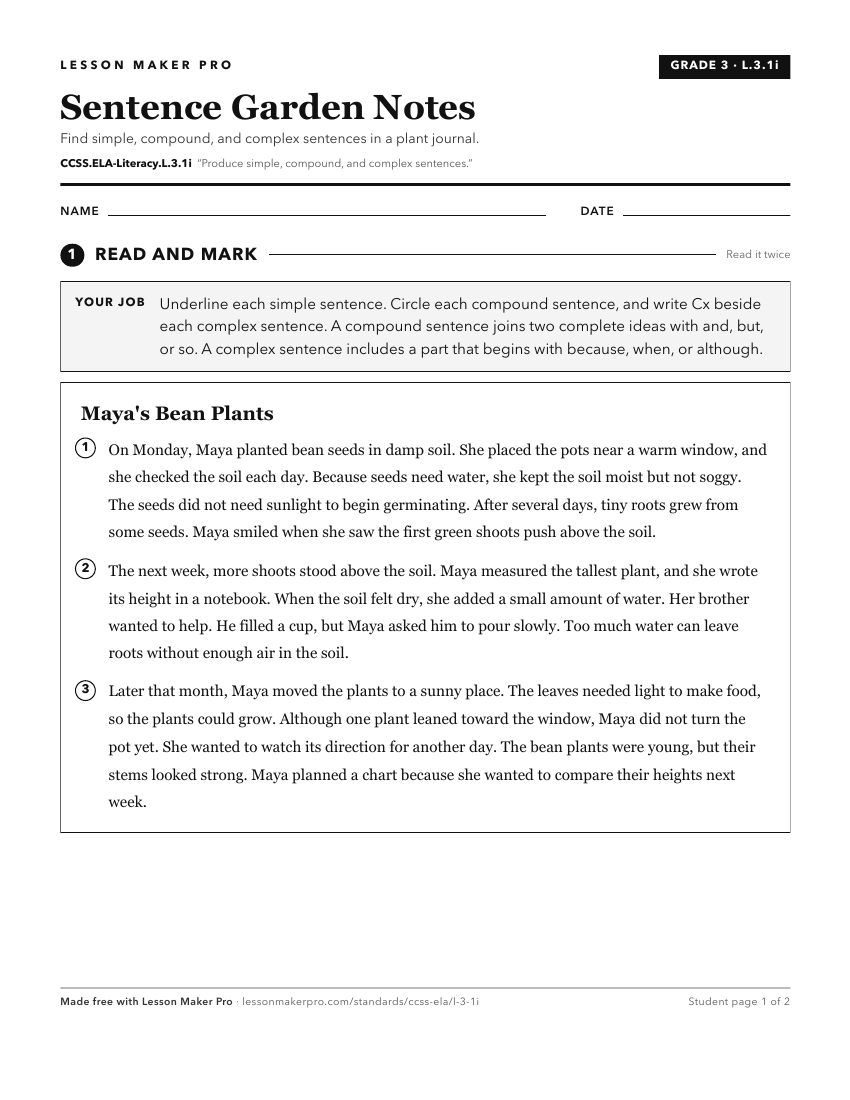
A ready-to-print activity worksheet aligned to CCSS.ELA-Literacy.L.3.1i, with an answer key for the teacher on its own page. No account needed.
PDF, US Letter, prints cleanly in black and white.
Download the worksheetKeep exploring
Related Standards
- CCSS.ELA-Literacy.L.7.1b
Choose among simple, compound, complex, and compound-complex sentences to signal differing relationships among ideas.
- CCSS.ELA-Literacy.L.1.1j
Produce and expand complete simple and compound declarative, interrogative, imperative, and exclamatory sentences in response to prompts.
- CCSS.ELA-Literacy.L.4.1f
Produce complete sentences, recognizing and correcting inappropriate fragments and run-ons.
- CCSS.ELA-Literacy.SL.1.6
Produce complete sentences when appropriate to task and situation.
Turn this exact standard into a lesson
Grade, subject, topic, and the complete standard are prefilled. Create one free, no account needed.
Also for this standard:Make a WorksheetMake a QuizMake a Sub Lesson