CCSS.
The Standard
Produce complete sentences, recognizing and correcting inappropriate fragments and run-ons.
Common Core State Standards for English Language Arts
Teacher's field guide
What This Standard Means
What Students Need to Do
- Students decide whether words form a complete thought. They add missing parts to fragments and separate or correctly join ideas in run-on sentences.
What Mastery Looks Like
- Students write sentences with a clear subject, verb, and complete thought. They repair fragments and run-ons while keeping the original meaning.
Common Misconceptions
- Students may think any long group of words is a sentence and any short one is a fragment. They may join sentences with only a comma or leave words beginning with “because” or “when” as incomplete thoughts.
How to Assess It
- Use this exit ticket: Label and correct each item: “Because the rain started.” “Mia grabbed her coat she ran outside.” “The bus arrived late.”
Lesson moves
Ways to Teach It
Give pairs sentence strips to sort into complete sentences, fragments, and run-ons, then have them repair each incorrect strip.
Ask students to explain how they would fix, “When the final bell rang,” and compare two possible complete sentences.
Play Sentence Repair Relay, where teams correct one fragment or run-on on the board before passing the marker.
Have students edit a mock class announcement for fragments and run-ons before reading the corrected version aloud.
Free download
Printable L.4.1f Worksheet
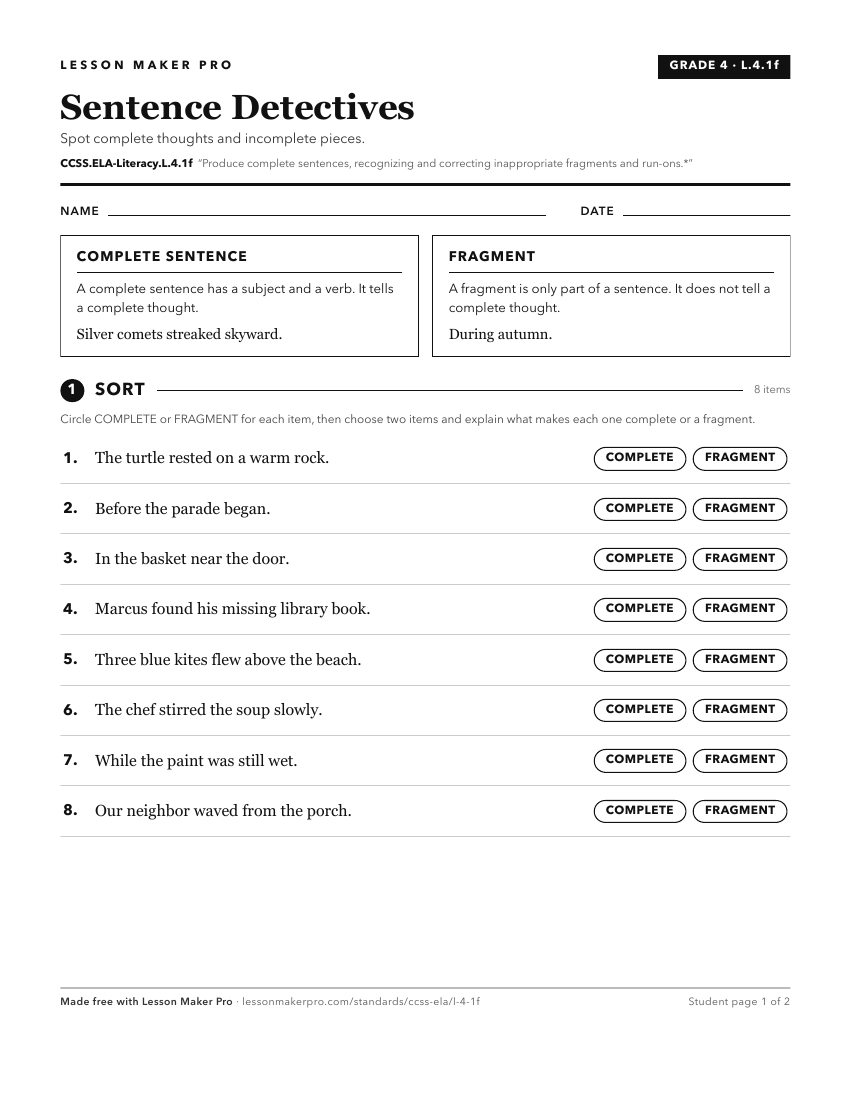
A ready-to-print activity worksheet aligned to CCSS.ELA-Literacy.L.4.1f, with an answer key for the teacher on its own page. No account needed.
PDF, US Letter, prints cleanly in black and white.
Download the worksheetKeep exploring
Related Standards
- CCSS.ELA-Literacy.L.1.1j
Produce and expand complete simple and compound declarative, interrogative, imperative, and exclamatory sentences in response to prompts.
- CCSS.ELA-Literacy.SL.2.6
Produce complete sentences when appropriate to task and situation in order to provide requested detail or clarification.
- CCSS.ELA-Literacy.L.3.1i
Produce simple, compound, and complex sentences.
- CCSS.ELA-Literacy.SL.1.6
Produce complete sentences when appropriate to task and situation.
Turn this exact standard into a lesson
Grade, subject, topic, and the complete standard are prefilled. Create one free, no account needed.
Also for this standard:Make a WorksheetMake a QuizMake a Sub Lesson