CCSS.
The Standard
Produce and expand complete simple and compound declarative, interrogative, imperative, and exclamatory sentences in response to prompts.
Common Core State Standards for English Language Arts
Teacher's field guide
What This Standard Means
What Students Need to Do
- Students say and write complete statements, questions, commands, and exclamations from pictures or oral prompts. They add useful details and join two complete thoughts when appropriate.
What Mastery Looks Like
- Students can create complete statements, questions, commands, and exclamations with correct capital letters and end marks. They can add details and connect two complete thoughts with words such as “and” or “but.”
Common Misconceptions
- Students may write fragments, such as “The big dog,” and think they are complete sentences. They may rely only on punctuation, or join ideas with “and” without making both thoughts complete.
How to Assess It
- Show a picture of children at a playground. Ask students to write a statement, question, command, and exclamation, then expand one sentence with two details.
Lesson moves
Ways to Teach It
Give pairs word cards to build four sentence types, then add detail cards for where, when, or how.
Ask students to rewrite “The dog ran” to show a question, command, strong feeling, and added detail.
Play Sentence Type Spin, where students spin for a sentence type and write one about a displayed picture.
Have students create classroom signs that give information, ask a question, give a direction, or show excitement.
Free download
Printable L.1.1j Worksheet
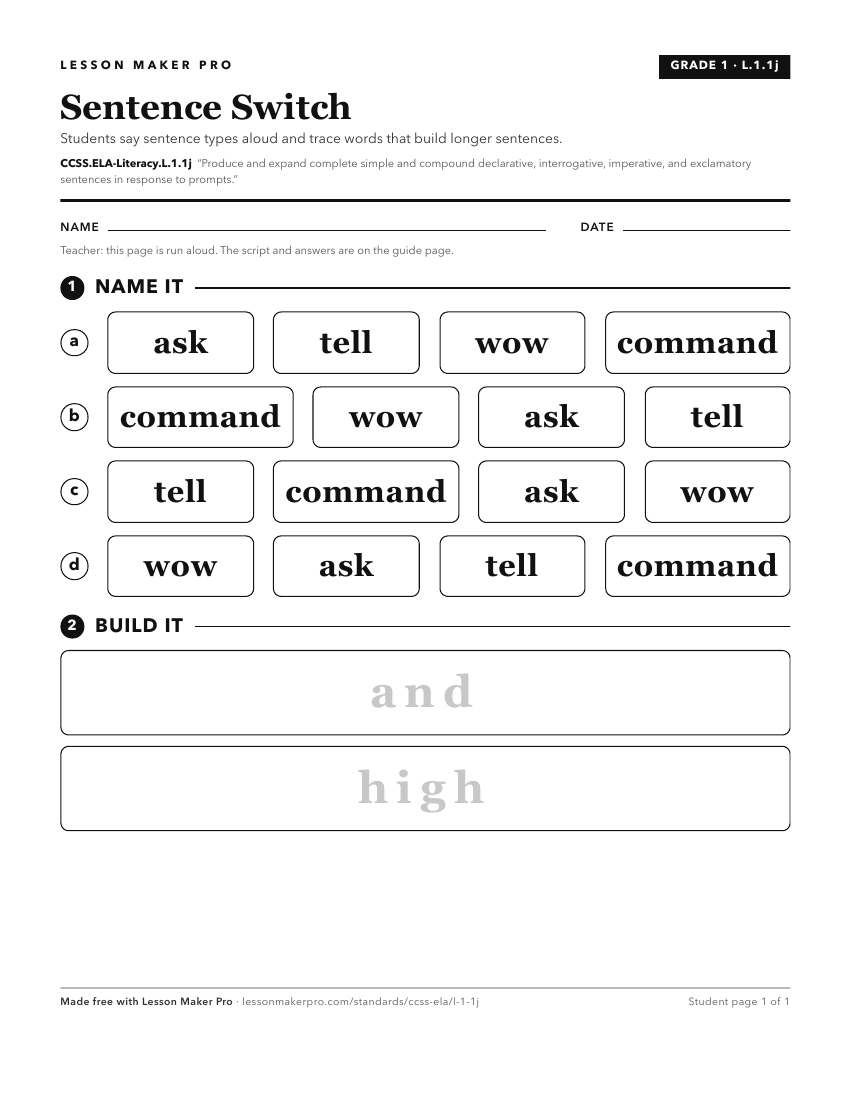
A ready-to-print activity worksheet aligned to CCSS.ELA-Literacy.L.1.1j, with an answer key for the teacher on its own page. No account needed.
PDF, US Letter, prints cleanly in black and white.
Download the worksheetKeep exploring
Related Standards
- CCSS.ELA-Literacy.L.K.1f
Produce and expand complete sentences in shared language activities.
- CCSS.ELA-Literacy.SL.2.6
Produce complete sentences when appropriate to task and situation in order to provide requested detail or clarification.
- CCSS.ELA-Literacy.L.3.1i
Produce simple, compound, and complex sentences.
- CCSS.ELA-Literacy.SL.1.6
Produce complete sentences when appropriate to task and situation.
Turn this exact standard into a lesson
Grade, subject, topic, and the complete standard are prefilled. Create one free, no account needed.
Also for this standard:Make a WorksheetMake a QuizMake a Sub Lesson