CCSS.
The Standard
Explain the function of verbals (gerunds, participles, infinitives) in general and their function in particular sentences.
Common Core State Standards for English Language Arts
Teacher's field guide
What This Standard Means
What Students Need to Do
- Students find gerunds, participles, and infinitives in sentences. They explain whether each verbal works as a noun, adjective, or adverb in that sentence.
What Mastery Looks Like
- Students correctly label gerunds, participles, and infinitives in sentences. They explain whether each one acts as a noun, adjective, or adverb and name what it modifies.
Common Misconceptions
- Students often label every word ending in -ing as a gerund. They may confuse participles with main verbs or mistake every use of to for an infinitive.
How to Assess It
- Give students this sentence: “To win the race, Ava practiced swimming every morning.” Ask them to label each verbal and explain its job.
Lesson moves
Ways to Teach It
Give groups sentence strips with highlighted verbals, then have them sort the strips by noun, adjective, or adverb function.
Ask students to explain how the meaning changes when “Running is fun” becomes “The running water felt cold.”
Play verbal detective by projecting sentences and awarding points for naming each verbal, its type, and its job.
Collect headlines or advertisements containing verbals, then have students annotate how each verbal shapes the message.
Free download
Printable L.8.1a Worksheet
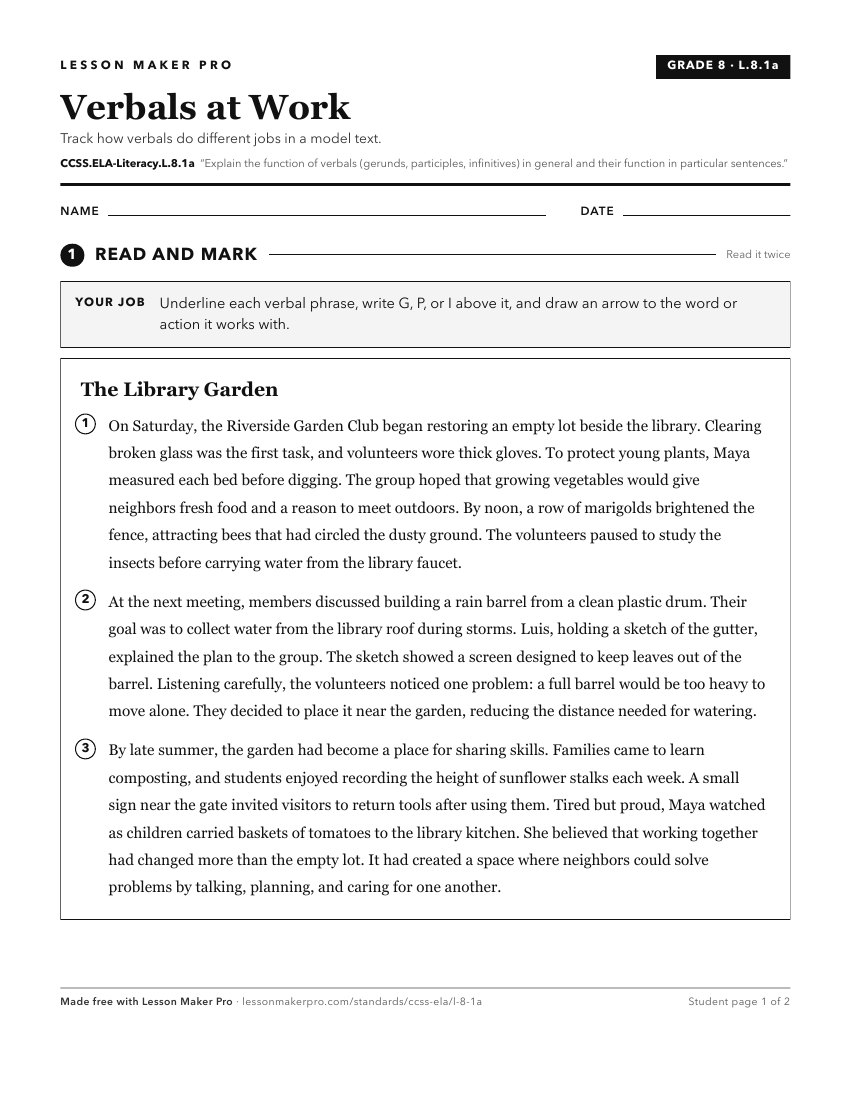
A ready-to-print activity worksheet aligned to CCSS.ELA-Literacy.L.8.1a, with an answer key for the teacher on its own page. No account needed.
PDF, US Letter, prints cleanly in black and white.
Download the worksheetLearning progression
Where This Standard Sits
Before This Standard
If students are struggling here, check these first.
What This Unlocks
Mastery here sets students up for these next.
Keep exploring
Related Standards
- CCSS.ELA-Literacy.L.3.1a
Explain the function of nouns, pronouns, verbs, adjectives, and adverbs in general and their functions in particular sentences.
- CCSS.ELA-Literacy.L.5.1a
Explain the function of conjunctions, prepositions, and interjections in general and their function in particular sentences.
- CCSS.ELA-Literacy.L.3.1d
Form and use regular and irregular verbs.
Turn this exact standard into a lesson
Grade, subject, topic, and the complete standard are prefilled. Create one free, no account needed.
Also for this standard:Make a WorksheetMake a QuizMake a Sub Lesson