CCSS.
The Standard
Interpret figurative language, including similes and metaphors, in context.
Common Core State Standards for English Language Arts
Teacher's field guide
What This Standard Means
What Students Need to Do
- Students work out what a comparison suggests rather than reading it literally. They use nearby words and details to explain the image, feeling, or idea.
What Mastery Looks Like
- Students can name the two things being compared and describe the quality they share. They explain the intended meaning and support it with details from the sentence or passage.
Common Misconceptions
- Students may treat comparisons as literal facts or think every use of “like” or “as” is a simile. They may name the device without explaining the shared quality or intended meaning.
How to Assess It
- Exit ticket: “No one spoke after the loss. The locker room was a tomb.” Ask students to explain the comparison and cite one context clue.
Lesson moves
Ways to Teach It
Give pairs figurative sentence cards, meaning cards, and context cards to match, then have them explain each match.
Ask students to write what “The moon was a flashlight” suggests and which shared quality makes the comparison work.
Play Comparison Detective, where teams earn points by identifying the comparison, meaning, and context clue on each card.
Have students find a simile or metaphor in an advertisement and explain what the comparison encourages customers to believe.
Free download
Printable L.5.5a Worksheet
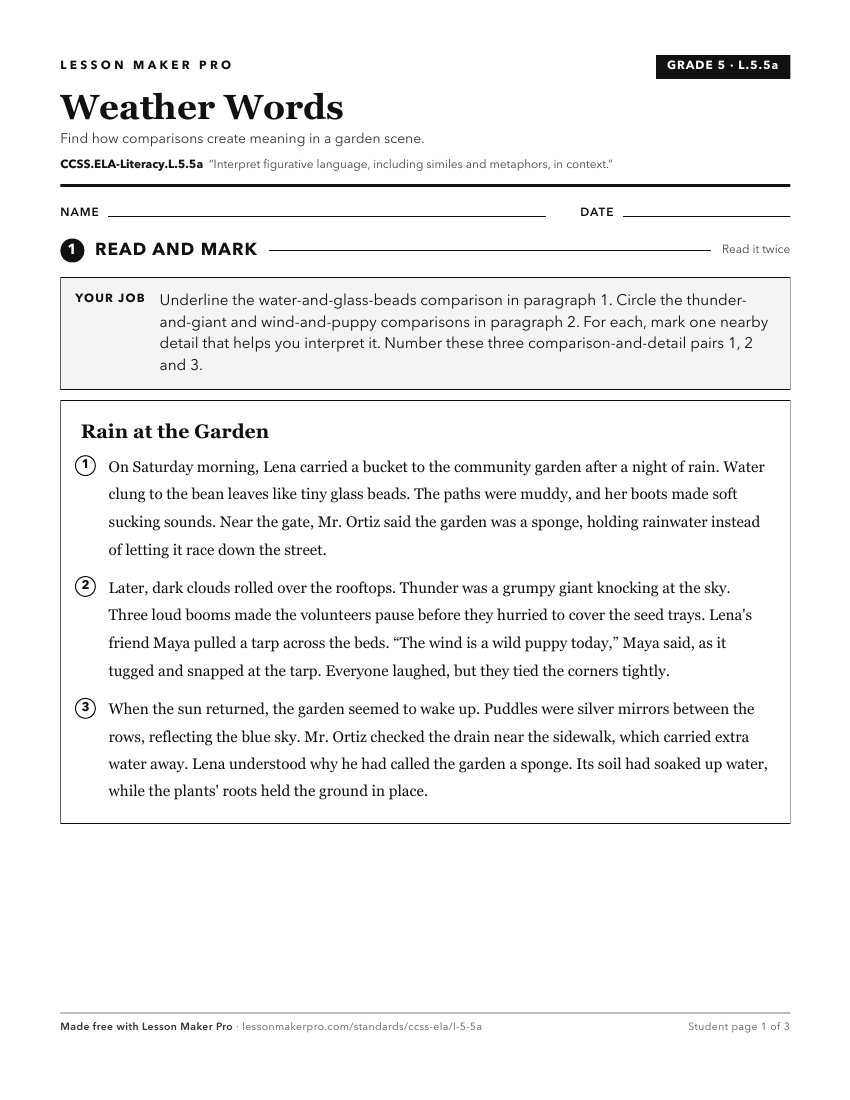
A ready-to-print activity worksheet aligned to CCSS.ELA-Literacy.L.5.5a, with an answer key for the teacher on its own page. No account needed.
PDF, US Letter, prints cleanly in black and white.
Download the worksheetLearning progression
Where This Standard Sits
Before This Standard
If students are struggling here, check these first.
What This Unlocks
Mastery here sets students up for these next.
Keep exploring
Related Standards
- CCSS.ELA-Literacy.L.8.5a
Interpret figures of speech (e.g. verbal irony, puns) in context.
- CCSS.ELA-Literacy.L.11-12.5a
Interpret figures of speech (e.g., hyperbole, paradox) in context and analyze their role in the text.
- CCSS.ELA-Literacy.L.7.5a
Interpret figures of speech (e.g., literary, biblical, and mythological allusions) in context.
Turn this exact standard into a lesson
Grade, subject, topic, and the complete standard are prefilled. Create one free, no account needed.
Also for this standard:Make a WorksheetMake a QuizMake a Sub Lesson