CCSS.
The Standard
Correctly use frequently confused words (e.g., to, too, two; there, their).
Common Core State Standards for English Language Arts
Teacher's field guide
What This Standard Means
What Students Need to Do
- Students use sentence meaning to choose the correct word when two or more words sound alike. They apply the correct spelling when writing and editing sentences.
What Mastery Looks Like
- Students choose the right spelling by using the sentence meaning. They correctly use words such as to, too, two, there, their, and they're in their own writing.
Common Misconceptions
- Students often choose a word by sound instead of meaning. They may use there for every form, or forget that too can mean also or more than needed.
How to Assess It
- Exit ticket: Complete “___ going ___ bring ___ books over ___, ___.” Ask students to explain one choice.
Lesson moves
Ways to Teach It
Give pairs word cards for to, too, two, there, their, and they're, then have them place each card into matching sentence strips.
Write three connected sentences using there, their, and they're, then explain to a partner how each word's meaning guided the choice.
Play homophone bingo by reading sentences with blanks while students cover the correctly spelled word on their boards.
Examine a class email or school notice, circle confused words, and revise any incorrect choices.
Free download
Printable L.4.1g Worksheet
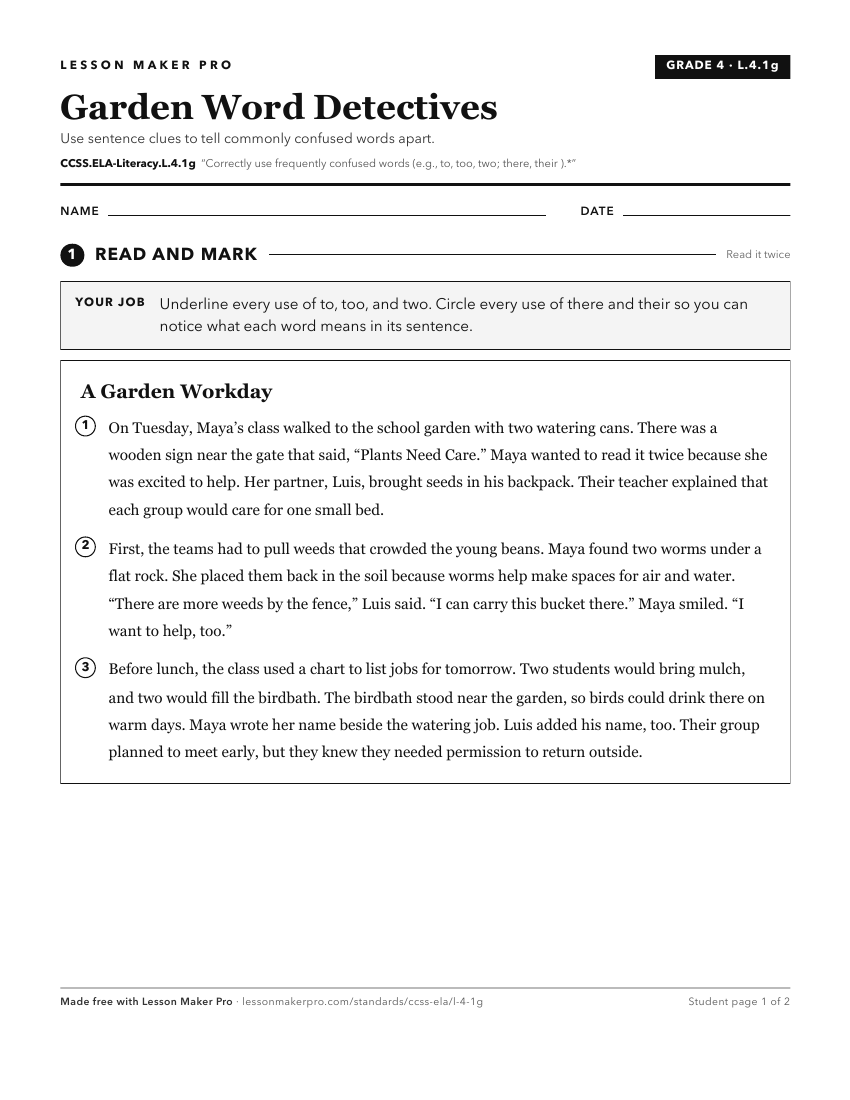
A ready-to-print activity worksheet aligned to CCSS.ELA-Literacy.L.4.1g, with an answer key for the teacher on its own page. No account needed.
PDF, US Letter, prints cleanly in black and white.
Download the worksheetKeep exploring
Related Standards
- CCSS.ELA-Literacy.L.1.1i
Use frequently occurring prepositions (e.g., during, beyond, toward).
- CCSS.ELA-Literacy.L.5.6
Acquire and use accurately grade-appropriate general academic and domain-specific words and phrases, including those that signal contrast, addition, and other l...
- CCSS.ELA-Literacy.L.1.1g
Use frequently occurring conjunctions (e.g., and, but, or, so, because).
- CCSS.ELA-Literacy.L.K.1b
Use frequently occurring nouns and verbs.
Turn this exact standard into a lesson
Grade, subject, topic, and the complete standard are prefilled. Create one free, no account needed.
Also for this standard:Make a WorksheetMake a QuizMake a Sub Lesson