CCSS.
The Standard
Use modal auxiliaries (e.g., can, may, must) to convey various conditions.
Common Core State Standards for English Language Arts
Teacher's field guide
What This Standard Means
What Students Need to Do
- Students use helping verbs such as can, may, might, should, and must to show different meanings. They explain whether a sentence expresses ability, permission, possibility, advice, or obligation.
What Mastery Looks Like
- Students choose a modal that clearly shows ability, permission, possibility, advice, or obligation. They can replace the modal in a sentence and explain how the meaning changes.
Common Misconceptions
- Students may treat can, may, might, should, and must as interchangeable. They may write forms such as “musts go” or “can to go” instead of using the base verb.
How to Assess It
- Give students the sentence “Lena finish her homework tonight.” Ask them to add two different modals, then explain how each one changes the meaning.
Lesson moves
Ways to Teach It
Give pairs action cards and modal cards, then have them build sentences showing permission, possibility, ability, advice, or obligation.
Ask students to write three versions of “We leave now” using modals, then explain the meaning of each version.
Play Modal Switch by reading a sentence aloud and having teams replace its modal to match a meaning you call out.
Examine classroom rules and permission slips, then rewrite selected sentences with can, may, should, or must.
Free download
Printable L.4.1c Worksheet
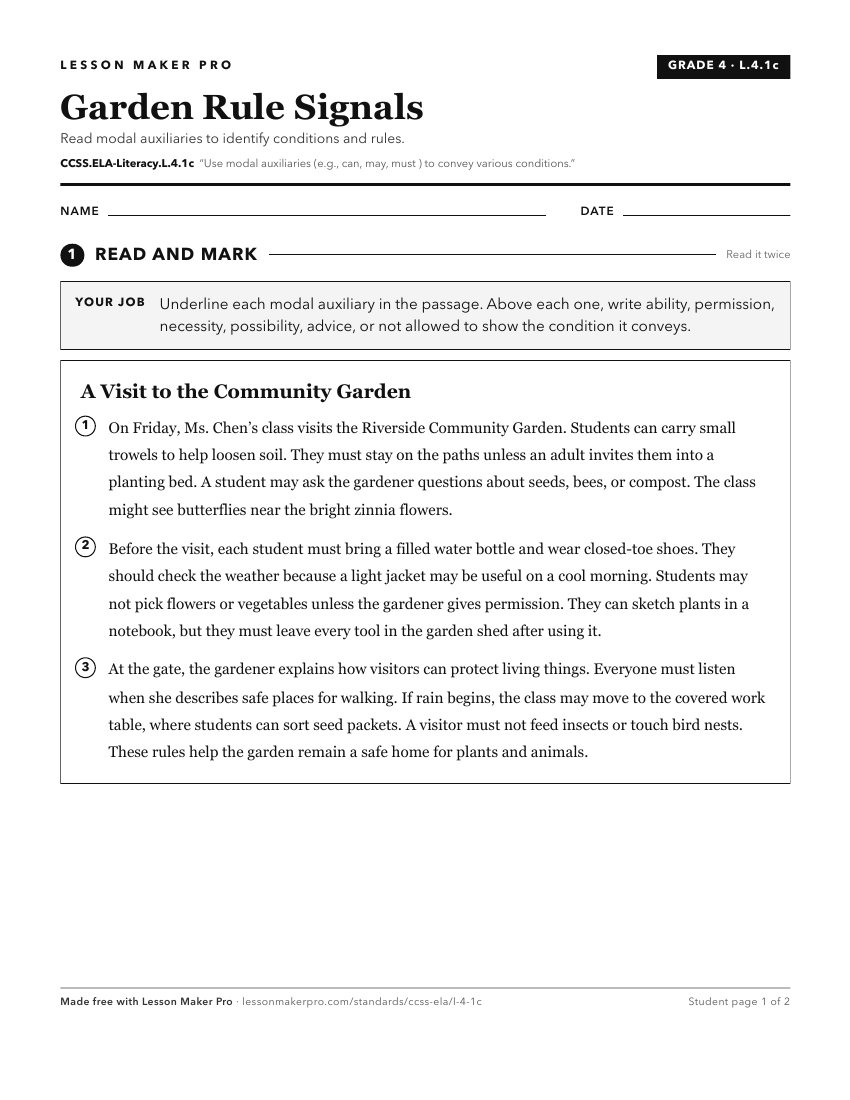
A ready-to-print activity worksheet aligned to CCSS.ELA-Literacy.L.4.1c, with an answer key for the teacher on its own page. No account needed.
PDF, US Letter, prints cleanly in black and white.
Download the worksheetLearning progression
Where This Standard Sits
What This Unlocks
Mastery here sets students up for these next.
Keep exploring
Related Standards
- CCSS.ELA-Literacy.L.8.1c
Form and use verbs in the indicative, imperative, interrogative, conditional, and subjunctive mood.
- CCSS.ELA-Literacy.L.8.3a
Use verbs in the active and passive voice and in the conditional and subjunctive mood to achieve particular effects (e.g., emphasizing the actor or the action; ...
- CCSS.ELA-Literacy.L.2.1e
Use adjectives and adverbs, and choose between them depending on what is to be modified.
Turn this exact standard into a lesson
Grade, subject, topic, and the complete standard are prefilled. Create one free, no account needed.
Also for this standard:Make a WorksheetMake a QuizMake a Sub Lesson