CCSS.
The Standard
Form and use verbs in the indicative, imperative, interrogative, conditional, and subjunctive mood.
Common Core State Standards for English Language Arts
Teacher's field guide
What This Standard Means
What Students Need to Do
- Students form and use verbs to state facts, give commands, ask questions, describe conditions, and express wishes or unlikely situations. They choose forms that match the speaker’s purpose.
What Mastery Looks Like
- Students correctly label the mood of a verb in context. They can rewrite one idea in five ways, using forms such as commands, questions, conditions, and wishes accurately.
Common Misconceptions
- Students may confuse interrogative sentences with any sentence containing a question word. They may miss the understood “you” in commands or treat conditional “would” forms as subjunctive forms.
How to Assess It
- Give an exit ticket: Write one sentence in each mood about a canceled field trip. Underline each verb phrase and label the mood.
Lesson moves
Ways to Teach It
Give pairs sentence cards to sort by mood, then have them revise one card into each of the other four moods.
Ask students to write five versions of “We leave now,” then explain how each version changes the speaker’s purpose.
Play Mood Match: students draw a purpose card and race to write a sentence using the verb mood that fits.
Examine rules, advertisements, interviews, and advice columns, then label the verb mood each writer uses and explain why.
Free download
Printable L.8.1c Worksheet
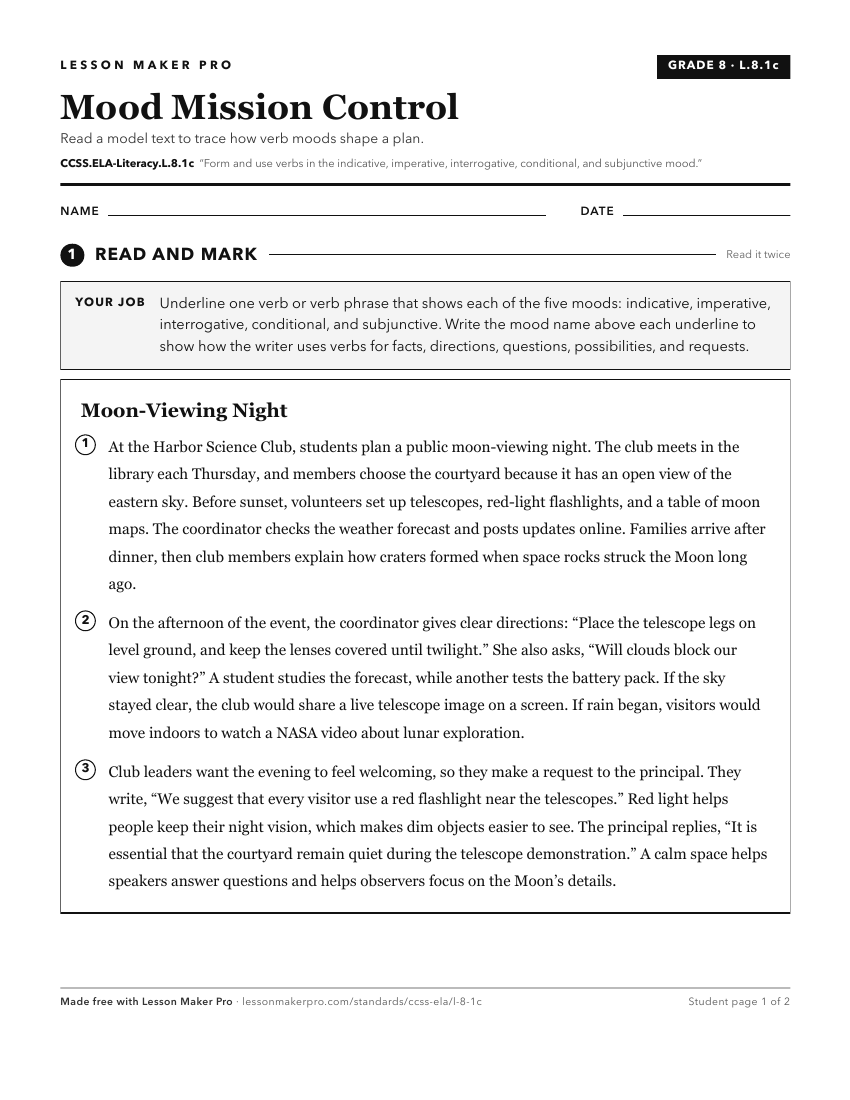
A ready-to-print activity worksheet aligned to CCSS.ELA-Literacy.L.8.1c, with an answer key for the teacher on its own page. No account needed.
PDF, US Letter, prints cleanly in black and white.
Download the worksheetKeep exploring
Related Standards
- CCSS.ELA-Literacy.L.2.1d
Form and use the past tense of frequently occurring irregular verbs (e.g., sat, hid, told).
- CCSS.ELA-Literacy.L.8.3a
Use verbs in the active and passive voice and in the conditional and subjunctive mood to achieve particular effects (e.g., emphasizing the actor or the action; ...
- CCSS.ELA-Literacy.L.8.1b
Form and use verbs in the active and passive voice.
- CCSS.ELA-Literacy.L.3.1d
Form and use regular and irregular verbs.
Turn this exact standard into a lesson
Grade, subject, topic, and the complete standard are prefilled. Create one free, no account needed.
Also for this standard:Make a WorksheetMake a QuizMake a Sub Lesson