CCSS.
The Standard
Form and use verbs in the active and passive voice.
Common Core State Standards for English Language Arts
Teacher's field guide
What This Standard Means
What Students Need to Do
- Students identify who performs an action and who receives it. They rewrite sentences to place either the actor or the receiver in focus.
What Mastery Looks Like
- A student can switch a sentence between active and passive voice while keeping its meaning and tense. The student forms complete verb phrases and explains which version better fits the writer's purpose.
Common Misconceptions
- Students may label any sentence with "was" as passive, or confuse passive voice with past tense. They may write incomplete forms such as "The ball thrown by Maya." They may also change the tense when rewriting a sentence.
How to Assess It
- Exit ticket: Rewrite "The storm damaged three houses" in passive voice, then rewrite "The trophy was carried by Lena" in active voice. Underline each complete verb phrase.
Lesson moves
Ways to Teach It
Give pairs word cards for actor, action, and receiver; students arrange each set in both voices and read the sentences aloud.
Compare "The principal canceled the dance" with "The dance was canceled"; discuss what each version highlights and what the second leaves unknown.
Play a relay where teams convert sentence cards between voices while preserving tense, earning a point for correct verb forms.
Display news headlines, recipes, and lab directions; students mark the voice and explain why each writer foregrounded or omitted the actor.
Free download
Printable L.8.1b Worksheet
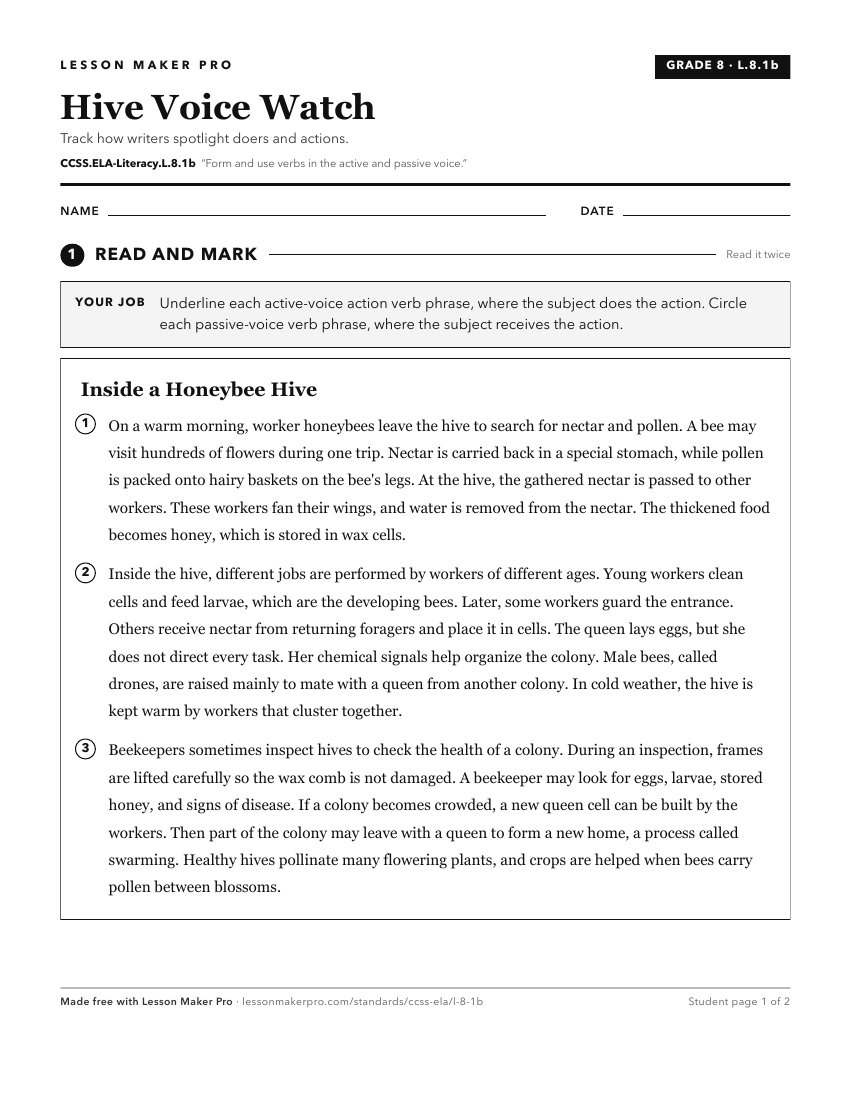
A ready-to-print activity worksheet aligned to CCSS.ELA-Literacy.L.8.1b, with an answer key for the teacher on its own page. No account needed.
PDF, US Letter, prints cleanly in black and white.
Download the worksheetKeep exploring
Related Standards
- CCSS.ELA-Literacy.L.8.1c
Form and use verbs in the indicative, imperative, interrogative, conditional, and subjunctive mood.
- CCSS.ELA-Literacy.L.2.1d
Form and use the past tense of frequently occurring irregular verbs (e.g., sat, hid, told).
- CCSS.ELA-Literacy.L.8.3a
Use verbs in the active and passive voice and in the conditional and subjunctive mood to achieve particular effects (e.g., emphasizing the actor or the action; ...
- CCSS.ELA-Literacy.L.3.1d
Form and use regular and irregular verbs.
Turn this exact standard into a lesson
Grade, subject, topic, and the complete standard are prefilled. Create one free, no account needed.
Also for this standard:Make a WorksheetMake a QuizMake a Sub Lesson