CCSS.
The Standard
Use verbs in the active and passive voice and in the conditional and subjunctive mood to achieve particular effects (e.g., emphasizing the actor or the action; expressing uncertainty or describing a state contrary to fact).
Common Core State Standards for English Language Arts
Teacher's field guide
What This Standard Means
What Students Need to Do
- Students choose verb forms based on what they want a sentence to highlight or suggest. They show possibilities, wishes, demands, conditions, and situations that are not true.
What Mastery Looks Like
- A student can revise “The window was broken by Maya” to “Maya broke the window” and explain how the focus changes. The student can use “I would help if I had time” for a condition and “If I were mayor” for an unreal situation.
Common Misconceptions
- Students often label every form of “be” as passive, even when no action is received. They may think passive voice is always wrong, or use “was” instead of “were” for an unreal situation. They also confuse a firm future claim with a result that depends on a condition.
How to Assess It
- Exit ticket: Rewrite “The mural was painted by the eighth graders” to focus on the painters. Then complete “If school closed tomorrow, I would...” and “If I were principal...” and label each verb choice.
Lesson moves
Ways to Teach It
Give pairs word cards from six sentences; have them build active and passive versions, then point to the person or action each highlights.
Compare “If I was rude, I apologize” with “If I were invisible, I would travel free,” then explain why the verb forms differ.
Play Sentence Switch: teams draw actor, action, and situation cards, then rewrite each sentence in the voice or mood called.
Examine three news headlines and a school rule, then revise each to reveal or hide responsibility and discuss the effect.
Free download
Printable L.8.3a Worksheet
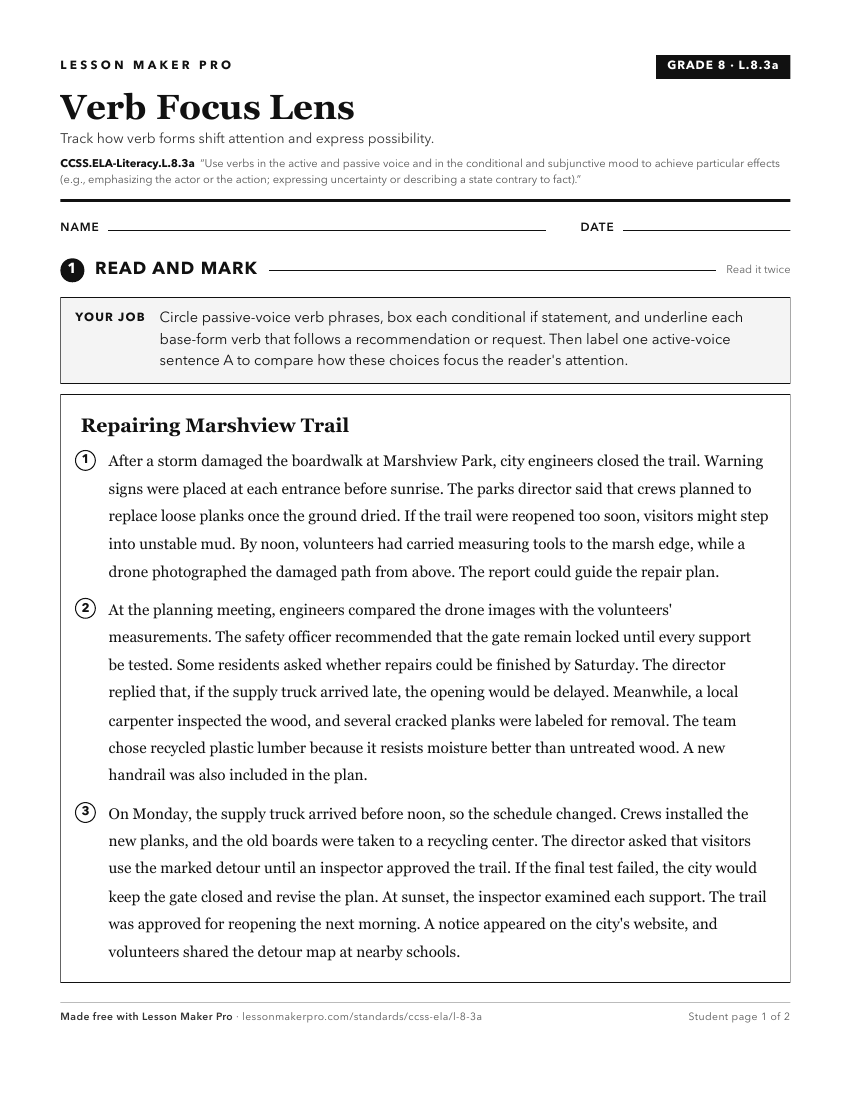
A ready-to-print activity worksheet aligned to CCSS.ELA-Literacy.L.8.3a, with an answer key for the teacher on its own page. No account needed.
PDF, US Letter, prints cleanly in black and white.
Download the worksheetLearning progression
Where This Standard Sits
Before This Standard
If students are struggling here, check these first.
Keep exploring
Related Standards
- CCSS.ELA-Literacy.L.8.1c
Form and use verbs in the indicative, imperative, interrogative, conditional, and subjunctive mood.
- CCSS.ELA-Literacy.L.5.1c
Use verb tense to convey various times, sequences, states, and conditions.
- CCSS.ELA-Literacy.L.8.1b
Form and use verbs in the active and passive voice.
- CCSS.ELA-Literacy.L.3.1d
Form and use regular and irregular verbs.
Turn this exact standard into a lesson
Grade, subject, topic, and the complete standard are prefilled. Create one free, no account needed.
Also for this standard:Make a WorksheetMake a QuizMake a Sub Lesson