CCSS.
The Standard
Form and use the simple (e.g., I walked; I walk; I will walk) verb tenses.
Common Core State Standards for English Language Arts
Teacher's field guide
What This Standard Means
What Students Need to Do
- Students choose verb forms that show whether an action happened in the past, happens now, or will happen later. They form regular and common irregular verbs correctly.
What Mastery Looks Like
- Students use simple past, present, and future verbs correctly in complete sentences. They keep the tense consistent and use correct forms for common irregular verbs such as went, saw, and ate.
Common Misconceptions
- Students may add -ed to every past-tense verb, producing forms such as goed or runned. They may omit the -s in present-tense forms such as she walks. They may also shift tense within one sentence or forget will for future actions.
How to Assess It
- Exit ticket: Rewrite “Maya walks to school” to show yesterday and tomorrow, then label all three sentences past, present, or future.
Lesson moves
Ways to Teach It
Give pairs sentence strips to sort under past, present, and future headings, then have them circle each verb.
Write three sentences about recess: what happened yesterday, what happens each day, and what will happen tomorrow.
Play tense switch: call out a verb and time, and students say a complete sentence using the matching form.
Have students create a three-day weather report using was, is, and will be for yesterday, today, and tomorrow.
Free download
Printable L.3.1e Worksheet
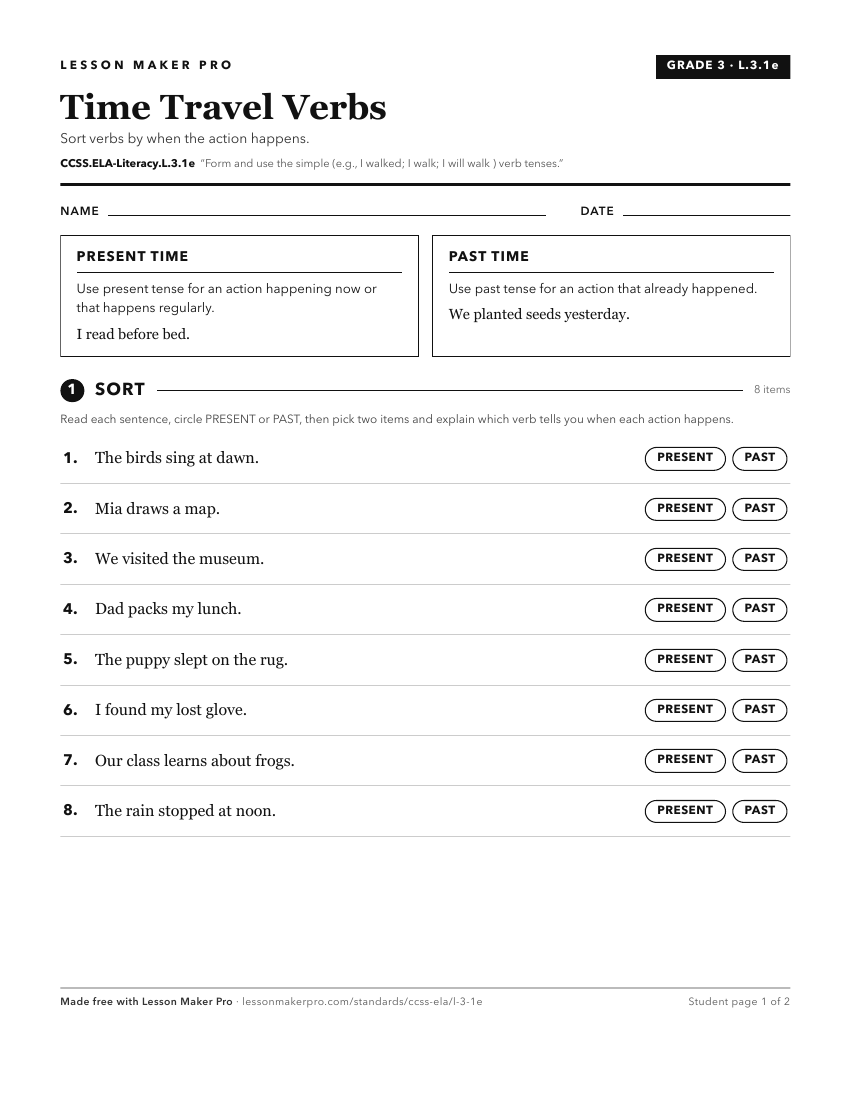
A ready-to-print activity worksheet aligned to CCSS.ELA-Literacy.L.3.1e, with an answer key for the teacher on its own page. No account needed.
PDF, US Letter, prints cleanly in black and white.
Download the worksheetKeep exploring
Related Standards
- CCSS.ELA-Literacy.L.1.1e
Use verbs to convey a sense of past, present, and future (e.g., Yesterday I walked home; Today I walk home; Tomorrow I will walk home).
- CCSS.ELA-Literacy.L.4.1b
Form and use the progressive (e.g., I was walking; I am walking; I will be walking) verb tenses.
- CCSS.ELA-Literacy.L.5.1b
Form and use the perfect (e.g., I had walked; I have walked; I will have walked) verb tenses.
- CCSS.ELA-Literacy.L.3.1d
Form and use regular and irregular verbs.
Turn this exact standard into a lesson
Grade, subject, topic, and the complete standard are prefilled. Create one free, no account needed.
Also for this standard:Make a WorksheetMake a QuizMake a Sub Lesson