Virginia SOL 4.MG.3.d
The Standard
Use concrete materials and pictorial models to explore the relationship between area and perimeter of rectangles.
Virginia Standards of Learning for Mathematics · The student will use multiple representations to develop and use formulas to solve problems, including those in context, involving area and perimeter limited to rectangles and squares (in both U.S. Customary and metric units).
Teacher's field guide
What This Standard Means
What Students Need to Do
- Students build and draw rectangles, then measure the space inside and the distance around each one. They compare models to explain how changing side lengths affects area and perimeter.
What Mastery Looks Like
- Students correctly find area and perimeter from tiles, grid drawings, or side lengths. They can show that rectangles may share an area but have different perimeters, or share a perimeter but have different areas.
Common Misconceptions
- Students may confuse area units with perimeter units or add side lengths when they should count square units. Some think equal areas must have equal perimeters, or that a larger perimeter always means a larger area.
How to Assess It
- Show 2-by-8 and 4-by-4 rectangles on a square grid. Ask students to find each area and perimeter, then explain what the pair shows.
Lesson moves
Ways to Teach It
Give pairs 24 square tiles to build every possible rectangle, then trace each shape and record its area and perimeter.
Ask students to compare 3-by-8 and 4-by-6 rectangles and write why equal area does not guarantee equal perimeter.
Play a card sort matching rectangle diagrams, dimensions, areas, and perimeters, including pairs with equal areas or equal perimeters.
Plan a rectangular garden with 24 square meters of planting space, then compare how much fencing different layouts require.
Free download
Printable 4.MG.3.d Worksheet
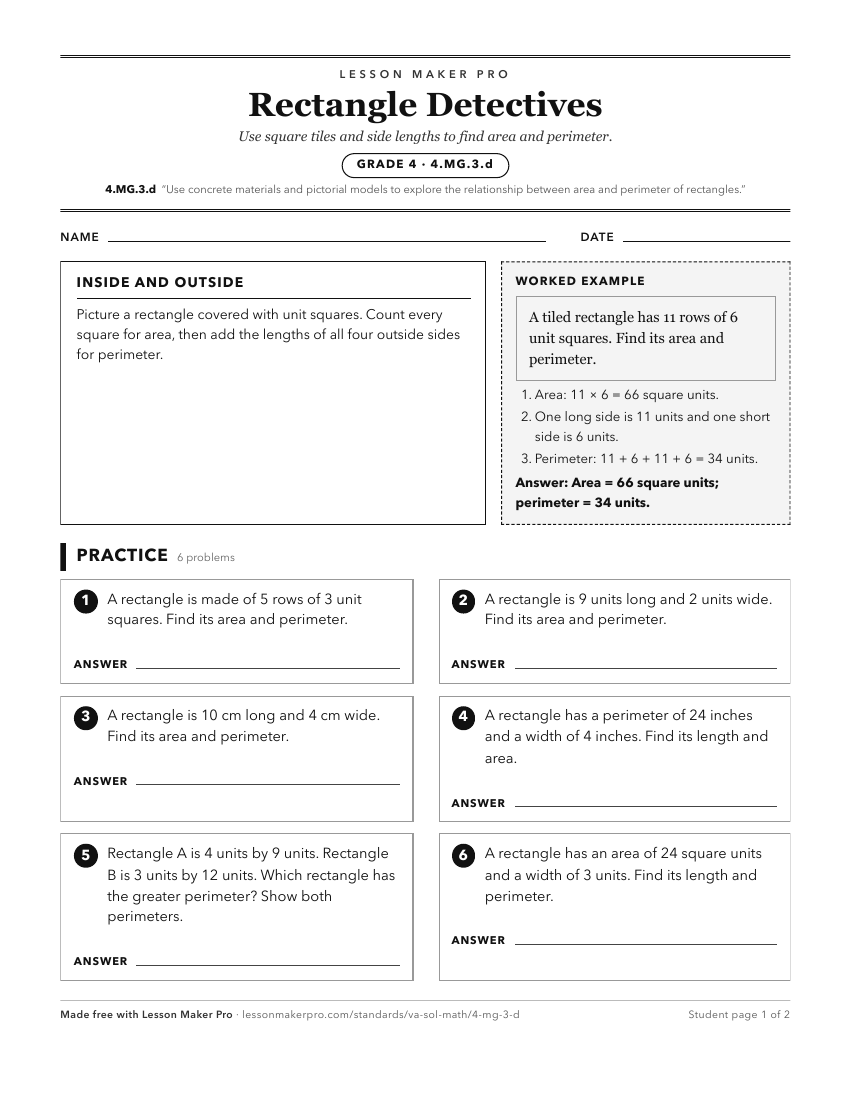
A ready-to-print activity worksheet aligned to 4.MG.3.d, with an answer key for the teacher on its own page. No account needed.
PDF, US Letter, prints cleanly in black and white.
Download the worksheetKeep exploring
Related Standards
- 4.MG.3.e
Identify and represent rectangles with the same perimeter and different areas or with the same area and different perimeters.
- 4.MG.3.b
Determine the area and perimeter of a rectangle when given the measure of two adjacent sides (in whole number units), with and without models.
- 4.MG.3.f
Solve contextual problems involving area and perimeter of rectangles and squares.
- 4.MG.3.a
Use concrete materials and pictorial models to develop a formula for the area and perimeter of a rectangle (including a square).
Turn this exact standard into a lesson
Grade, subject, topic, and the complete standard are prefilled. Create one free, no account needed.
Also for this standard:Make a WorksheetMake a QuizMake a Sub Lesson