Virginia SOL 4.CE.2.e
The Standard
Determine all factor pairs for a whole number 1 to 100, using concrete, pictorial, and numerical representations.
Virginia Standards of Learning for Mathematics · The student will estimate, represent, solve, and justify solutions to single-step and multistep problems, including those in context, using multiplication with whole numbers, and single-step problems, including those in context, using division with whole numbers; and recall with automaticity the multiplication facts through 12 × 12 and the corresponding division facts.
Teacher's field guide
What This Standard Means
What Students Need to Do
- Students build or draw rectangular arrays and record the two side lengths that make a given product. They use multiplication and division to find every pair without repeats.
What Mastery Looks Like
- Given a number such as 36, a student lists 1 × 36, 2 × 18, 3 × 12, 4 × 9, and 6 × 6. The student models a pair with an array and uses division to confirm the list is complete.
Common Misconceptions
- Students may list factors without pairing them, count reversed pairs twice, or stop before finding every pair. They may include pairs with a remainder, forget 1 and the number itself, or misclassify prime numbers.
How to Assess It
- Exit ticket: Find every factor pair of 48. Draw one array and explain how you know your list is complete.
Lesson moves
Ways to Teach It
Give students 24 counters and have them build every possible rectangle, recording each pair of side lengths.
Ask: How can you prove your factor-pair list for 36 is complete? Write two sentences using division or arrays.
Play Factor Pair Match with product cards and pair cards, awarding a point only when a player names every pair.
Plan rectangular seating layouts for 32 guests, then list the row and seat combinations that use every chair.
Free download
Printable 4.CE.2.e Worksheet
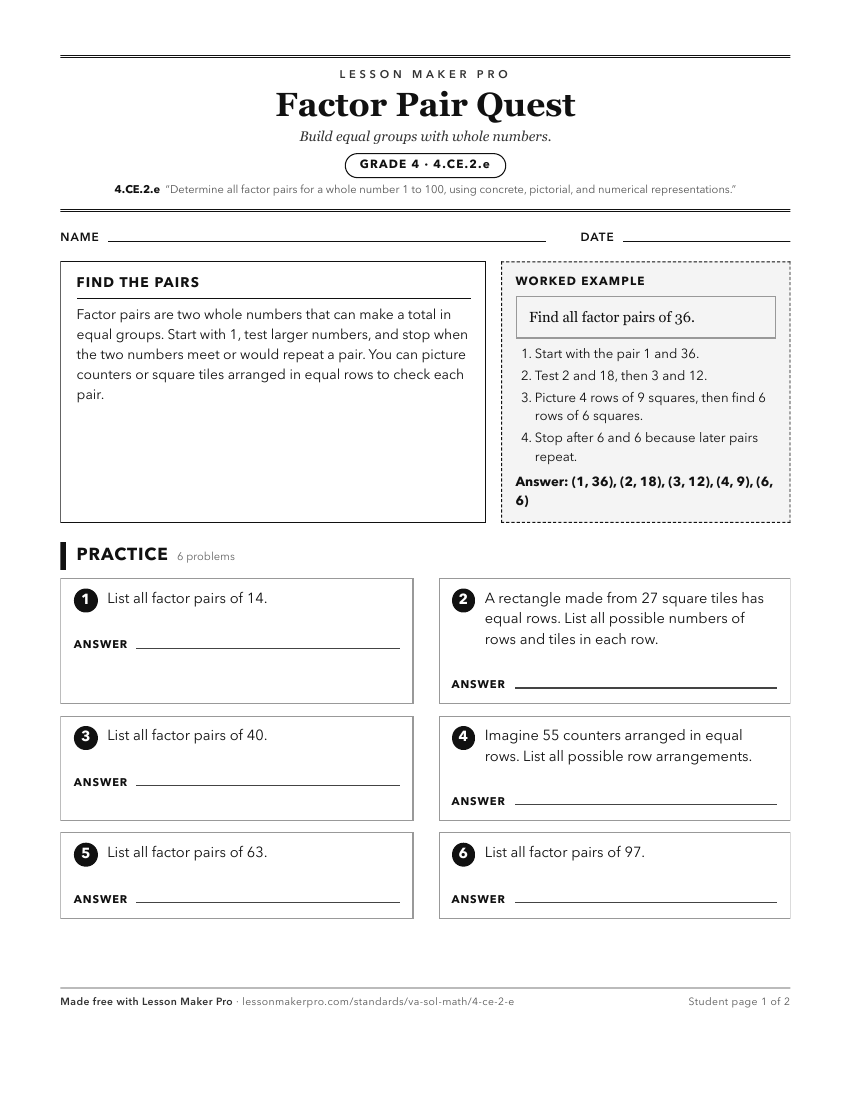
A ready-to-print activity worksheet aligned to 4.CE.2.e, with an answer key for the teacher on its own page. No account needed.
PDF, US Letter, prints cleanly in black and white.
Download the worksheetKeep exploring
Related Standards
- 5.NS.2
The student will demonstrate an understanding of prime and composite numbers, and determine the prime factorization of a whole number up to 100.
- 5.NS.2.a
Given a whole number up to 100, create a concrete or pictorial representation to demonstrate whether the number is prime or composite, and justify reasoning.
- 1.NS.2.c
Create a concrete or pictorial representation of a number using tens and ones and write the corresponding numeral up to 120 (e.g., 47 can be represented as 47 o...
- 5.NS.2.c
Determine the prime factorization for a whole number up to 100.
Turn this exact standard into a lesson
Grade, subject, topic, and the complete standard are prefilled. Create one free, no account needed.
Also for this standard:Make a WorksheetMake a QuizMake a Sub Lesson