NGSS MS-LS2-2
The Standard
Construct an explanation that predicts patterns of interactions among organisms across multiple ecosystems.
Next Generation Science Standards
Teacher's field guide
What This Standard Means
What Students Need to Do
- Students compare relationships among organisms in more than one ecosystem. They use evidence about living things and conditions such as water, light, or temperature to predict repeated patterns.
What Mastery Looks Like
- Students identify competition, feeding, or mutual benefit in two different ecosystems. They use organism and environmental evidence to predict how each relationship changes when conditions change.
Common Misconceptions
- Students may think predators always eliminate prey or that competition happens only within one species. They may treat mutual benefit as intentional cooperation and overlook how water, light, or temperature changes relationships.
How to Assess It
- Exit ticket: A drought reduces plant growth in a grassland and near a pond. Predict one interaction change in each ecosystem and explain the shared pattern.
Lesson moves
Ways to Teach It
Build two tabletop food webs with organism cards and yarn, then remove water or food cards and record predicted interaction changes.
Write a response predicting how less rainfall changes competition in a desert and grassland, using resource evidence for both predictions.
Play Interaction Match by pairing ecosystem scenario cards with competition, predation, or mutual benefit cards and defending each match.
Use local wildlife and weather records to predict how a dry month might change feeding or competition among nearby species.
Free download
Printable MS-LS2-2 Worksheet
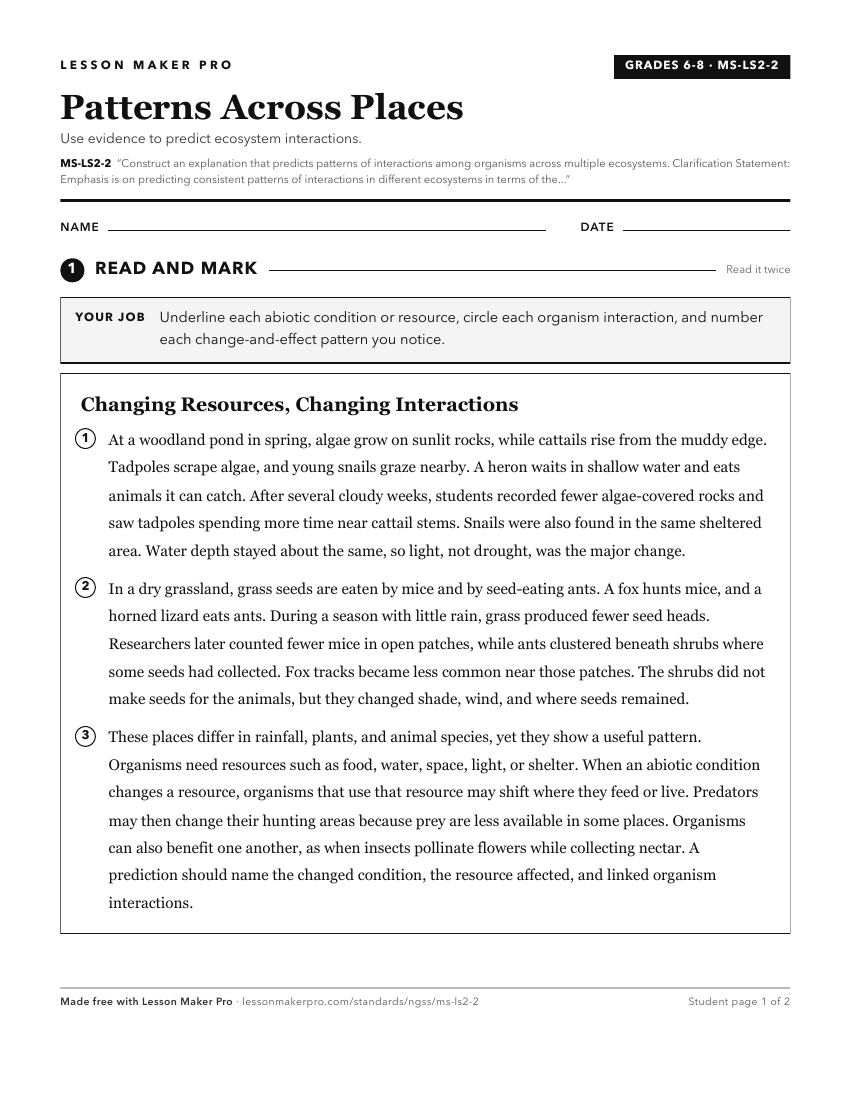
A ready-to-print activity worksheet aligned to MS-LS2-2, with an answer key for the teacher on its own page. No account needed.
PDF, US Letter, prints cleanly in black and white.
Download the worksheetWhat This Unlocks
Mastery here sets students up for these next.
- HS-LS2-2
Predicting organism interactions across ecosystems prepares students to explain population and biodiversity changes across scales using evidence and mathematics.
- HS-LS2-1
Predicting organism interaction patterns supports explaining how resource limits, competition, and other factors affect carrying capacity across ecosystem scales.
Keep exploring
Related Standards
- MS-LS1-5
Construct a scientific explanation based on evidence for how environmental and genetic factors influence the growth of organisms.
- HS-LS2-6
Evaluate the claims, evidence, and reasoning that the complex interactions in ecosystems maintain relatively consistent numbers and types of organisms in stable...
- MS-LS1-6
Construct a scientific explanation based on evidence for the role of photosynthesis in the cycling of matter and flow of energy into and out of organisms.
Turn this exact standard into a lesson
Grade, subject, topic, and the complete standard are prefilled. Create one free, no account needed.
Also for this standard:Make a WorksheetMake a QuizMake a Sub Lesson