NGSS 5-ESS1-1
The Standard
Support an argument that differences in the apparent brightness of the sun compared to other stars is due to their relative distances from Earth.
Next Generation Science Standards
Teacher's field guide
What This Standard Means
What Students Need to Do
- Students make a claim about why the Sun looks brighter than other stars. They use evidence about relative distance from Earth to support their reasoning.
What Mastery Looks Like
- Students explain that the Sun appears brighter because it is much closer to Earth than other stars. They support the claim with distance data, a diagram, or results from a light model.
Common Misconceptions
- Students may think the Sun appears brightest because it is the largest star. They may also assume that dim stars produce less light, rather than considering their greater distance from Earth.
How to Assess It
- Give students a diagram showing Earth, the Sun, and three distant stars. Ask: “Why does the Sun look brighter from Earth? Use the distances in the diagram as evidence.”
Lesson moves
Ways to Teach It
Place identical flashlights at different distances from a wall, then have students compare the brightness of each light spot.
Ask students to write: “Why can a nearby light look brighter than the same light far away?”
Give pairs distance cards and brightness cards, then have them match closer stars with brighter appearances and explain each choice.
Compare nearby and distant streetlights at night, focusing on how distance changes how bright each light appears.
Free download
Printable 5-ESS1-1 Worksheet
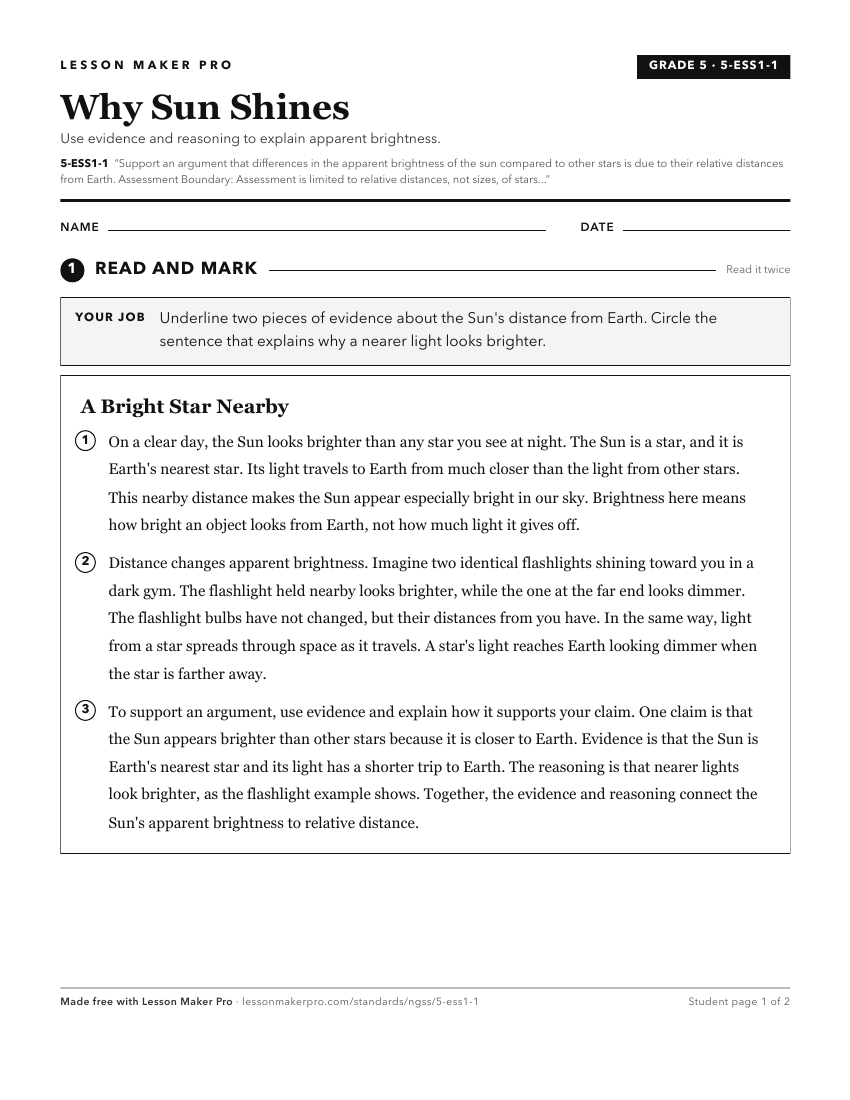
A ready-to-print activity worksheet aligned to 5-ESS1-1, with an answer key for the teacher on its own page. No account needed.
PDF, US Letter, prints cleanly in black and white.
Download the worksheetLearning progression
Where This Standard Sits
See the whole path on the Earth & Space Science progression map.
What This Unlocks
Mastery here sets students up for these next.
Keep exploring
Related Standards
- MS-PS2-4
Construct and present arguments using evidence to support the claim that gravitational interactions are attractive and depend on the masses of interacting objec...
- K-PS3-1
Make observations to determine the effect of sunlight on Earth's surface.
- 1-ESS1-1
Use observations of the sun, moon, and stars to describe patterns that can be predicted.
- 5-PS2-1
Support an argument that the gravitational force exerted by Earth on objects is directed down.
Turn this exact standard into a lesson
Grade, subject, topic, and the complete standard are prefilled. Create one free, no account needed.
Also for this standard:Make a WorksheetMake a QuizMake a Sub Lesson