NGSS 2-PS1-4
The Standard
Construct an argument with evidence that some changes caused by heating or cooling can be reversed and some cannot.
Next Generation Science Standards
Teacher's field guide
What This Standard Means
What Students Need to Do
- Students observe how materials change when warmed or cooled. They decide whether each change can be undone and use observations as evidence for their claim.
What Mastery Looks Like
- Students correctly sort examples such as melting ice, hardening butter, cooking an egg, and burning paper. They make a clear claim and support it with what happened after the material was heated or cooled again.
Common Misconceptions
- Students may think every material returns to its original form when its temperature returns to normal. They may also confuse a change in shape or state with creating a new material.
How to Assess It
- Exit ticket: Ice melts into water, and an egg cooks in a pan. Label each change reversible or irreversible, then support each answer with evidence.
Lesson moves
Ways to Teach It
Place ice and butter in sealed bags, warm them by hand, then cool them on ice and record whether each change reverses.
Ask students to write: Why can melted ice become solid again, while a cooked egg cannot become raw again?
Sort scenario cards into reversible and irreversible changes, then have partners defend one card placement using evidence.
Compare making ice pops with toasting bread, and discuss which temperature changes can be undone at home.
Free download
Printable 2-PS1-4 Worksheet
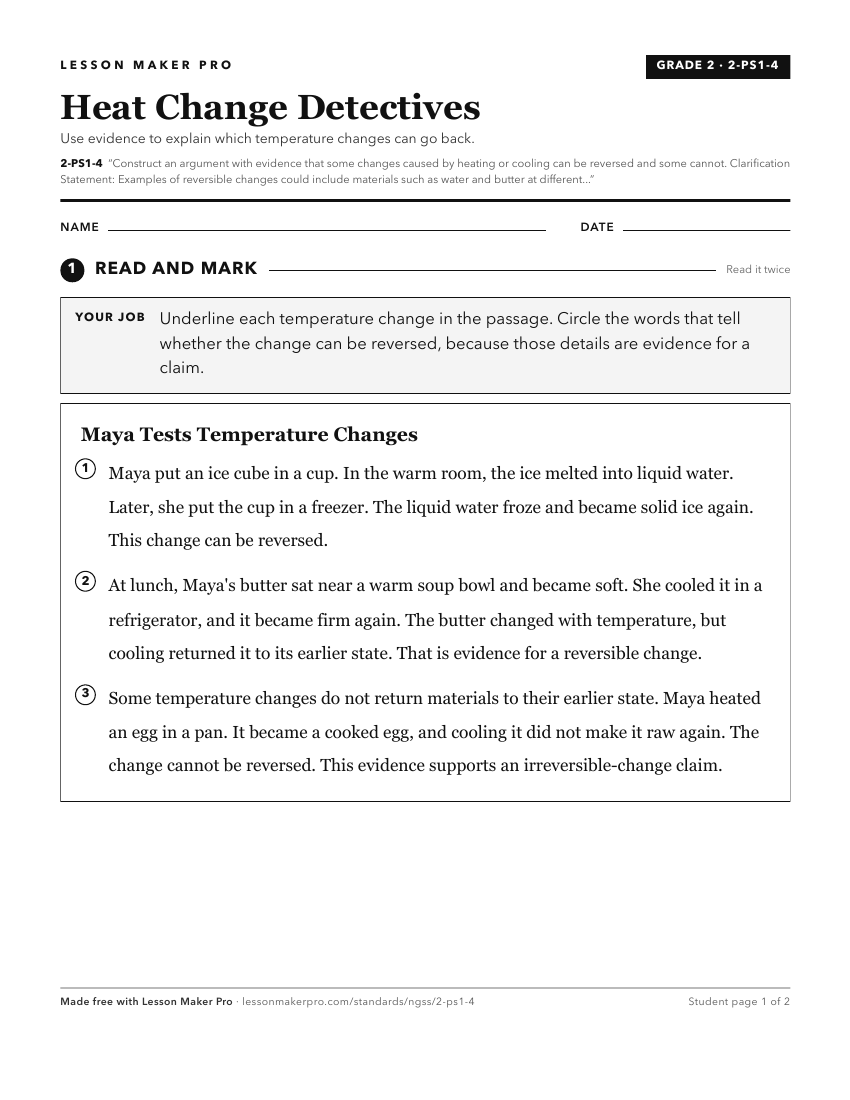
A ready-to-print activity worksheet aligned to 2-PS1-4, with an answer key for the teacher on its own page. No account needed.
PDF, US Letter, prints cleanly in black and white.
Download the worksheetKeep exploring
Related Standards
- 5-PS1-2
Measure and graph quantities to provide evidence that regardless of the type of change that occurs when heating, cooling, or mixing substances, the total weight...
- MS-LS2-4
Construct an argument supported by empirical evidence that changes to physical or biological components of an ecosystem affect populations.
- K-ESS2-2
Construct an argument supported by evidence for how plants and animals (including humans) can change the environment to meet their needs.
- 3-LS4-3
Construct an argument with evidence that in a particular habitat some organisms can survive well, some survive less well, and some cannot survive at all.
Turn this exact standard into a lesson
Grade, subject, topic, and the complete standard are prefilled. Create one free, no account needed.
Also for this standard:Make a WorksheetMake a QuizMake a Sub Lesson