CCSS.
The Standard
(+) Derive the formula A = 1/2 ab sin(C) for the area of a triangle by drawing an auxiliary line from a vertex perpendicular to the opposite side.
Common Core State Standards for Mathematics
Teacher's field guide
What This Standard Means
What Students Need to Do
- Students draw a perpendicular altitude to split a triangle into right triangles. They use sine to express the altitude from a side and the included angle, then substitute that height into the triangle area rule.
What Mastery Looks Like
- Students can choose one given side as the base, label the altitude, and write h = b sin C. They can substitute it into A = 1/2 ah and explain each step, including when the altitude falls outside an obtuse triangle.
Common Misconceptions
- Students often match the angle with the wrong side, use cosine instead of sine, or treat the slanted side as the height. They may think an obtuse triangle has no altitude because the perpendicular meets an extension of the base.
How to Assess It
- Give this exit ticket: A triangle has sides 8 cm and 11 cm enclosing a 35° angle. Draw an altitude, write a trig equation for its height, then derive and calculate the area.
Lesson moves
Ways to Teach It
Give students paper triangles, rulers, and protractors; have them draw an altitude, measure it, and compare measured and trigonometric heights.
Ask students to explain in writing why the sine of the included angle gives the ratio of altitude to side length.
Run a card sort matching triangle diagrams, altitude equations, and equivalent area expressions, including one obtuse triangle.
Have students find the area of a triangular sail from two edge lengths and their included angle, then sketch the needed altitude.
Free download
Printable HSG-SRT.D.9 Worksheet
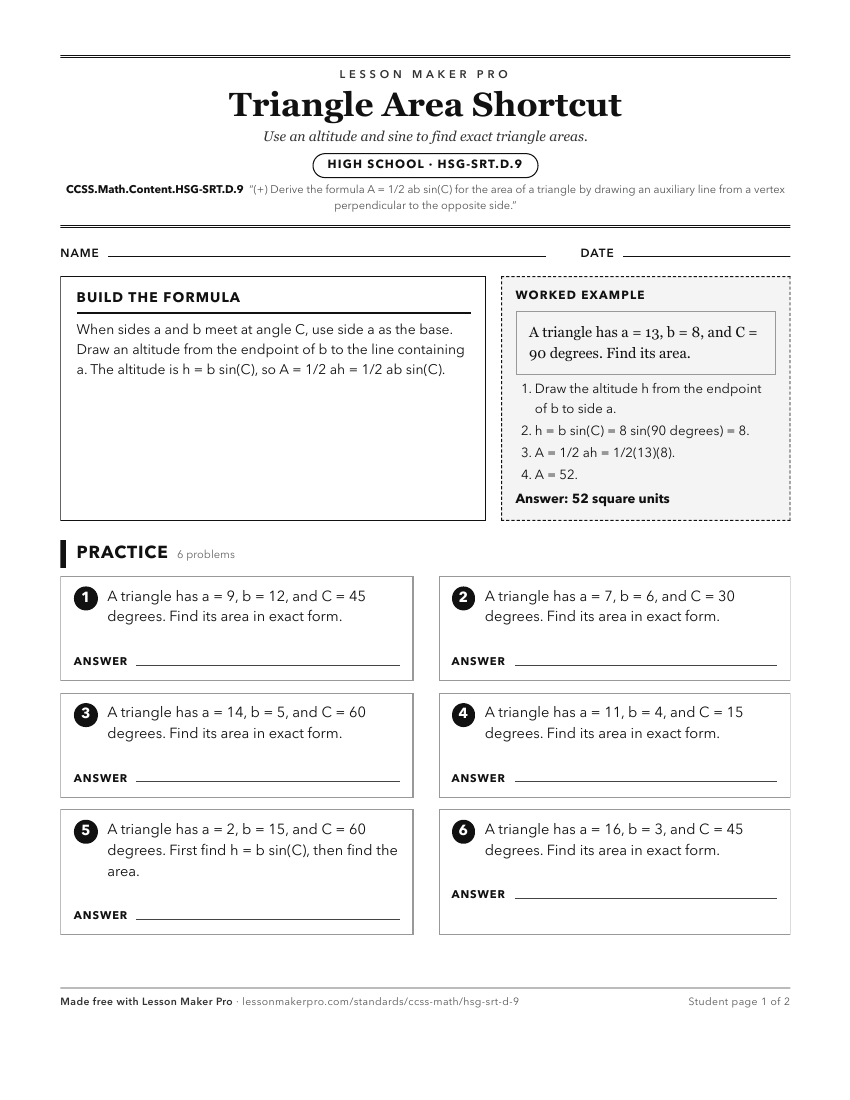
A ready-to-print activity worksheet aligned to CCSS.Math.Content.HSG-SRT.D.9, with an answer key for the teacher on its own page. No account needed.
PDF, US Letter, prints cleanly in black and white.
Download the worksheetLearning progression
Where This Standard Sits
Before This Standard
If students are struggling here, check these first.
- CCSS.Math.Content.HSG-SRT.C.6
Deriving the area formula requires using sine in the right triangle formed by the altitude to express height from a side and angle.
- CCSS.Math.Content.HSG-SRT.C.8
Deriving the area formula requires using sine in the right triangle formed by the altitude to express the height.
- CCSS.Math.Content.HSG-CO.A.1
Deriving the formula requires using a perpendicular height and angle relationships, which rely on knowing those geometric definitions.
What This Unlocks
Mastery here sets students up for these next.
Keep exploring
Related Standards
- CCSS.Math.Content.HSG-C.B.5
Derive using similarity the fact that the length of the arc intercepted by an angle is proportional to the radius, and define the radian measure of the angle as...
- CCSS.Math.Content.HSG-SRT.D
Apply trigonometry to general triangles
- CCSS.Math.Content.HSF-TF.C.9
(+) Prove the addition and subtraction formulas for sine, cosine, and tangent and use them to solve problems.
- CCSS.Math.Content.HSG-SRT.D.11
(+) Understand and apply the Law of Sines and the Law of Cosines to find unknown measurements in right and non-right triangles (e.g., surveying problems, result...
Turn this exact standard into a lesson
Grade, subject, topic, and the complete standard are prefilled. Create one free, no account needed.
Also for this standard:Make a WorksheetMake a QuizMake a Sub Lesson