CCSS.
The Standard
Use rational approximations of irrational numbers to compare the size of irrational numbers, locate them approximately on a number line diagram, and estimate the value of expressions (e.g., π²).
Common Core State Standards for Mathematics · The Number System
Teacher's field guide
What This Standard Means
What Students Need to Do
- Students trap an irrational number between rational decimal values. They use those approximations to compare numbers, place them on a number line, and estimate expressions.
What Mastery Looks Like
- A student can show 4.1 < √17 < 4.2 by comparing the squares of the endpoints with 17. They can order irrational values, place them accurately on a number line, and use approximations to estimate expressions.
Common Misconceptions
- Students may think every nonterminating decimal is irrational, forgetting that repeating decimals are rational. They may place √17 halfway between 4 and 5 without checking squares. They may also round too early when estimating an expression.
How to Assess It
- Exit ticket: Show that √17 is between 4.1 and 4.2, mark it on a number line, then estimate 3√17.
Lesson moves
Ways to Teach It
Give pairs index cards labeled with irrational numbers and decimal benchmarks, then have students place and justify them on a taped floor number line.
Ask students to explain how they could narrow the location of √10 from between 3 and 4 to within one hundredth.
Play an ordering game where teams arrange cards such as √5, 2.3, π, and √11, then earn points for correct justifications.
Estimate a circular table's area twice, using 3.14 and 3.15 for π, then describe the resulting range.
Free download
Printable 8.NS.A.2 Worksheet
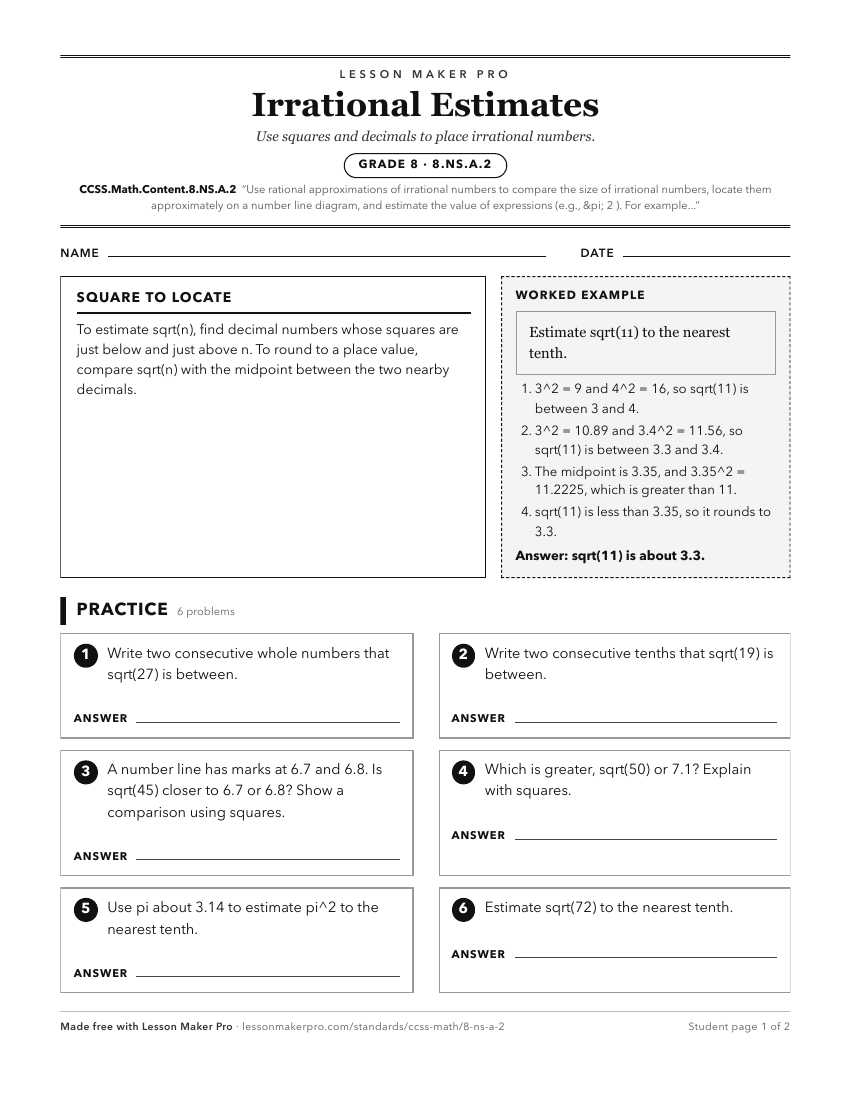
A ready-to-print activity worksheet aligned to CCSS.Math.Content.8.NS.A.2, with an answer key for the teacher on its own page. No account needed.
PDF, US Letter, prints cleanly in black and white.
Download the worksheetLearning progression
Where This Standard Sits
See the whole path on the The Number System progression map.
Before This Standard
If students are struggling here, check these first.
- CCSS.Math.Content.8.NS.A.1
Understanding irrationals and decimal expansions supports using rational decimals to approximate, compare, and place irrational numbers.
- CCSS.Math.Content.6.NS.C.7
Ordering rational numbers on a number line is needed to use decimal approximations to compare and locate irrational numbers.
- CCSS.Math.Content.6.NS.B.3
Fluent decimal operations support computing and comparing rational estimates, such as squaring 3.14 to approximate π².
Keep exploring
Related Standards
- CCSS.Math.Content.8.NS.A
Know that there are numbers that are not rational, and approximate them by rational numbers.
- CCSS.Math.Content.HSN-RN.B
Use properties of rational and irrational numbers.
- CCSS.Math.Content.6.NS.C
Apply and extend previous understandings of numbers to the system of rational numbers.
Turn this exact standard into a lesson
Grade, subject, topic, and the complete standard are prefilled. Create one free, no account needed.
Also for this standard:Make a WorksheetMake a QuizMake a Sub Lesson