CCSS.
Standard Cluster
Work with radicals and integer exponents.
Common Core State Standards for Mathematics
Cluster contents
Standards in This Cluster
CCSS.Math.Content.8.EE.A is a cluster heading. These are the individual standards under it.
- CCSS.Math.Content.8.EE.A.1
Know and apply the properties of integer exponents to generate equivalent numerical expressions.
- CCSS.Math.Content.8.EE.A.2
Use square root and cube root symbols to represent solutions to equations of the form x² = p and x³ = p, where p is a positive rational number. Evaluate square ...
- CCSS.Math.Content.8.EE.A.3
Use numbers expressed in the form of a single digit times an integer power of 10 to estimate very large or very small quantities, and to express how many times ...
- CCSS.Math.Content.8.EE.A.4
Perform operations with numbers expressed in scientific notation, including problems where both decimal and scientific notation are used. Use scientific notatio...
Teacher's field guide
What This Cluster Means
What Students Need to Do
- Students rewrite and calculate expressions using zero, negative, and other integer exponents. They find square and cube roots, identify irrational roots such as √2, and compute with scientific notation.
What Mastery Looks Like
- A student can simplify 2^3 × 2^-5 to 1/4 and name the exponent rule used. They can evaluate perfect square and cube roots, recognize that √2 is irrational, and calculate with scientific notation.
Common Misconceptions
- Students often think a^-2 means -a^2 or that a^0 equals 0. They may add exponents when raising a power to a power, or report √49 as ±7. In scientific notation, they often use the wrong sign for the power of ten.
How to Assess It
- Exit ticket: simplify 2^3 × 2^-5, evaluate √144 and ∛125, then write 0.00072 in scientific notation.
Lesson moves
Ways to Teach It
Give groups cards showing expressions and values, then have them build matching sets such as 3^-2, 1/9, √81, and 9.
Ask students to explain why a negative exponent creates a reciprocal rather than a negative value, using one numerical example.
Play exponent bingo, calling out expressions such as 5^0 or 2^3 × 2^-1 while students cover simplified values.
Use planet distances and cell sizes to compare, multiply, and divide measurements written in scientific notation.
Free download
Printable 8.EE.A Worksheet
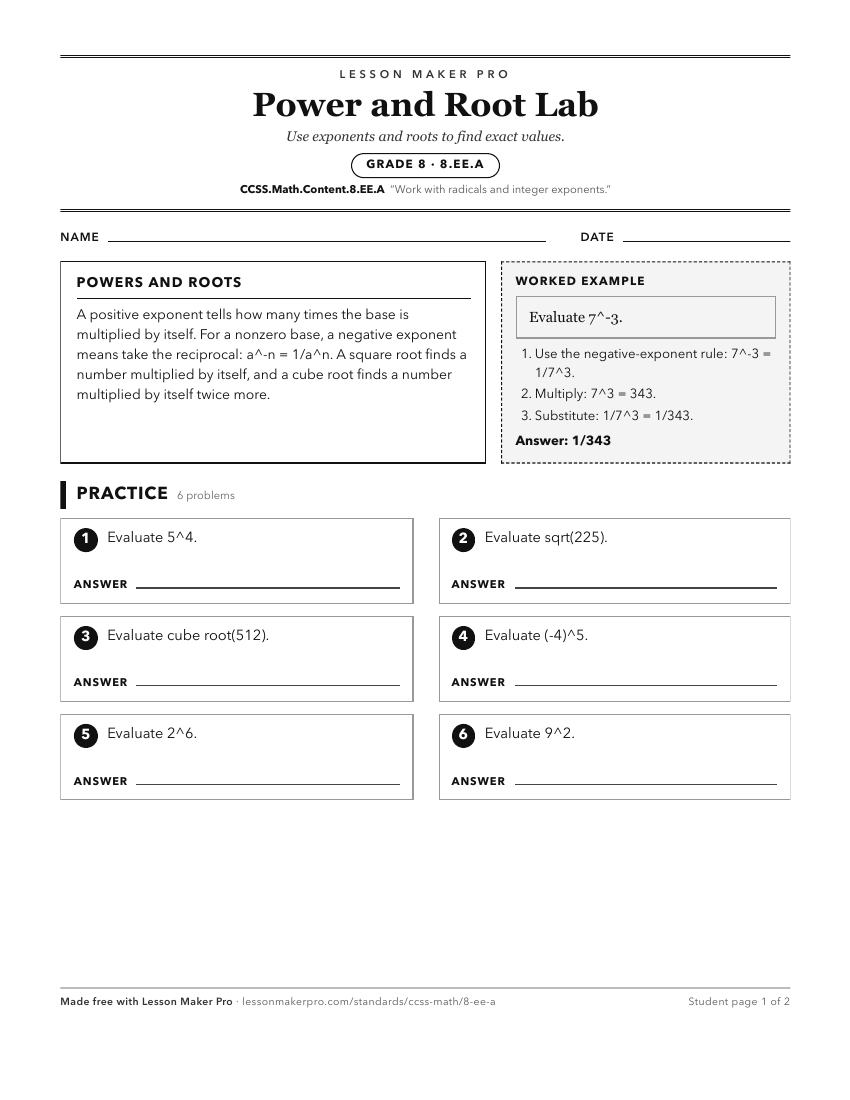
A ready-to-print activity worksheet aligned to CCSS.Math.Content.8.EE.A, with an answer key for the teacher on its own page. No account needed.
PDF, US Letter, prints cleanly in black and white.
Download the worksheetKeep exploring
Related Standards
- CCSS.Math.Content.HSN-RN.A.2
Rewrite expressions involving radicals and rational exponents using the properties of exponents.
- CCSS.Math.Content.HSN-RN.A
Extend the properties of exponents to rational exponents.
- CCSS.Math.Content.6.EE.A.1
Write and evaluate numerical expressions involving whole-number exponents.
Turn this cluster into a lesson
Grade, subject, topic, and the complete cluster are prefilled. Create one free, no account needed.
Also for this cluster:Make a WorksheetMake a QuizMake a Sub Lesson