CCSS.
Standard Cluster
Multiply and divide within 100.
Common Core State Standards for Mathematics
Cluster contents
Standards in This Cluster
CCSS.Math.Content.3.OA.C is a cluster heading. These are the individual standards under it.
Teacher's field guide
What This Cluster Means
What Students Need to Do
- Students find products and quotients for basic facts through 10 × 10. They use fact families, properties, or known facts instead of counting one by one.
What Mastery Looks Like
- Students find products and related quotients accurately and efficiently without counting each object. They can explain a strategy and check division answers with multiplication.
Common Misconceptions
- Students may switch the divisor and quotient or treat division as commutative. Some count by ones, confuse factors with products, or miss the link between related multiplication and division facts.
How to Assess It
- Give an exit ticket with 6 × 8, 54 ÷ 6, 7 × 9, and 72 ÷ 8. Ask students to use multiplication to check one division answer.
Lesson moves
Ways to Teach It
Build arrays for 24 with counters, record each multiplication equation, then write the two related division equations.
Ask, “How can knowing 7 × 6 help you solve 42 ÷ 7?” Students answer with an equation and one sentence.
Play Fact Family Match: students pair multiplication cards with related division cards, then verify each match aloud.
Give groups 48 stickers and 6 envelopes; they find how many stickers go in each envelope and write a matching equation.
Free download
Printable 3.OA.C Worksheet
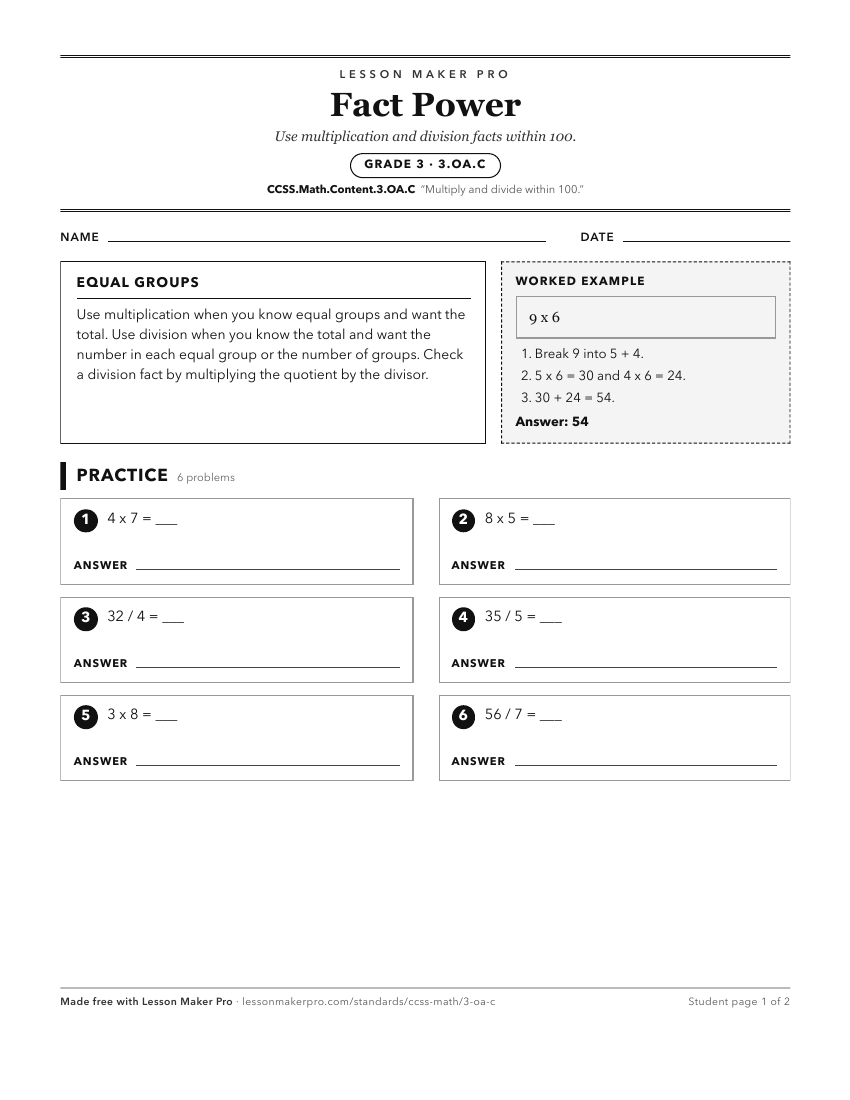
A ready-to-print activity worksheet aligned to CCSS.Math.Content.3.OA.C, with an answer key for the teacher on its own page. No account needed.
PDF, US Letter, prints cleanly in black and white.
Download the worksheetKeep exploring
Related Standards
- CCSS.Math.Content.6.NS.B.3
Fluently add, subtract, multiply, and divide multi-digit decimals using the standard algorithm for each operation.
- CCSS.Math.Content.K.CC.A.1
Count to 100 by ones and by tens.
- CCSS.Math.Content.3.OA.A.3
Use multiplication and division within 100 to solve word problems in situations involving equal groups, arrays, and measurement quantities, e.g., by using drawi...
- CCSS.Math.Content.3.NBT.A.3
Multiply one-digit whole numbers by multiples of 10 in the range 10—90 (e.g., 9 × 80, 5 × 60) using strategies based on place value and properties of operations...
Turn this cluster into a lesson
Grade, subject, topic, and the complete cluster are prefilled. Create one free, no account needed.
Also for this cluster:Make a WorksheetMake a QuizMake a Sub Lesson