CCSS.
The Standard
100 can be thought of as a bundle of ten tens — called a "hundred."
Common Core State Standards for Mathematics
Teacher's field guide
What This Standard Means
What Students Need to Do
- Students group ten sets of ten objects to make one hundred. They connect ten tens, 100 ones, and the numeral 100.
What Mastery Looks Like
- Students can build 100 using ten groups of ten objects. They can explain that ten tens and 100 ones name the same amount.
Common Misconceptions
- Students may count each group of ten as one instead of ten. They may also think 100 needs to be counted one by one rather than built from ten groups of ten.
How to Assess It
- Give students a drawing of nine ten-rods and one loose group of ten cubes. Ask, “Does this show 100? Explain how you know.”
Lesson moves
Ways to Teach It
Give pairs ten bundles of ten straws, then have them combine the bundles and label the total as 100.
Show a hundred flat and ten ten-rods, then ask students to write how both models show the same amount.
Play a matching game with cards showing ten tens, 100 ones, the numeral 100, and base-ten drawings.
Examine 100 paper clips packed in groups of ten, then explain why ten packs fill the box.
Free download
Printable 2.NBT.A.1a Worksheet
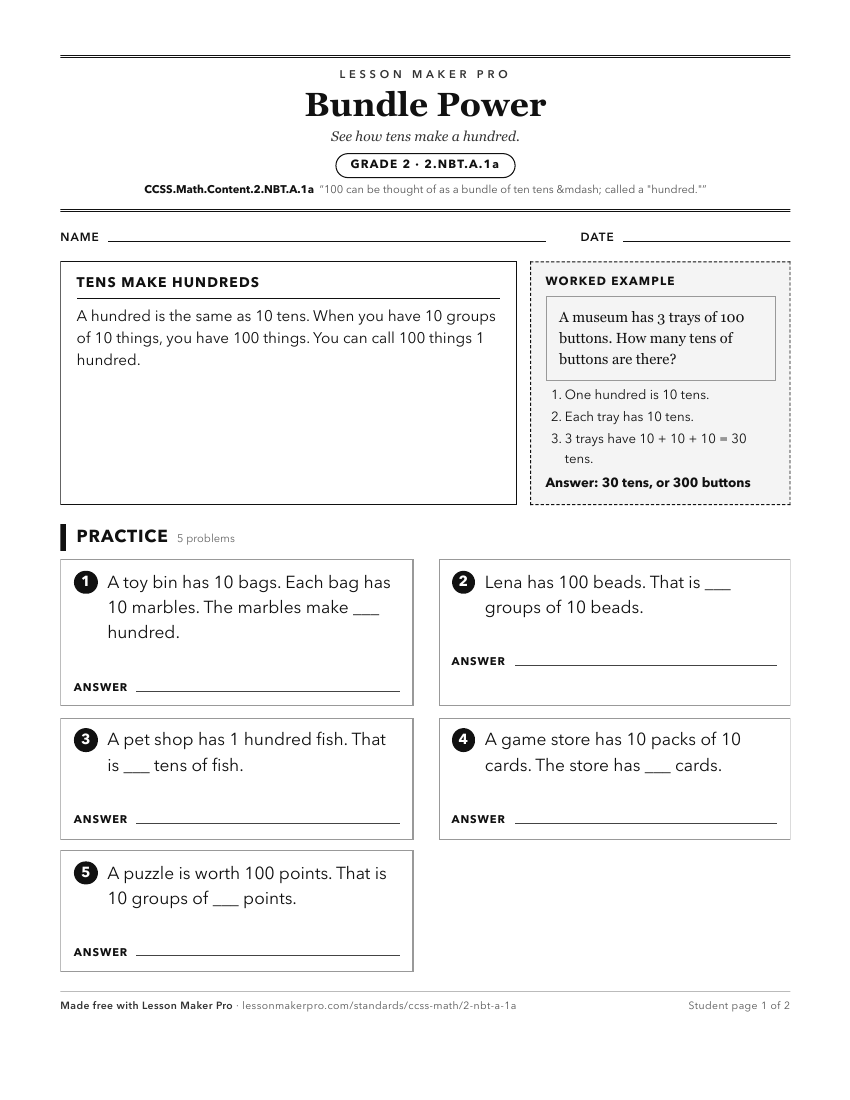
A ready-to-print activity worksheet aligned to CCSS.Math.Content.2.NBT.A.1a, with an answer key for the teacher on its own page. No account needed.
PDF, US Letter, prints cleanly in black and white.
Download the worksheetLearning progression
Where This Standard Sits
Before This Standard
If students are struggling here, check these first.
- CCSS.Math.Content.1.NBT.B.2a
Seeing ten as one unit is essential before grouping ten of those units into a hundred.
- CCSS.Math.Content.1.NBT.B.2c
Knowing decade numbers as groups of tens supports seeing ten tens as the next unit, one hundred.
- CCSS.Math.Content.K.CC.A.1
Counting by tens to 100 supports seeing ten groups of ten as one hundred.
What This Unlocks
Mastery here sets students up for these next.
- CCSS.Math.Content.2.NBT.A.1
Understanding a hundred as ten tens is needed to interpret the hundreds digit in three-digit numbers.
- CCSS.Math.Content.4.NBT.A.1
Seeing 100 as ten tens is the concrete case of the ten-times place-value relationship used with larger numbers.
- CCSS.Math.Content.2.NBT.A.1b
Students must know a hundred is ten tens before interpreting 200 through 900 as repeated hundred units with no tens or ones.
Turn this exact standard into a lesson
Grade, subject, topic, and the complete standard are prefilled. Create one free, no account needed.
Also for this standard:Make a WorksheetMake a QuizMake a Sub Lesson