CCSS.
The Standard
Draw evidence from informational texts to support analysis, reflection, and research.
Common Core State Standards for English Language Arts · Writing Standards for Literacy in History/Social Studies, Science, and Technical Subjects 6—12
Teacher's field guide
What This Standard Means
What Students Need to Do
- Students find facts, examples, and quotations that support a claim about an informational text. They connect each chosen detail to their analysis, reflection, or research question.
What Mastery Looks Like
- Students choose accurate, relevant details from one or more sources. They introduce each detail, cite its source, and explain how it supports their analysis or conclusion.
Common Misconceptions
- Students may copy long passages instead of choosing the strongest detail. They may include evidence without naming the source or explaining how it supports their point.
How to Assess It
- Give students a short article and ask: “What caused the change described in the text?” Require one claim, one quoted detail, and two explanation sentences.
Lesson moves
Ways to Teach It
Give pairs three source excerpts and claim cards, then have them match each claim to the strongest supporting detail.
Ask students to write which detail best supports an author’s conclusion and explain why it is stronger than another detail.
Play Evidence Sort by having teams label detail cards as strong, weak, irrelevant, or needing more context.
Use a school lunch survey and nutrition article to write a recommendation supported by one result and one source detail.
Free download
Printable WHST.6-8.9 Worksheet
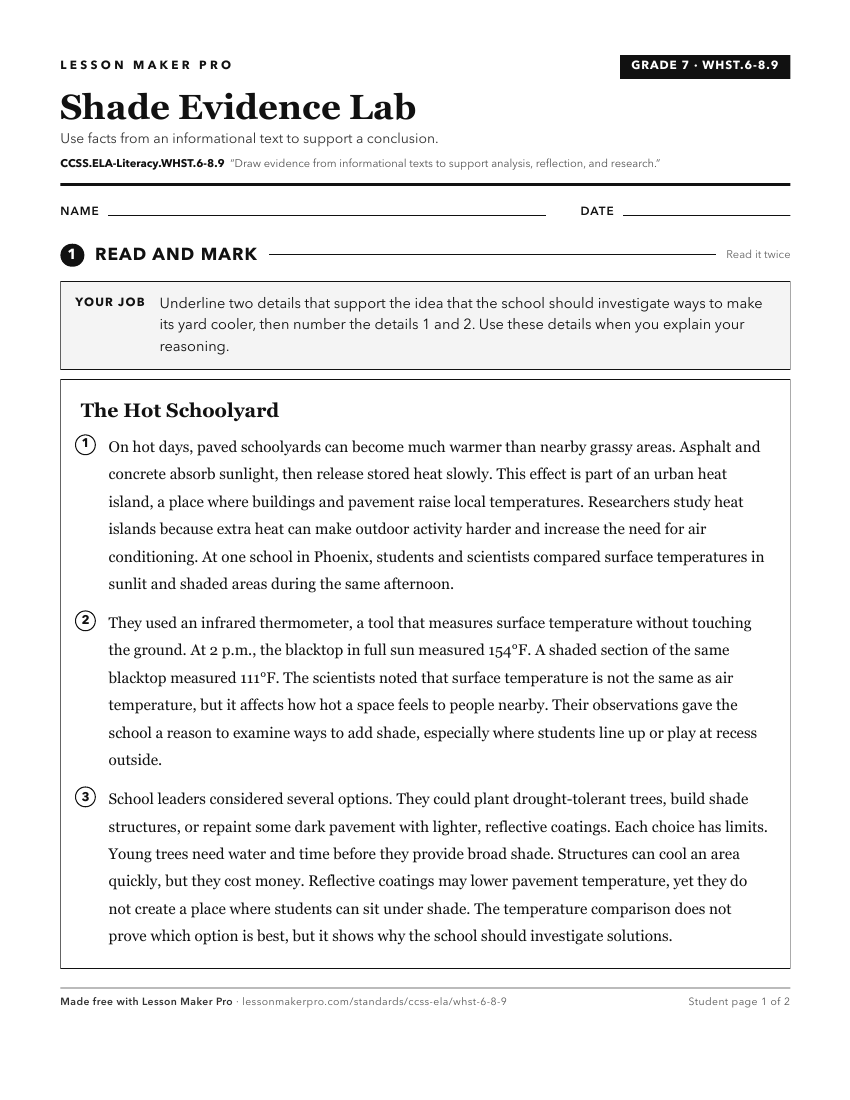
A ready-to-print activity worksheet aligned to CCSS.ELA-Literacy.WHST.6-8.9, with an answer key for the teacher on its own page. No account needed.
PDF, US Letter, prints cleanly in black and white.
Download the worksheetKeep exploring
Related Standards
- CCSS.ELA-Literacy.W.9-10.9
Draw evidence from literary or informational texts to support analysis, reflection, and research.
- CCSS.ELA-Literacy.WHST.9-10.9
The Grades 9–10 version of this standard.
- CCSS.ELA-Literacy.W.7.9
Draw evidence from literary or informational texts to support analysis, reflection, and research.
- CCSS.ELA-Literacy.WHST.11-12.9
The Grades 11–12 version of this standard.
Turn this exact standard into a lesson
Grade, subject, topic, and the complete standard are prefilled. Create one free, no account needed.
Also for this standard:Make a WorksheetMake a QuizMake a Sub Lesson