CCSS.
The Standard
Use narrative techniques, such as dialogue, pacing, description, reflection, and multiple plot lines, to develop experiences, events, and/or characters.
Common Core State Standards for English Language Arts
Teacher's field guide
What This Standard Means
What Students Need to Do
- Students develop scenes and characters by controlling what readers hear, see, and learn. They use conversation, detail, timing, character thoughts, and connected story threads for a clear purpose.
What Mastery Looks Like
- A student can build a scene with purposeful dialogue, specific details, and changes in pacing. The character’s thoughts and any secondary plot connect clearly to the main event.
Common Misconceptions
- Students may add dialogue that gives no new information or description that stalls the action. They may rush major moments, overexplain feelings, or introduce a second plot that never connects to the main story.
How to Assess It
- Give students a flat five-sentence scene and ask them to revise it with dialogue, sensory detail, and a pause for reflection. Have them underline each addition.
Lesson moves
Ways to Teach It
Give pairs a plain event paragraph, dialogue cards, sensory detail cards, and reflection cards, then have them build and read a fuller scene.
Ask students to rewrite one tense moment twice, once with fast pacing and once with slow pacing, then explain the different effects.
Play Scene Revision Relay, where teams add dialogue, description, reflection, and a connected subplot to the same short draft.
Use a news report as source material, then write a narrative scene showing the event through one witness’s words, thoughts, and observations.
Free download
Printable W.9-10.3b Worksheet
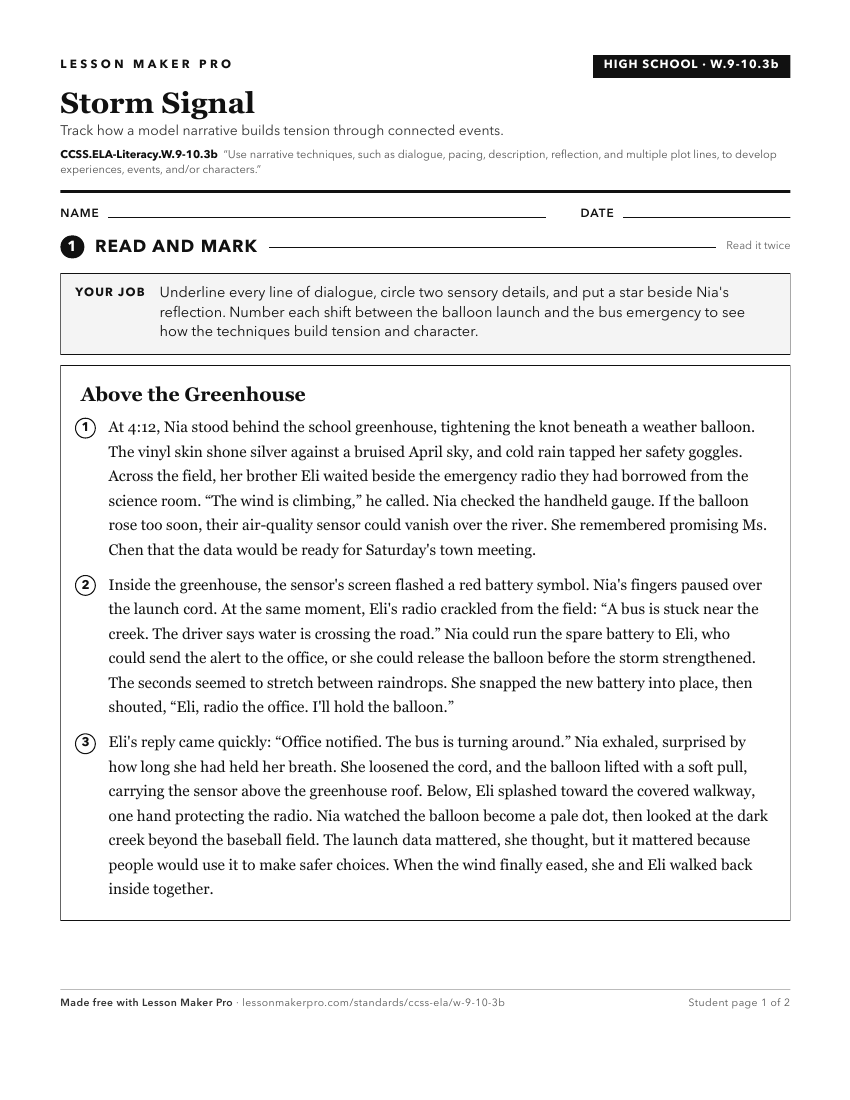
A ready-to-print activity worksheet aligned to CCSS.ELA-Literacy.W.9-10.3b, with an answer key for the teacher on its own page. No account needed.
PDF, US Letter, prints cleanly in black and white.
Download the worksheetLearning progression
Where This Standard Sits
Before This Standard
If students are struggling here, check these first.
What This Unlocks
Mastery here sets students up for these next.
Keep exploring
Related Standards
Turn this exact standard into a lesson
Grade, subject, topic, and the complete standard are prefilled. Create one free, no account needed.
Also for this standard:Make a WorksheetMake a QuizMake a Sub Lesson