CCSS.
The Standard
Provide a concluding statement or section that follows from and supports the argument presented.
Common Core State Standards for English Language Arts
Teacher's field guide
What This Standard Means
What Students Need to Do
- Students write an ending that returns to the claim and brings the main reasons together. They explain why the argument matters without adding unrelated evidence.
What Mastery Looks Like
- A student can write a final paragraph that clearly grows from the claim, reasons, and evidence. The ending synthesizes the argument and leaves the reader with a clear implication or next step.
Common Misconceptions
- Students often repeat the thesis word for word instead of bringing the ideas together. Some introduce new evidence or a new claim. Others end with a vague phrase such as “That is why I am right.”
How to Assess It
- Give students a short argument with its final paragraph removed. Ask them to write a three-sentence ending that revisits the claim, connects the reasons, and explains why the argument matters.
Lesson moves
Ways to Teach It
Give pairs a cut-up argument and three ending cards, then have them choose the best ending and label its links to reasons.
Write for three minutes: What should a reader think or do after hearing your argument, and why?
Play Conclusion Match: teams pair thesis and reason cards with conclusion cards, earning a point only when they explain each match.
Examine the final paragraph of a local editorial, then identify how it reinforces the writer's position and signals why the issue matters.
Free download
Printable W.9-10.1e Worksheet
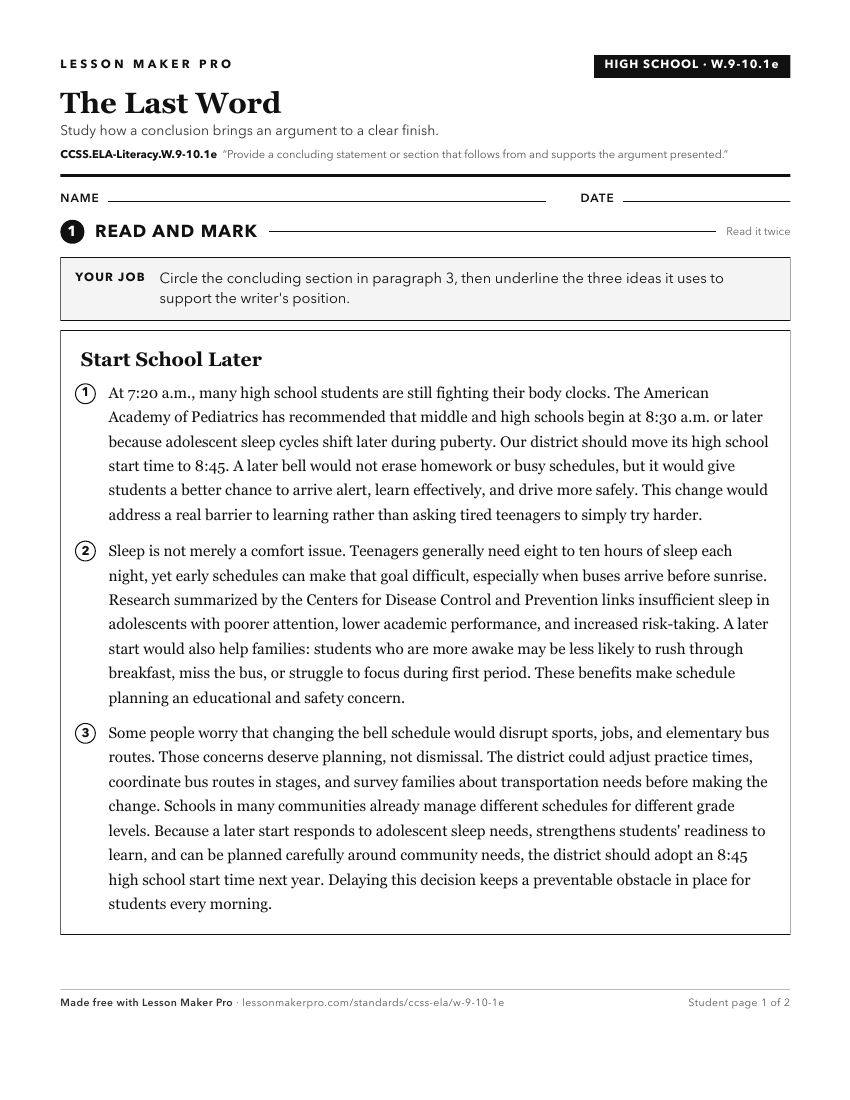
A ready-to-print activity worksheet aligned to CCSS.ELA-Literacy.W.9-10.1e, with an answer key for the teacher on its own page. No account needed.
PDF, US Letter, prints cleanly in black and white.
Download the worksheetLearning progression
Where This Standard Sits
Before This Standard
If students are struggling here, check these first.
What This Unlocks
Mastery here sets students up for these next.
Keep exploring
Related Standards
Turn this exact standard into a lesson
Grade, subject, topic, and the complete standard are prefilled. Create one free, no account needed.
Also for this standard:Make a WorksheetMake a QuizMake a Sub Lesson