CCSS.
The Standard
Provide a concluding statement or section that follows from and supports the argument presented.
Common Core State Standards for English Language Arts
Teacher's field guide
What This Standard Means
What Students Need to Do
- Students write an ending that grows from their claim, reasons, and evidence. They synthesize the argument instead of merely repeating the thesis or adding a new point.
What Mastery Looks Like
- Students can write a conclusion that reconnects the claim, reasons, and evidence in fresh language. The ending gives the reader a clear final understanding without adding an unrelated idea.
Common Misconceptions
- Students often copy the thesis word for word or summarize every paragraph. They may introduce new evidence, make an unsupported emotional appeal, or end with a vague phrase such as "That is why I am right."
How to Assess It
- Give students a short argument without an ending. Ask them to write a three-sentence conclusion that synthesizes the reasons, reinforces the claim, and adds no new evidence.
Lesson moves
Ways to Teach It
Give pairs a model essay and three cut-apart conclusions, then have them select and annotate the ending that best fits the argument.
Read two conclusions and ask: Which one follows logically from the argument, and what specific words make it fit?
Play Conclusion Repair by having teams revise weak endings that repeat the thesis, introduce new evidence, or drift from the claim.
Students write the closing paragraph for a school board letter arguing for a specific change to a school rule or program.
Free download
Printable W.11-12.1e Worksheet
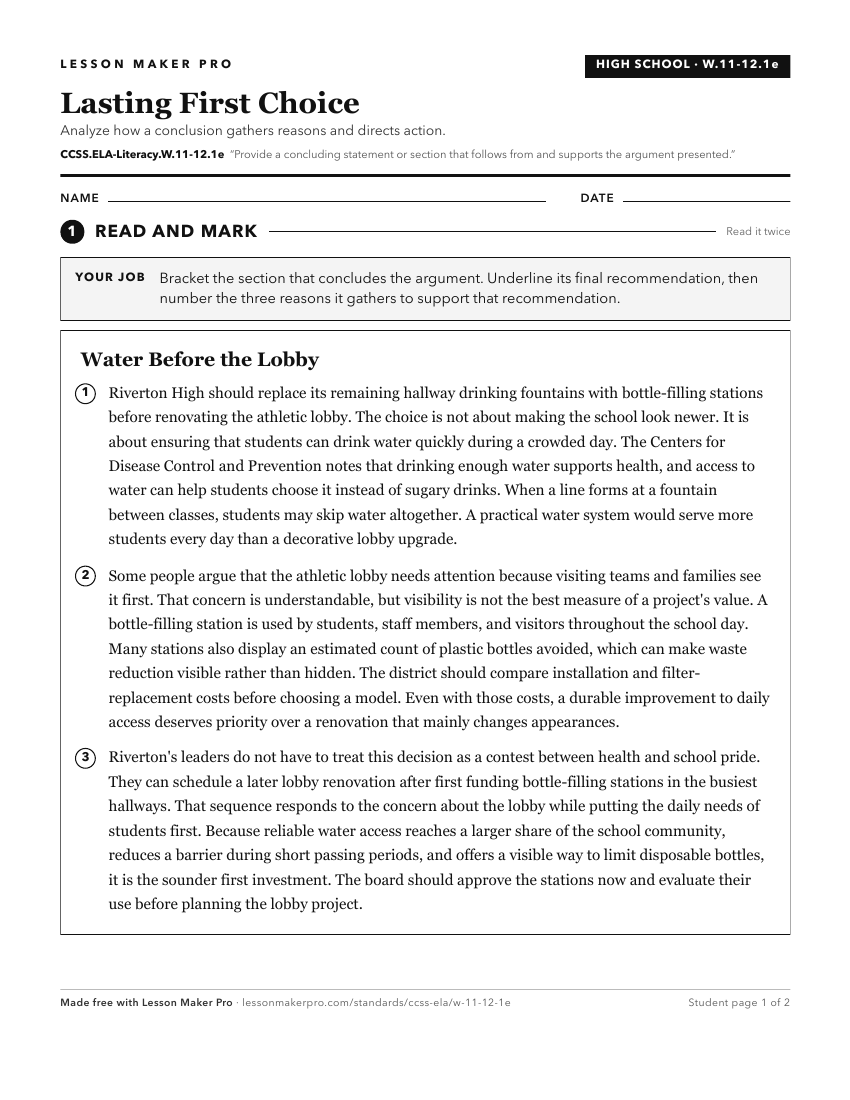
A ready-to-print activity worksheet aligned to CCSS.ELA-Literacy.W.11-12.1e, with an answer key for the teacher on its own page. No account needed.
PDF, US Letter, prints cleanly in black and white.
Download the worksheetLearning progression
Where This Standard Sits
Before This Standard
If students are struggling here, check these first.
Keep exploring
Related Standards
Turn this exact standard into a lesson
Grade, subject, topic, and the complete standard are prefilled. Create one free, no account needed.
Also for this standard:Make a WorksheetMake a QuizMake a Sub Lesson