CCSS.
The Standard
Provide a concluding statement or section that follows from or supports the argument presented.
Common Core State Standards for English Language Arts
Teacher's field guide
What This Standard Means
What Students Need to Do
- Students end an argument by connecting the final statement or section to the claim, reasons, and evidence. They close the reasoning without introducing unrelated ideas or unsupported claims.
What Mastery Looks Like
- Students write an ending that clearly matches the claim and grows from the reasons and evidence. They may explain the argument’s larger meaning, suggest a fitting action, or leave readers with a supported final thought.
Common Misconceptions
- Students often repeat the claim word for word or summarize every body paragraph. Some add new evidence, switch positions, or end with a vague phrase such as “That is why I am right.”
How to Assess It
- Give students a short argument without an ending. Ask: “Write a two-sentence conclusion that connects the claim and strongest reason without adding new evidence.”
Lesson moves
Ways to Teach It
Give groups claim, reason, evidence, and conclusion cards to sort, then replace the weakest conclusion with one that fits the argument.
Ask students to write two possible endings for the same argument, then explain which one best supports the claim and why.
Play Conclusion Match by having teams pair anonymous conclusions with argument summaries and justify each match using details from the text.
Examine the ending of a school newspaper editorial, then rewrite it for a real audience such as the principal or student council.
Free download
Printable WHST.9-10.1e Worksheet
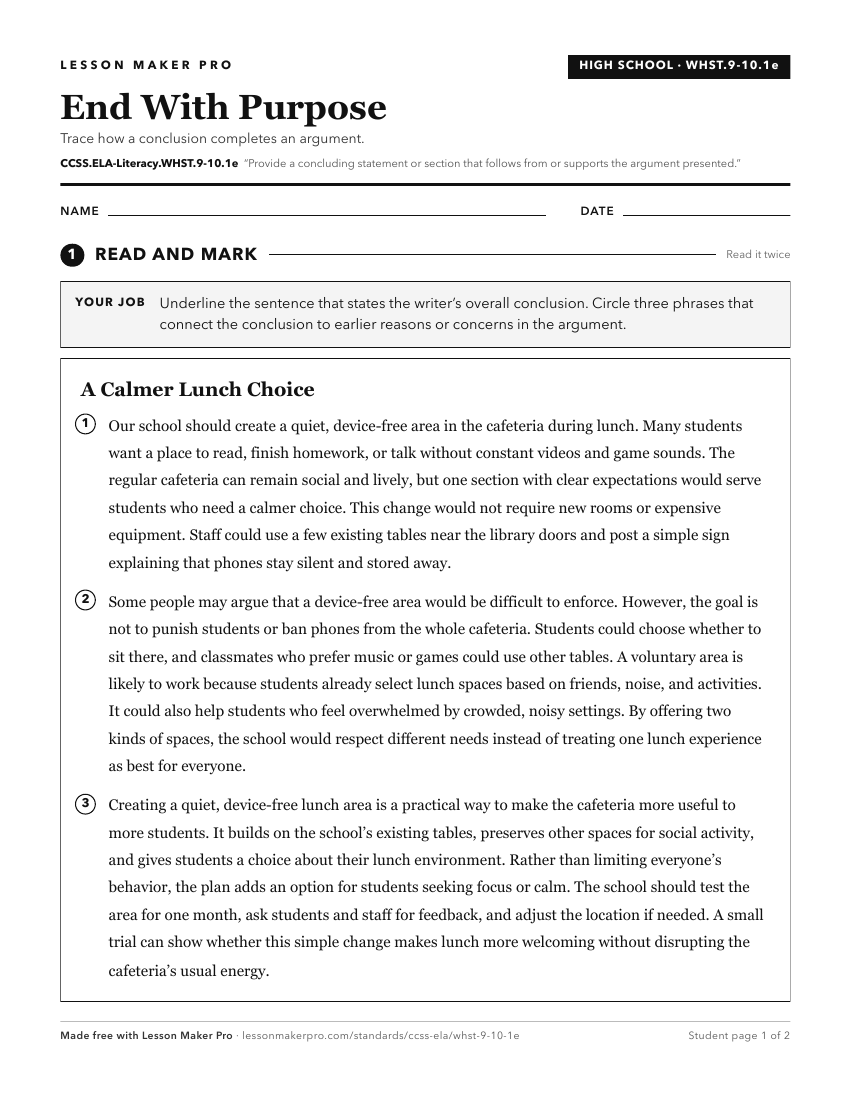
A ready-to-print activity worksheet aligned to CCSS.ELA-Literacy.WHST.9-10.1e, with an answer key for the teacher on its own page. No account needed.
PDF, US Letter, prints cleanly in black and white.
Download the worksheetLearning progression
Where This Standard Sits
What This Unlocks
Mastery here sets students up for these next.
Keep exploring
Related Standards
- CCSS.ELA-Literacy.W.8.1e
Provide a concluding statement or section that follows from and supports the argument presented.
- CCSS.ELA-Literacy.WHST.6-8.1e
The 7th Grade version of this standard.
- CCSS.ELA-Literacy.W.7.1e
Provide a concluding statement or section that follows from and supports the argument presented.
Turn this exact standard into a lesson
Grade, subject, topic, and the complete standard are prefilled. Create one free, no account needed.
Also for this standard:Make a WorksheetMake a QuizMake a Sub Lesson