CCSS.
The Standard
Provide a concluding statement or section that follows from or supports the argument presented.
Common Core State Standards for English Language Arts
Teacher's field guide
What This Standard Means
What Students Need to Do
- Students write an ending that grows directly from the claim, reasons, and evidence already presented. They bring the argument to a clear close without introducing a new topic.
What Mastery Looks Like
- Students end an argument by restating the claim in fresh words and tying together the main reasons. Their ending fits the evidence and adds no unrelated ideas.
Common Misconceptions
- Students may copy the claim word for word or add new evidence that was never explained. They may also write “In conclusion” and assume the argument is finished without connecting the main reasons.
How to Assess It
- Exit ticket: “Our school should add more outdoor seating.” Write a two-sentence ending that restates the claim and connects it to one main reason.
Lesson moves
Ways to Teach It
Give groups claim, evidence, and conclusion sentence strips; students match each conclusion to the argument it best completes.
Read two endings for the same argument, then ask: Which ending is stronger, and which words connect it to the reasons?
Play Conclusion Fix-It by giving pairs weak endings to revise without adding new evidence or copying the claim.
Students write the final paragraph for a proposal asking the principal to change one school rule or improve one shared space.
Free download
Printable WHST.6-8.1e Worksheet
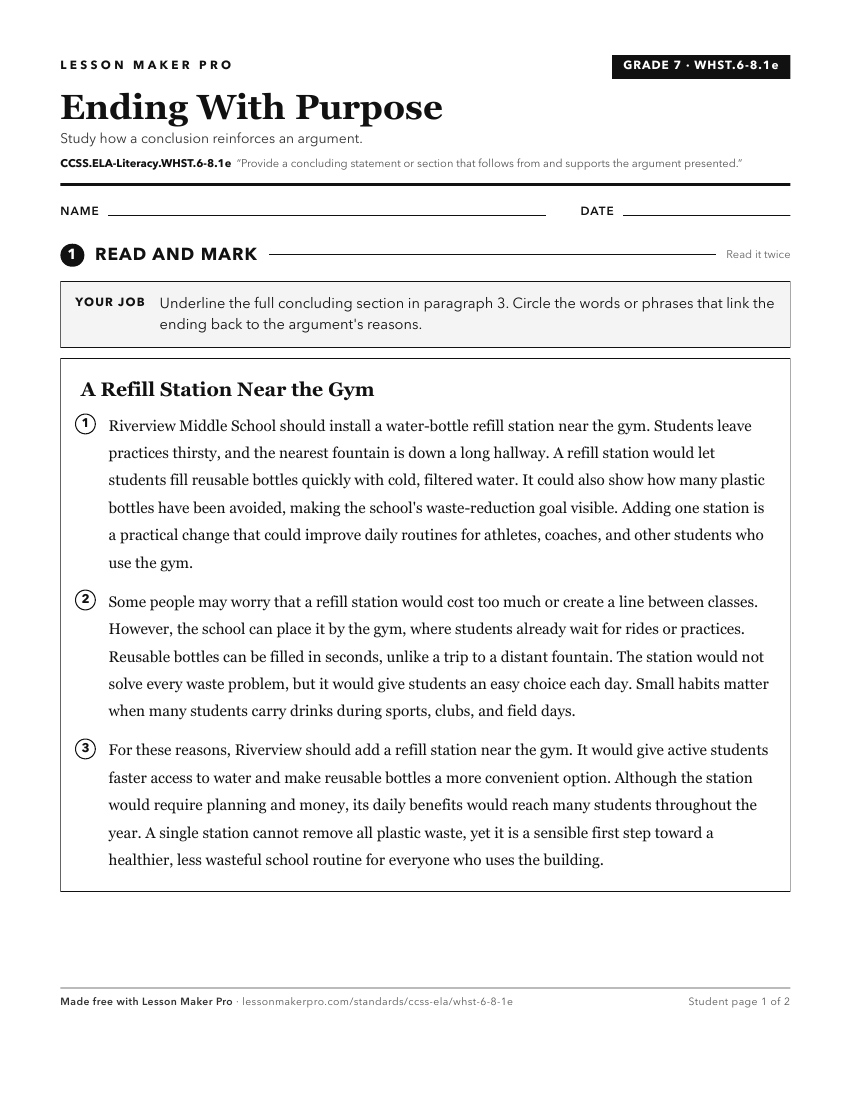
A ready-to-print activity worksheet aligned to CCSS.ELA-Literacy.WHST.6-8.1e, with an answer key for the teacher on its own page. No account needed.
PDF, US Letter, prints cleanly in black and white.
Download the worksheetKeep exploring
Related Standards
- CCSS.ELA-Literacy.W.8.1e
Provide a concluding statement or section that follows from and supports the argument presented.
- CCSS.ELA-Literacy.WHST.9-10.1e
The Grades 9–10 version of this standard.
- CCSS.ELA-Literacy.W.7.1e
Provide a concluding statement or section that follows from and supports the argument presented.
- CCSS.ELA-Literacy.WHST.11-12.1e
The Grades 11–12 version of this standard.
Turn this exact standard into a lesson
Grade, subject, topic, and the complete standard are prefilled. Create one free, no account needed.
Also for this standard:Make a WorksheetMake a QuizMake a Sub Lesson