CCSS.
The Standard
Provide a conclusion that follows from the narrated experiences or events.
Common Core State Standards for English Language Arts
Teacher's field guide
What This Standard Means
What Students Need to Do
- Students write an ending that fits the events, conflict, characters, and tone already established. They give the reader closure without adding unrelated events or explaining every detail.
What Mastery Looks Like
- The ending shows what the character decides, learns, or experiences after the main event. It matches the story’s point of view and tone, and connects to an earlier detail.
Common Misconceptions
- Students may stop with “The End” or end immediately after the main action. They may introduce a new problem, repeat the whole story, or add a moral that does not fit.
How to Assess It
- Exit ticket: Give students a short narrative with the ending removed and ask them to write a three-sentence ending that fits the conflict and tone.
Lesson moves
Ways to Teach It
Give groups mixed sentence strips from a story’s final paragraph and have them arrange, justify, and revise the ending.
Ask students to write: Which earlier detail should return in the ending, and what will it show about the character?
Play Ending Match by pairing short story openings and conflicts with several possible endings, then defending the strongest match.
Read the ending of a personal essay or memoir excerpt and identify how the writer shows why the experience mattered.
Free download
Printable W.6.3e Worksheet
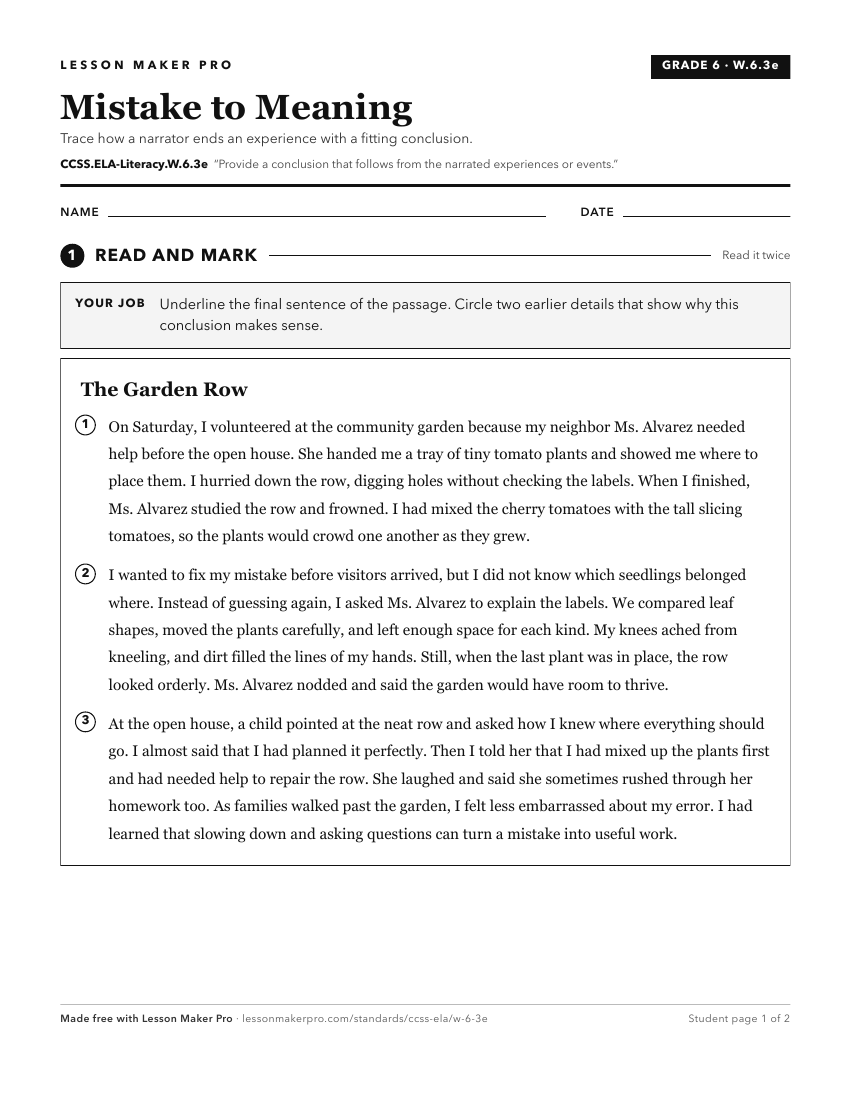
A ready-to-print activity worksheet aligned to CCSS.ELA-Literacy.W.6.3e, with an answer key for the teacher on its own page. No account needed.
PDF, US Letter, prints cleanly in black and white.
Download the worksheetLearning progression
Where This Standard Sits
Before This Standard
If students are struggling here, check these first.
What This Unlocks
Mastery here sets students up for these next.
Keep exploring
Related Standards
Turn this exact standard into a lesson
Grade, subject, topic, and the complete standard are prefilled. Create one free, no account needed.
Also for this standard:Make a WorksheetMake a QuizMake a Sub Lesson