CCSS.
The Standard
Provide a conclusion that follows from the narrated experiences or events.
Common Core State Standards for English Language Arts
Teacher's field guide
What This Standard Means
What Students Need to Do
- Students write an ending that grows naturally from the story’s events. They show what happens, changes, or is understood without adding unrelated action.
What Mastery Looks Like
- A student resolves the main problem or experience and keeps the characters’ actions believable. The final lines match the narrator, setting, and tone.
Common Misconceptions
- Students may stop immediately after the main event, leaving the reader unsure what changed. They may add a surprise character or problem that has no link to earlier events. Some endings repeat the beginning instead of resolving the experience.
How to Assess It
- Exit ticket: “Maya finally finds the missing class pet under the bookshelf just before dismissal.” Write two final sentences that resolve the experience and fit its tone.
Lesson moves
Ways to Teach It
Give pairs story-event cards and three possible ending cards, then have them sequence the events and choose the ending that fits best.
After reading a class story, ask, “What should the character do next, and which earlier event makes that choice believable?”
Play Ending Match: teams pair five short story summaries with five endings, then earn a point by explaining each match.
Students write the final two sentences of a true classroom event, such as a science experiment, field trip, or team challenge.
Free download
Printable W.4.3e Worksheet
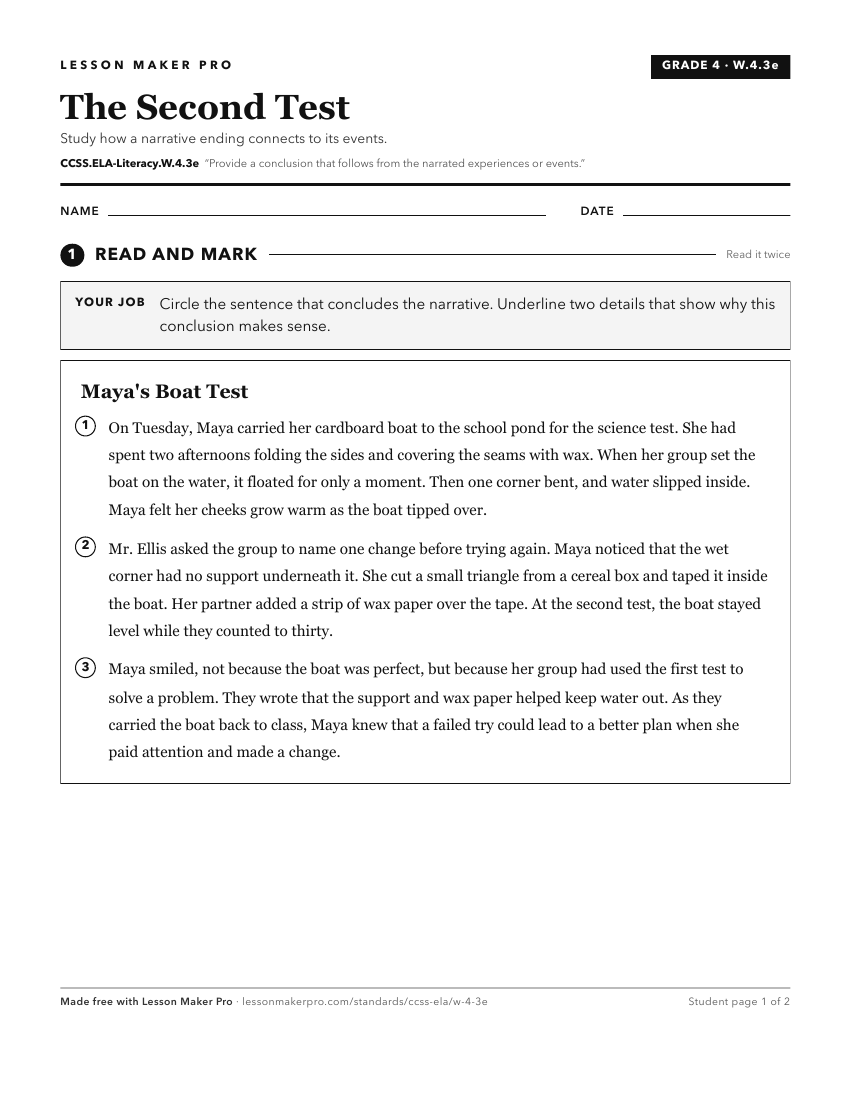
A ready-to-print activity worksheet aligned to CCSS.ELA-Literacy.W.4.3e, with an answer key for the teacher on its own page. No account needed.
PDF, US Letter, prints cleanly in black and white.
Download the worksheetLearning progression
Where This Standard Sits
What This Unlocks
Mastery here sets students up for these next.
Keep exploring
Related Standards
Turn this exact standard into a lesson
Grade, subject, topic, and the complete standard are prefilled. Create one free, no account needed.
Also for this standard:Make a WorksheetMake a QuizMake a Sub Lesson