CCSS.
The Standard
Provide a conclusion that follows from the narrated experiences or events.
Common Core State Standards for English Language Arts
Teacher's field guide
What This Standard Means
What Students Need to Do
- Students write a conclusion that makes sense after the events in a narrative. They close the main situation and show what happened, changed, or was learned.
What Mastery Looks Like
- A student writes an ending that grows naturally from the events and resolves the main situation. The conclusion may show a result, reflection, lesson, or change without introducing an unrelated problem.
Common Misconceptions
- Students may add a sudden new event, end with “The End,” or repeat the opening without resolving the story. They may also write a conclusion that does not match the narrator’s experiences or the event sequence.
How to Assess It
- Give students a short narrative with the final paragraph removed. Ask them to write a two-sentence conclusion that resolves the main event and shows its effect on the narrator.
Lesson moves
Ways to Teach It
Give pairs event cards from a short story, then have them arrange the cards and write an ending that fits the sequence.
Ask students to explain in three sentences how the final event changed the narrator’s thoughts, feelings, or actions.
Play Ending Match by pairing short narratives with several conclusions and having teams defend the best fit using story details.
Read the ending of a personal blog post, then write a conclusion for a true classroom experience using a result or reflection.
Free download
Printable W.5.3e Worksheet
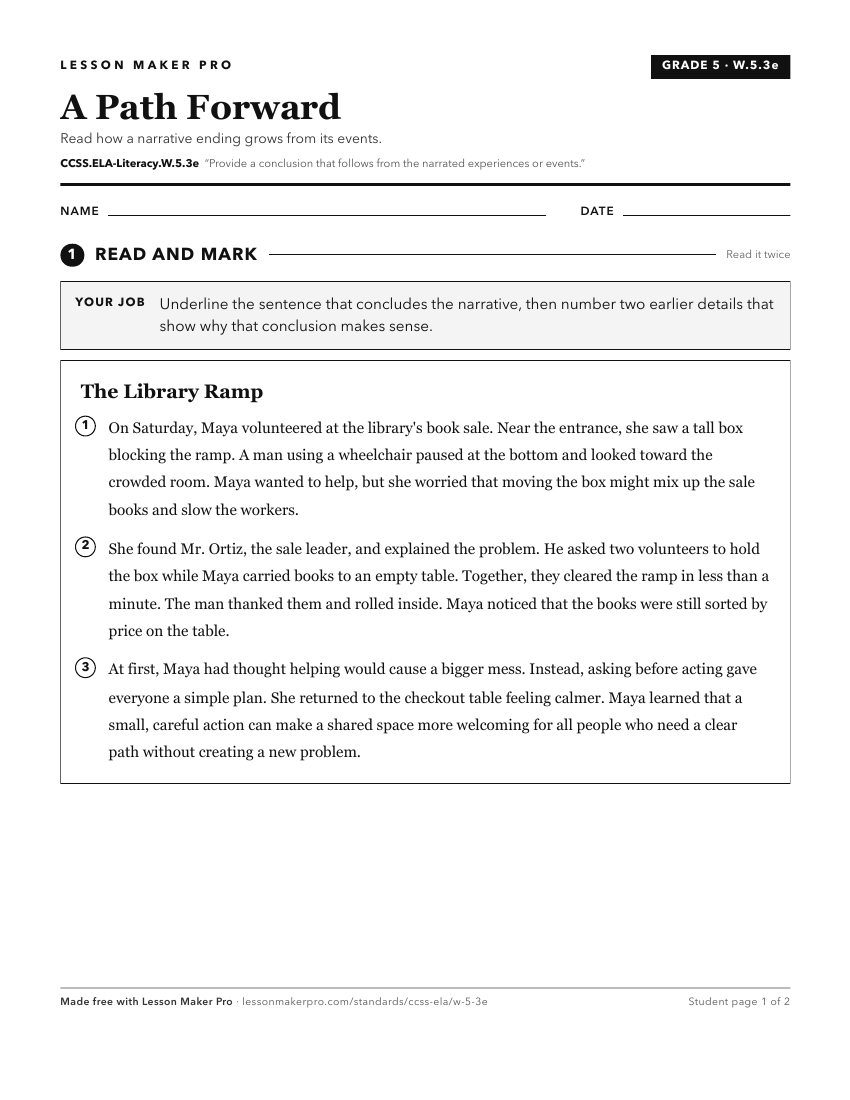
A ready-to-print activity worksheet aligned to CCSS.ELA-Literacy.W.5.3e, with an answer key for the teacher on its own page. No account needed.
PDF, US Letter, prints cleanly in black and white.
Download the worksheetLearning progression
Where This Standard Sits
Before This Standard
If students are struggling here, check these first.
What This Unlocks
Mastery here sets students up for these next.
Keep exploring
Related Standards
Turn this exact standard into a lesson
Grade, subject, topic, and the complete standard are prefilled. Create one free, no account needed.
Also for this standard:Make a WorksheetMake a QuizMake a Sub Lesson