CCSS.
The Standard
Apply grade 4 Reading standards to informational texts (e.g., "Explain how an author uses reasons and evidence to support particular points in a text").
Common Core State Standards for English Language Arts
Teacher's field guide
What This Standard Means
What Students Need to Do
- Students identify an author's main points in an informational text. They write about each point using relevant facts, examples, or quotations and explain the connection.
What Mastery Looks Like
- Given a short article, a student can state one point accurately and select strong supporting details. The student explains how each detail supports the point instead of merely copying it.
Common Misconceptions
- Students may confuse the topic with the author's point. They may choose an interesting fact that does not support the point, or copy a sentence without explaining its relevance. Some treat their own opinion as textual evidence.
How to Assess It
- Give students a one-page article and ask, "What point does the author make? Use two details and explain how each supports that point."
Lesson moves
Ways to Teach It
Give pairs an article and mixed sentence strips, then have them sort strips into author's point, supporting evidence, and unrelated details.
After reading a paragraph, ask students to write which detail best supports the author's point and why, then compare answers.
Play Evidence Match: teams pair point cards with evidence cards, earning a point only when they explain the match.
Examine a school lunch flyer, identify its main claim, and write how two facts are used to persuade families.
Free download
Printable W.4.9b Worksheet
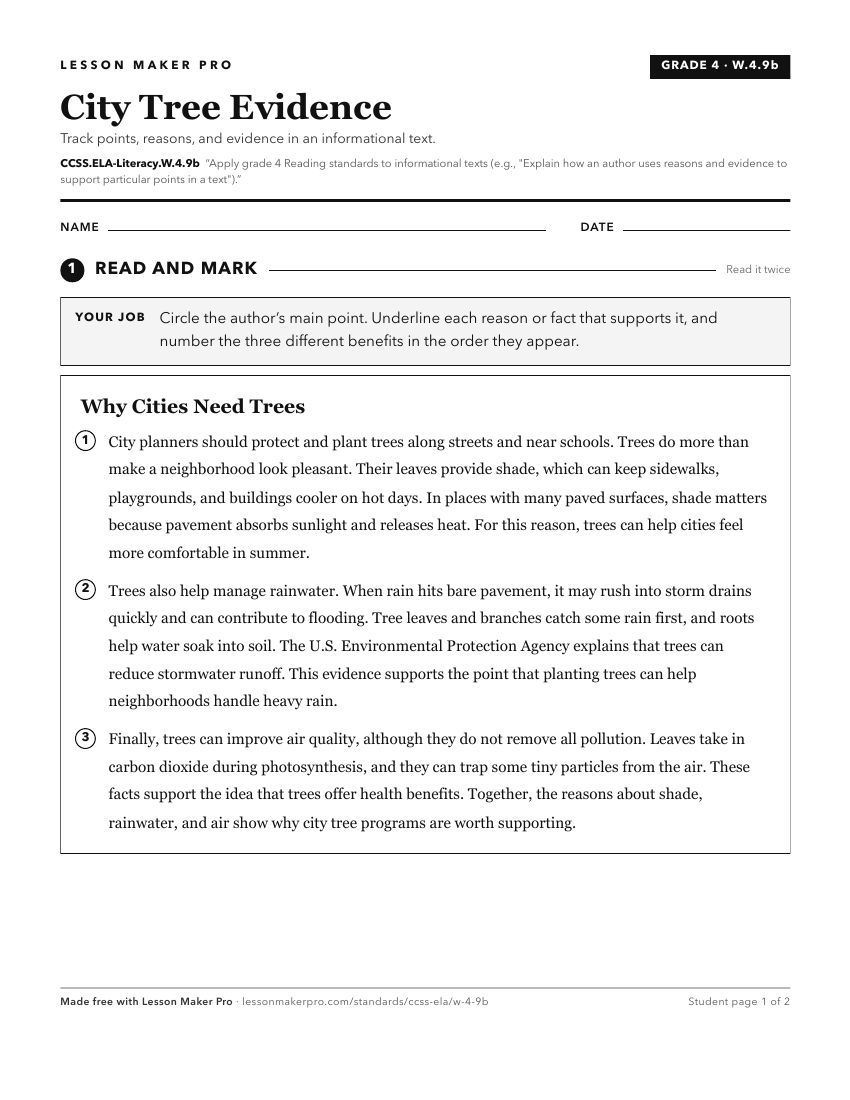
A ready-to-print activity worksheet aligned to CCSS.ELA-Literacy.W.4.9b, with an answer key for the teacher on its own page. No account needed.
PDF, US Letter, prints cleanly in black and white.
Download the worksheetLearning progression
Where This Standard Sits
What This Unlocks
Mastery here sets students up for these next.
Keep exploring
Related Standards
- CCSS.ELA-Literacy.W.4.9a
Apply grade 4 Reading standards to literature (e.g., "Describe in depth a character, setting, or event in a story or drama, drawing on specific details in the t...
- CCSS.ELA-Literacy.W.7.9b
Apply grade 7 Reading standards to literary nonfiction (e.g. "Trace and evaluate the argument and specific claims in a text, assessing whether the reasoning is ...
- CCSS.ELA-Literacy.W.6.9b
Apply grade 6 Reading standards to literary nonfiction (e.g., "Trace and evaluate the argument and specific claims in a text, distinguishing claims that are sup...
Turn this exact standard into a lesson
Grade, subject, topic, and the complete standard are prefilled. Create one free, no account needed.
Also for this standard:Make a WorksheetMake a QuizMake a Sub Lesson