CCSS.
Standard Cluster
Write narratives to develop real or imagined experiences or events using effective technique, well-chosen details, and well-structured event sequences.
Common Core State Standards for English Language Arts · Writing Standards
Cluster contents
Standards in This Cluster
CCSS.ELA-Literacy.W.11-12.3 is a cluster heading. These are the individual standards under it.
- CCSS.ELA-Literacy.W.11-12.3a
Engage and orient the reader by setting out a problem, situation, or observation and its significance, establishing one or multiple point(s) of view, and introd...
- CCSS.ELA-Literacy.W.11-12.3b
Use narrative techniques, such as dialogue, pacing, description, reflection, and multiple plot lines, to develop experiences, events, and/or characters.
- CCSS.ELA-Literacy.W.11-12.3c
Use a variety of techniques to sequence events so that they build on one another to create a coherent whole and build toward a particular tone and outcome (e.g....
- CCSS.ELA-Literacy.W.11-12.3d
Use precise words and phrases, telling details, and sensory language to convey a vivid picture of the experiences, events, setting, and/or characters.
- CCSS.ELA-Literacy.W.11-12.3e
Provide a conclusion that follows from and reflects on what is experienced, observed, or resolved over the course of the narrative.
Teacher's field guide
What This Cluster Means
What Students Need to Do
- Students shape a real or invented experience into a focused narrative with a clear sequence and point of view. They use pacing, dialogue, description, reflection, and selected details to create meaning.
What Mastery Looks Like
- A strong writer establishes a clear viewpoint and orders events to build tension, change, or insight. The writer controls pacing and uses dialogue, description, reflection, and precise details for a clear purpose.
Common Misconceptions
- Students often treat a narrative as a list of events rather than a shaped story. They may add dialogue or sensory details that do not develop character, conflict, mood, or meaning.
How to Assess It
- Exit ticket: Write a 150-word scene about a difficult choice. Include a clear viewpoint, one line of dialogue, two purposeful details, and a turning point.
Adopted as
This framework is adopted as written in Connecticut, Delaware, District of Columbia, Michigan, Nevada, New Hampshire, Vermont, Wyoming.
- California: W_11-12_3
- Connecticut: CCSS.ELA-Literacy.W.11-12.3
- Delaware: CC11-12W3
- District of Columbia: CCSS.ELA-Literacy.W.11-12.3
- Maryland: W_11-12_3
- Maryland: W_11-12_3_a
- Michigan: CCSS.ELA-Literacy.W.11-12.3
- Montana: CCSS.ELA-Literacy.W.11-12.3
- Nevada: CCSS.ELA-Literacy.W.11-12.3
- New Hampshire: CCSS.ELA-Literacy.W.11-12.3
- New Mexico: CCSS.ELA-Literacy.W.11-12.3
- New York: 11-12W3
State teaching guidance: Across grades 11–12 writing, teach planning, revision and strengthening of texts independently and collaboratively, for varied purposes using print and digital tools. Students should move between conversational and academic registers, show mastery of academic conventions and demonstrate proficient keyboarding. (Grade guidance, p. 111.) Use the complete NY 11-12W3 family: NY’s narrative components distribute introduction, significance and smooth progression differently and call for explicit details. The matching parent lead statement does not make all national components interchangeable. (NY family, p. 112.) New York State Next Generation English Language Arts Learning Standards (2017), page 111. Check shared national resources against this guidance before use.
- Vermont: CCSS.ELA-Literacy.W.11-12.3
- Washington: CCSS.ELA-Literacy.W.11-12.3
- Wyoming: CCSS.ELA-Literacy.W.11-12.3
Lesson moves
Ways to Teach It
Give pairs printed scene cards to arrange, then have them add or remove one card to improve pacing.
Discuss which details in a short mentor text reveal character, then explain why the writer included each one.
Play a revision challenge where students draw technique cards and improve a flat paragraph using dialogue, pacing, description, or reflection.
Turn a school event, job shift, or team practice into a narrative that shows why the moment mattered.
Free download
Printable W.11-12.3 Worksheet
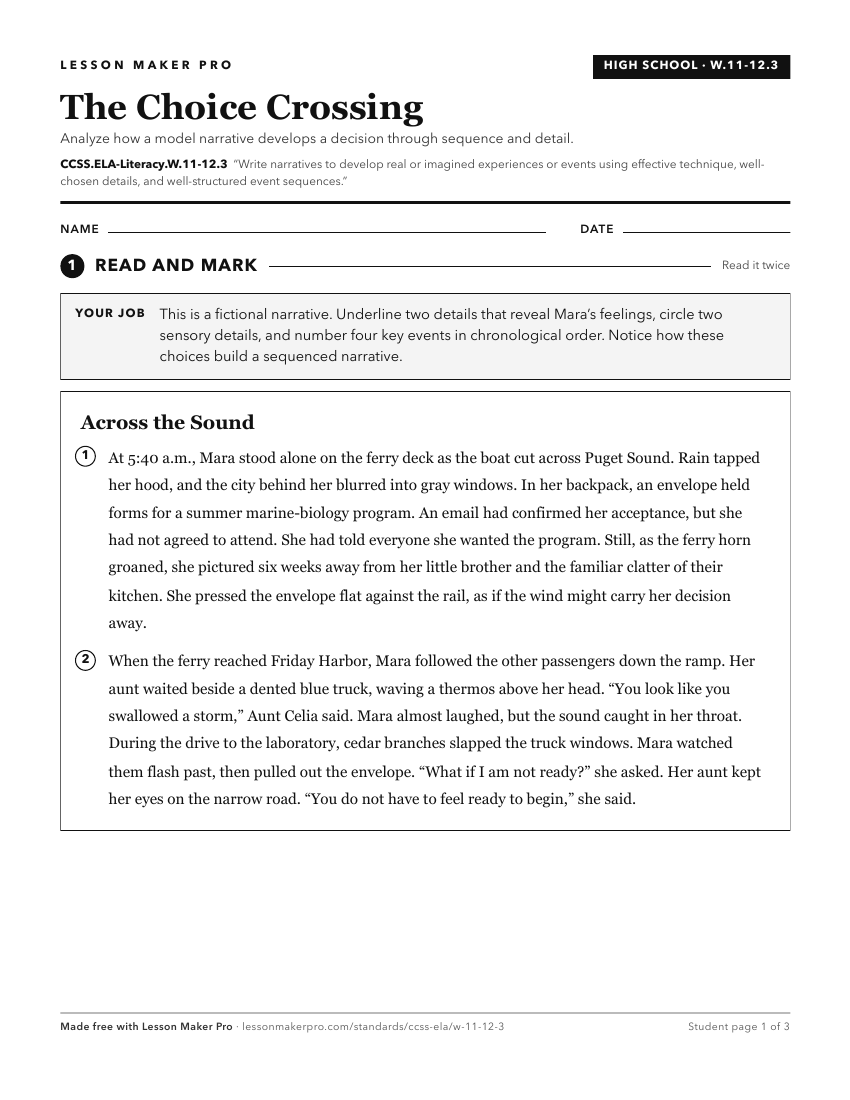
A ready-to-print activity worksheet aligned to CCSS.ELA-Literacy.W.11-12.3, with an answer key for the teacher on its own page. No account needed.
PDF, US Letter, prints cleanly in black and white.
Download the worksheetBefore This Standard
If students are struggling here, check these first.
Keep exploring
Related Standards
- CCSS.ELA-Literacy.CCRA.W.3
Write narratives to develop real or imagined experiences or events using effective technique, well-chosen details, and well-structured event sequences.
- CCSS.ELA-Literacy.W.8.3
Write narratives to develop real or imagined experiences or events using effective technique, relevant descriptive details, and well-structured event sequences.
- CCSS.ELA-Literacy.W.6.3
Write narratives to develop real or imagined experiences or events using effective technique, relevant descriptive details, and well-structured event sequences.
Turn this cluster into a lesson
Grade, subject, topic, and the complete cluster are prefilled. Create one free, no account needed.
Also for this cluster:Make a WorksheetMake a QuizMake a Sub Lesson