CCSS.
Standard Cluster
Write narratives to develop real or imagined experiences or events using effective technique, relevant descriptive details, and well-structured event sequences.
Common Core State Standards for English Language Arts · Writing Standards
Cluster contents
Standards in This Cluster
CCSS.ELA-Literacy.W.6.3 is a cluster heading. These are the individual standards under it.
- CCSS.ELA-Literacy.W.6.3a
Engage and orient the reader by establishing a context and introducing a narrator and/or characters; organize an event sequence that unfolds naturally and logic...
- CCSS.ELA-Literacy.W.6.3b
Use narrative techniques, such as dialogue, pacing, and description, to develop experiences, events, and/or characters.
- CCSS.ELA-Literacy.W.6.3c
Use a variety of transition words, phrases, and clauses to convey sequence and signal shifts from one time frame or setting to another.
- CCSS.ELA-Literacy.W.6.3d
Use precise words and phrases, relevant descriptive details, and sensory language to convey experiences and events.
- CCSS.ELA-Literacy.W.6.3e
Provide a conclusion that follows from the narrated experiences or events.
Teacher's field guide
What This Cluster Means
What Students Need to Do
- Students write real or imagined stories with a clear beginning, rising action, turning point, and ending. They use dialogue, pacing, description, and transitions to develop events and characters.
What Mastery Looks Like
- The reader can follow the events and understand the setting, characters, conflict, and outcome. Dialogue, pacing, and description build the experience rather than distract from it.
Common Misconceptions
- Students may list events without building a clear conflict or turning point. They may add dialogue that does not move the story forward, shift verb tense, or include details unrelated to the scene.
How to Assess It
- Give students this exit ticket: Write one paragraph about a character who loses something, using clear event order, dialogue, and two sensory details.
Adopted as
This framework is adopted as written in Connecticut, Delaware, District of Columbia, Michigan, Nevada, New Hampshire, Vermont, Wyoming.
- California: W_6_3
- Connecticut: CCSS.ELA-Literacy.W.6.3
- Delaware: CC6W3
- District of Columbia: CCSS.ELA-Literacy.W.6.3
- Maryland: W_6_3
- Michigan: CCSS.ELA-Literacy.W.6.3
- Montana: CCSS.ELA-Literacy.W.6.3
- Nevada: CCSS.ELA-Literacy.W.6.3
- New Hampshire: CCSS.ELA-Literacy.W.6.3
- New Mexico: CCSS.ELA-Literacy.W.6.3
- Vermont: CCSS.ELA-Literacy.W.6.3
- Washington: CCSS.ELA-Literacy.W.6.3
- Wyoming: CCSS.ELA-Literacy.W.6.3
Lesson moves
Ways to Teach It
Give groups mixed-up story cards, then have them arrange the events and explain where the conflict, turning point, and resolution belong.
Ask students to write about a time when a small choice caused an unexpected result, including what happened before, during, and after.
Play a revision relay where teams improve a plain paragraph by adding dialogue, sensory details, transitions, and consistent verb tense.
Have students turn a family story, school event, or local news item into a narrative told from one person's point of view.
Free download
Printable W.6.3 Worksheet
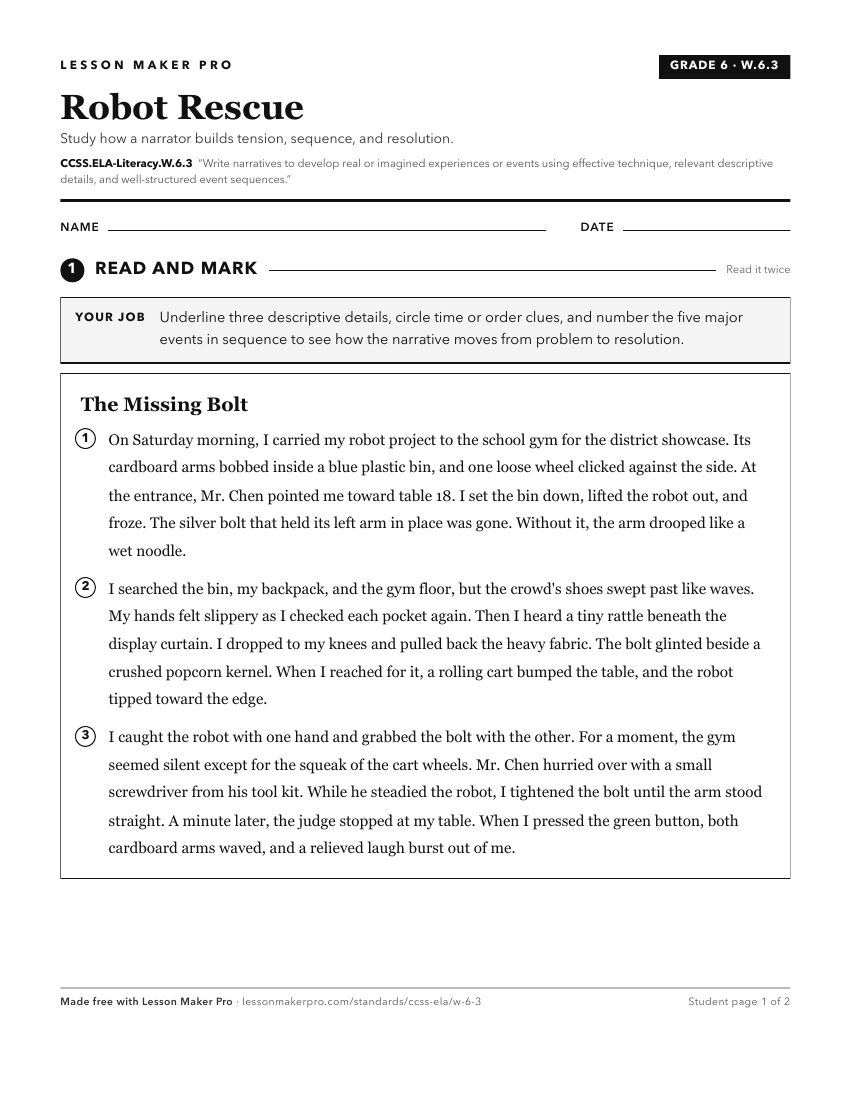
A ready-to-print activity worksheet aligned to CCSS.ELA-Literacy.W.6.3, with an answer key for the teacher on its own page. No account needed.
PDF, US Letter, prints cleanly in black and white.
Download the worksheetBefore This Standard
If students are struggling here, check these first.
What This Unlocks
Mastery here sets students up for these next.
Keep exploring
Related Standards
Turn this cluster into a lesson
Grade, subject, topic, and the complete cluster are prefilled. Create one free, no account needed.
Also for this cluster:Make a WorksheetMake a QuizMake a Sub Lesson