CCSS.
The Standard
Evaluate a speaker's point of view, reasoning, and use of evidence and rhetoric, identifying any fallacious reasoning or exaggerated or distorted evidence.
Common Core State Standards for English Language Arts · Speaking and Listening Standards
Teacher's field guide
What This Standard Means
What Students Need to Do
- Students listen closely to a speech or presentation and identify the speaker’s claim, perspective, reasons, evidence, and persuasive choices. They judge whether the argument is sound and flag weak logic, overstatement, or misleading evidence.
What Mastery Looks Like
- A student can explain how a speaker’s perspective shapes the message and trace each claim to its support. The student can name a specific fallacy or distortion, cite the speaker’s words, and explain its effect.
Common Misconceptions
- Students may treat disagreement with the speaker as proof that the reasoning is flawed. They may label any emotional appeal a fallacy, accept statistics without checking context, or notice exaggeration without explaining why it weakens the claim.
How to Assess It
- Play a one-minute campaign speech or advertisement. Ask students to write the main claim, judge one reason or piece of evidence, and quote one misleading or persuasive choice.
Lesson moves
Ways to Teach It
Give groups printed speech excerpts to cut apart and sort into claim, reason, evidence, rhetoric, and fallacy piles.
After a short speech, ask: How does the speaker’s perspective shape what is included, emphasized, or left out?
Run a fallacy card match where students pair examples with false dilemma, ad hominem, straw man, and hasty generalization.
Compare two video ads for the same product, then rank their evidence and identify any exaggerated or distorted claims.
Free download
Printable SL.9-10.3 Worksheet
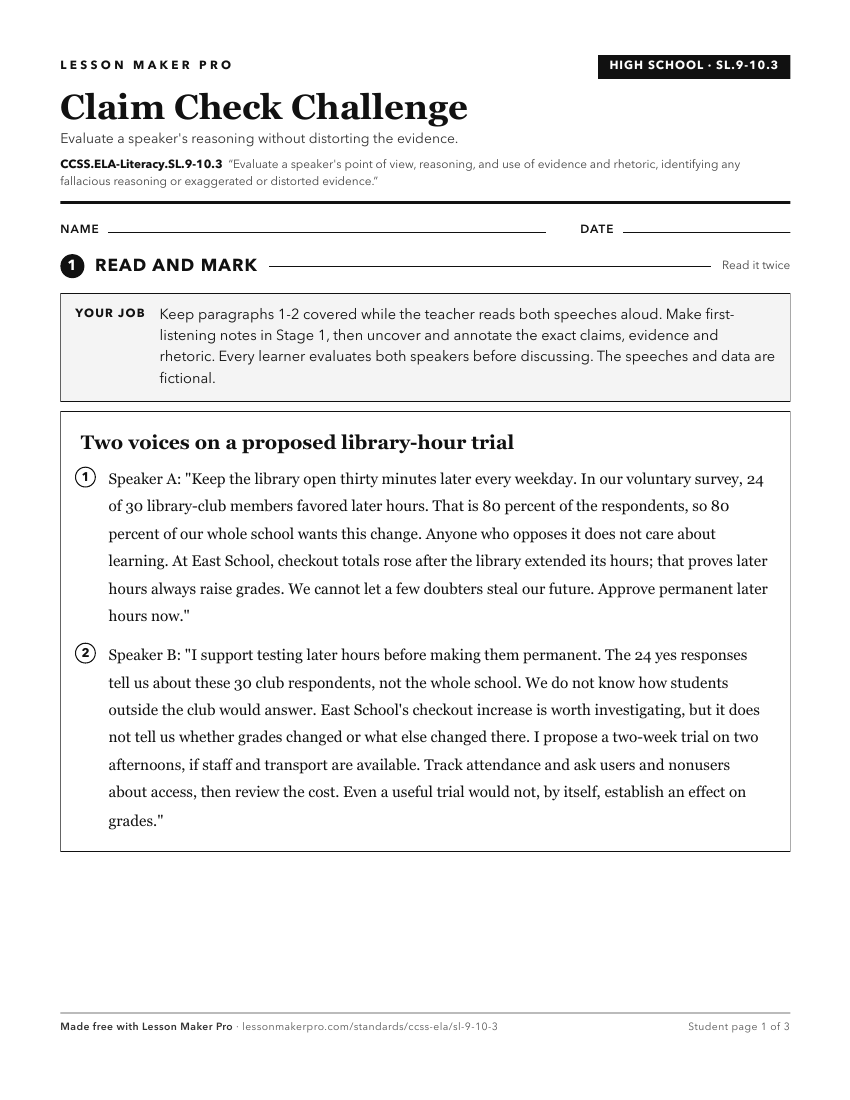
A ready-to-print activity worksheet aligned to CCSS.ELA-Literacy.SL.9-10.3, with an answer key for the teacher on its own page. No account needed.
PDF, US Letter, prints cleanly in black and white.
Download the worksheetLearning progression
Where This Standard Sits
See the whole path on the Speaking & Listening progression map.
Before This Standard
If students are struggling here, check these first.
What This Unlocks
Mastery here sets students up for these next.
Keep exploring
Related Standards
Turn this exact standard into a lesson
Grade, subject, topic, and the complete standard are prefilled. Create one free, no account needed.
Also for this standard:Make a WorksheetMake a QuizMake a Sub Lesson