CCSS.
The Standard
Evaluate a speaker's point of view, reasoning, and use of evidence and rhetoric, assessing the stance, premises, links among ideas, word choice, points of emphasis, and tone used.
Common Core State Standards for English Language Arts · Speaking and Listening Standards
Teacher's field guide
What This Standard Means
What Students Need to Do
- Students listen to a speech or presentation and identify the speaker's position, assumptions, and main line of argument. They judge whether the claims connect logically and whether language, vocal emphasis, and tone strengthen or weaken the message.
What Mastery Looks Like
- A student can annotate a transcript, trace each claim to supporting evidence, and point out gaps or unsupported assumptions. The student explains how a specific phrase, pause, repeated idea, or shift in tone shapes the audience's response.
Common Misconceptions
- Students often summarize the topic instead of judging the argument. They may treat confidence or emotional language as proof, overlook hidden assumptions, or label tone without citing exact words or delivery choices.
How to Assess It
- Play a two-minute speech clip. Ask students to identify the message, one weak point in the reasoning, and one delivery choice, using two time-stamped details.
Lesson moves
Ways to Teach It
Give pairs a printed speech transcript to cut into claims, evidence, assumptions, and rhetorical moves, then arrange the pieces to map the argument.
After hearing the same claim in calm and angry tones, students write which delivery is more convincing and cite two audible details.
Run Argument Detective: teams earn points for spotting unsupported claims, weak links, loaded words, repetition, and shifts in emphasis in short audio clips.
Compare two campaign ads or public service announcements on one issue, then rank their credibility using evidence quality, wording, and tone.
Free download
Printable SL.11-12.3 Worksheet
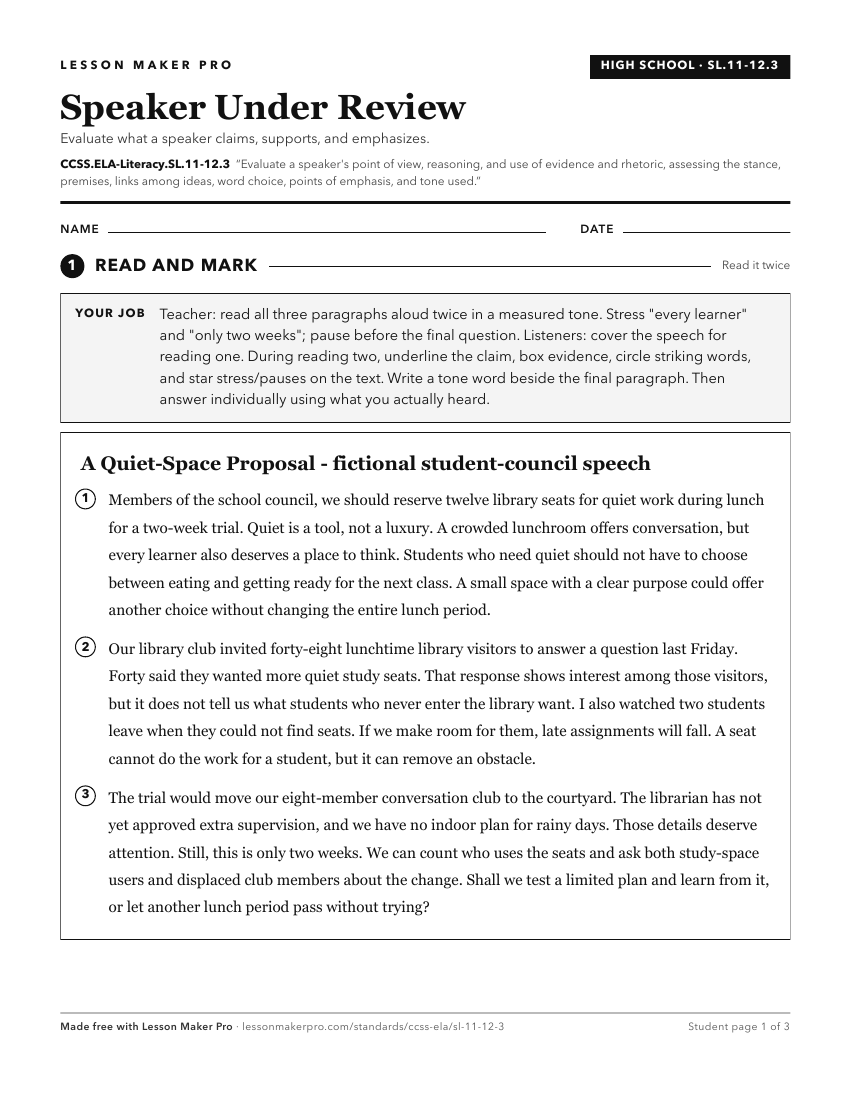
A ready-to-print activity worksheet aligned to CCSS.ELA-Literacy.SL.11-12.3, with an answer key for the teacher on its own page. No account needed.
PDF, US Letter, prints cleanly in black and white.
Download the worksheetLearning progression
Where This Standard Sits
See the whole path on the Speaking & Listening progression map.
Before This Standard
If students are struggling here, check these first.
Keep exploring
Related Standards
- CCSS.ELA-Literacy.SL.8.3
Delineate a speaker's argument and specific claims, evaluating the soundness of the reasoning and relevance and sufficiency of the evidence and identifying when...
- CCSS.ELA-Literacy.SL.7.3
Delineate a speaker's argument and specific claims, evaluating the soundness of the reasoning and the relevance and sufficiency of the evidence.
- CCSS.ELA-Literacy.CCRA.SL.3
Evaluate a speaker's point of view, reasoning, and use of evidence and rhetoric.
Turn this exact standard into a lesson
Grade, subject, topic, and the complete standard are prefilled. Create one free, no account needed.
Also for this standard:Make a WorksheetMake a QuizMake a Sub Lesson