CCSS.
The Standard
Evaluate a speaker's point of view, reasoning, and use of evidence and rhetoric.
Common Core State Standards for English Language Arts · College and Career Readiness Anchor Standards for Speaking and Listening
Teacher's field guide
What This Standard Means
What Students Need to Do
- Students identify what a speaker believes and how the speaker builds the message. They check whether reasons make sense, evidence supports the claims, and language or tone influences the audience.
What Mastery Looks Like
- Students can explain the speaker's position and trace how the reasons support it. They can judge whether the evidence is relevant and sufficient. They also explain how word choice, tone, or persuasive techniques affect the message.
Common Misconceptions
- Students may confuse a strong opinion with a well-supported claim. They may list evidence without checking its relevance, accuracy, or connection to the speaker's reasoning. They may also treat emotional language as proof.
How to Assess It
- Play or read a one-minute speech, then ask: What does the speaker believe, which evidence best supports that view, and which words shape your reaction?
Lesson moves
Ways to Teach It
Give groups claim, reason, and evidence cards from a short speech, then have them arrange the cards and remove weak support.
After a recorded speech, students write which statement reveals the speaker's viewpoint and explain how tone or word choice supports it.
Play Evidence Judge: teams label each supporting detail relevant, irrelevant, reliable, or questionable, then defend one label.
Compare two short product pitches and decide which is more convincing based on evidence, reasoning, tone, and persuasive language.
Free download
Printable CCRA.SL.3 Worksheet
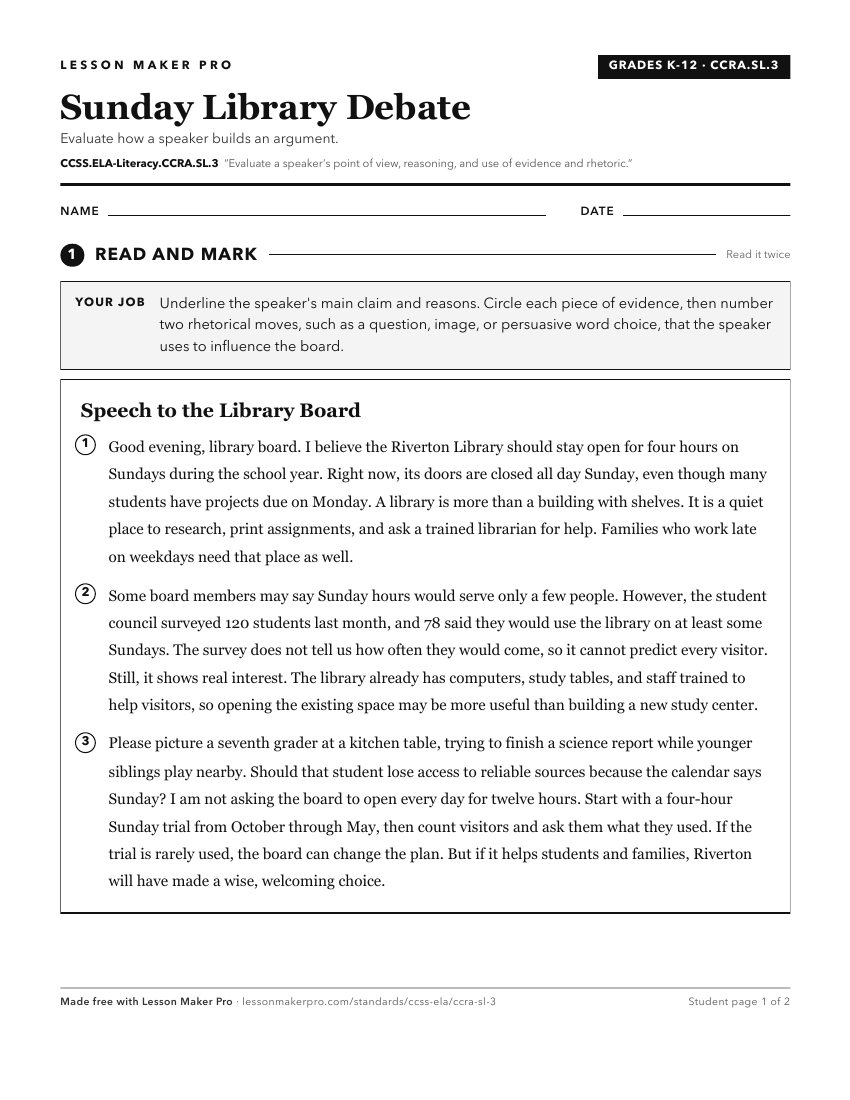
A ready-to-print activity worksheet aligned to CCSS.ELA-Literacy.CCRA.SL.3, with an answer key for the teacher on its own page. No account needed.
PDF, US Letter, prints cleanly in black and white.
Download the worksheetKeep exploring
Related Standards
- CCSS.ELA-Literacy.SL.8.3
Delineate a speaker's argument and specific claims, evaluating the soundness of the reasoning and relevance and sufficiency of the evidence and identifying when...
- CCSS.ELA-Literacy.SL.7.3
Delineate a speaker's argument and specific claims, evaluating the soundness of the reasoning and the relevance and sufficiency of the evidence.
- CCSS.ELA-Literacy.SL.11-12.3
Evaluate a speaker's point of view, reasoning, and use of evidence and rhetoric, assessing the stance, premises, links among ideas, word choice, points of empha...
- CCSS.ELA-Literacy.SL.9-10.3
Evaluate a speaker's point of view, reasoning, and use of evidence and rhetoric, identifying any fallacious reasoning or exaggerated or distorted evidence.
Turn this exact standard into a lesson
Grade, subject, topic, and the complete standard are prefilled. Create one free, no account needed.
Also for this standard:Make a WorksheetMake a QuizMake a Sub Lesson